USU clinical and practicum hours, program by program
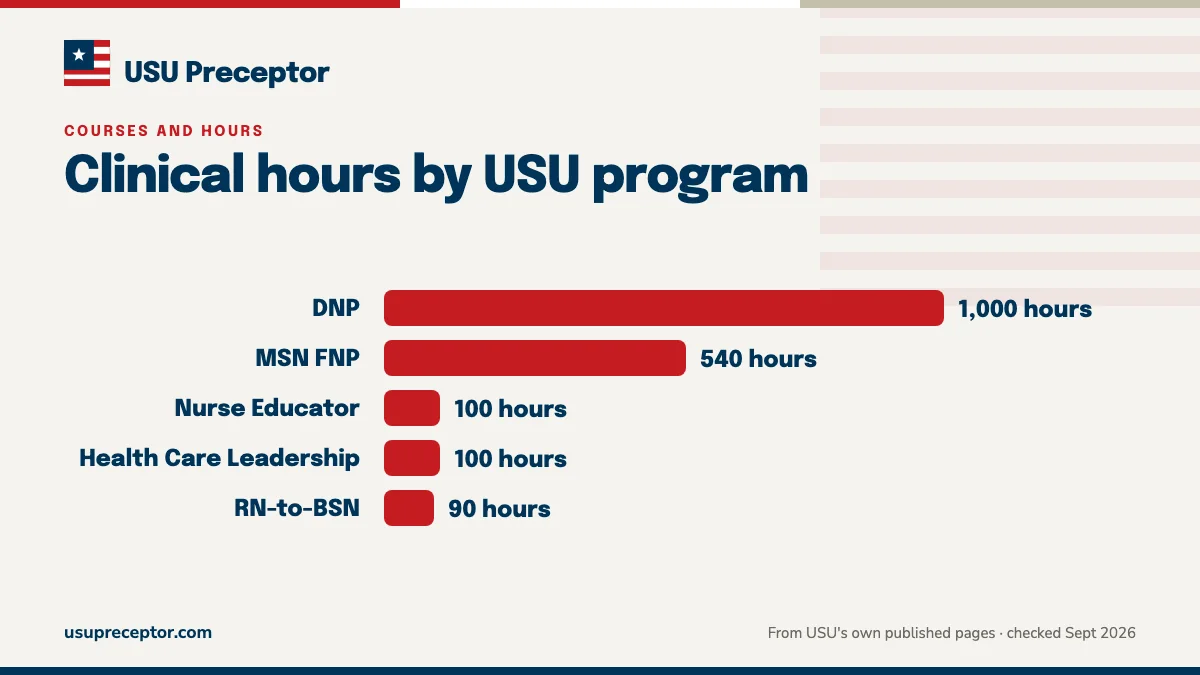
USU requires 540 precepted hours for the MSN FNP, 100 for the Nurse Educator and Health Care Leadership residencies, 90 community hours for the RN to BSN and 1,000 post-baccalaureate hours for the DNP. The table below names every practicum course, and the rest of the page explains which FNP hours USU will and won't count.
Get your placement plan
Tell us your USU track and where you live. A placement advisor replies with what a USU-ready preceptor and site look like for you.
Pick your USU track
Your clinical courses and hours, who can precept you, where, and when to start looking. From USU's own catalog and program pages.
- Who precepts
- A board-certified NP or an MD/DO with a year or more; at least 135 hours with an NP
- Where
- Primary care, family practice, pediatrics, women's health; never inpatient
- Start looking
- Name 3 preceptors 6 months before each practicum; approvals on file 16 weeks before
- Who precepts
- An MSN- or doctorate-prepared nurse with a year or more in the specialty
- Where
- A healthcare or academic setting
- Start looking
- Paperwork due 16 weeks before MSN578
- Who precepts
- A nurse leader who meets USU's residency rules
- Where
- A healthcare organization
- Start looking
- Paperwork due 16 weeks before MSN587
- Who precepts
- A Project Mentor approved through Appendix G
- Where
- Your immersion site; your employer is allowed for the DNP
- Start looking
- Start mentor search in the program's second course; documents 16 weeks before
- Who precepts
- An agency leader you find, at a community agency
- Where
- Agencies serving vulnerable community populations, open to the public
- Start looking
- Paperwork due 16 weeks before NUR378
Practicum hours for every USU nursing program
These totals come from USU's 2026-2027 catalog and its Board of Nursing disclosure (updated 5.19.2026). Four MSN tracks that the catalog lists as not accepting applicants stay in the table for students who are finishing them.
| Program | Practicum courses (hours) | Total hours | Who supervises |
|---|---|---|---|
| MSN Family Nurse Practitioner | FNP592, FNP594, FNP596, FNP597 (135 each) | 540 | Board-certified NP or licensed MD/DO |
| MSN Nurse Educator | MSN578 Teaching Residency for Nurse Educators (100) | 100 | Master's- or doctoral-prepared nurse |
| MSN Health Care Leadership | MSN587 Residency in Nursing Leadership and Systems Management (100) | 100 | Nurse leader with a graduate degree |
| RN to BSN | NUR378 (45) and NUR499 (45) | 90 | Community agency or organization leader |
| DNP (post-master's) | DNP707 (135), DNP708P (45), DNP710 (135), DNP711 (135), DNP712 (90) | 1,000 post-baccalaureate; up to 500 may transfer in | Doctorally prepared Project Mentor |
| MSN Administration & Management (not admitting) | MSN559 (40) and MSN595 (100) | 140 | Nurse executive preceptor in MSN595 |
| MSN Informatics (not admitting) | MSN598 (120 minimum) | 120 | Master's-prepared informatics nurse |
| MSN Forensic Nursing (not admitting) | MSN597 (120 minimum, 20 or more in direct care) | 120 | Master's-prepared nurse |
| MSN Public Health (not admitting) | MSN594 (120 minimum, 20 or more in direct care) | 120 | Master's-prepared nurse |
| Post-Master's FNP Certificate (teach-out) | The same four FNP practicums (135 each) | 540 | Same rules as the MSN FNP |
The current catalog has no RN-to-MSN curriculum. That track still appears in USU's state disclosures, with no FNP option, but no USU source lists its practicum courses or hours. If you are enrolled in it, ask your Clinical Placement Coordinator which course carries your practicum.
MSN597 and MSN594 are the Forensic Nursing and Public Health practicums, not FNP courses. FNP clinicals always carry the FNP prefix.
How the FNP's 540 hours are spread
FNP clinical hours begin in the second year. Each of the four practicums is a 3-credit, 8-week course graded credit/no credit, carries its own 135 hours and runs beside a didactic co-requisite: FNP591 with FNP592, FNP593 with FNP594, FNP595 with FNP596, and the MSN600 capstone with FNP597.
Fitting 135 hours into 8 weeks is why the FNP Clinical Handbook tells you to find preceptors available for “about 17 hours per week.” You may not spend more than 12 hours in one clinical day, and you need at least one clinical day every week. The catalog adds that most clinical hours fall Monday to Friday, 8:00 am to 5:00 pm.
Each course also points you at a setting. FNP592 must be family practice, primary care or primary care internal medicine. FNP594 is where urgent care becomes possible. FNP596 holds the pediatrics, women's health and geriatrics rotations, and FNP597 is the closing residency.
What counts toward FNP hours, and what never does
The FNP Clinical Handbook and its Appendix I cap or exclude these settings and formats:
- Inpatient: never counted. The handbook: “Inpatient hours are not approved and will not be counted.”
- Urgent care: 135 hours at most across the program (a March 2024 rule), and none of it counts toward your family practice minimum.
- Optional specialties: 40 hours combined. Using one before
FNP597needs Program Director approval (a July 2024 rule). - Telehealth: 40 hours for the whole program, only if approved, with your preceptor physically beside you, on video, and with patients in the state of your address on file. Telephone-only visits and teleprecepting from separate locations do not count.
- Hospice and skilled nursing within the geriatrics rotation: 40 hours at most.
- Immersion and lab time in
MSN572: none of it counts toward the 540. - Over-ratio hours: a preceptor may take two students at once (one in New Jersey), counting NP students from other schools. Hours logged above that ratio do not count.
The logging side, including the Appendix M matrix, is covered on what counts as an FNP hour. If you are weighing telehealth, read what virtual can mean at USU before you propose it.
Minimums you must reach by the end of the FNP
Beyond the 540 total, USU sets floors that decide where your hours need to go. They are measured at the end of the program, and FNP597 is the last course in which a shortfall can still be closed.
- 135 hours with a Nurse Practitioner preceptor. Physician hours are allowed, but they cannot fill this floor. USU also recommends spending most of your hours with FNPs.
- 135 hours in family practice. Urgent care time does not count toward it.
- Geriatrics (65 and over): 100 journal entries.
- Pediatrics: 80 journal entries: 15 newborn or infant, 50 aged 1 to 12, and 15 aged 13 to 17.
- Women's health, OB or GYN: 40 journal entries.
Journal entries are tracked against the FNP Hours & Journals Breakdown Matrix (Appendix M). Check your totals in Project Concert after each course.
Timing rules: approval, logging, roll-over and incompletes
- No hours before approval. You may not be on site or log hours until OFE emails your OFE Approval Letter. Hours before the course starts or during holiday breaks also need approval.
- Start in week one. The catalog requires clinical hours to begin in the first week of each clinical course. Miss it and you may have to withdraw, reapply and retake the course.
- Log within 48 hours. Encounters entered in Project Concert later than 48 hours do not count toward your total.
- No roll-over. The handbook says “Clinical hours do not roll over from course to course.” Extra hours in
FNP592do not reduce whatFNP594needs. - Incompletes need 81 hours. You must have at least 81 hours done to be considered for an Incomplete, and clinical attendance is expected to be 100%.
- Unfinished hours are lost. The catalog warns that the hours “will be lost and need to be repeated the following term.”
Hour rules in USU's other programs
Nurse Educator. All 100 hours sit in MSN578, a non-transferable course taken in the last session and logged weekly in Project Concert. The ratio is 1:1, and hours that are part of your current job do not count. Tennessee students must complete the residency in a nursing clinical specialty.
Health Care Leadership. MSN587 is also 100 hours in the last session, 1:1 with a nurse leader preceptor, with feedback in weeks 1, 4 and 8.
RN to BSN. Ninety community hours are split across NUR378 and NUR499, with the same agency or organization leader for both. The agency must serve vulnerable community members and be open to the public. This 90-hour structure applies to students enrolled on or after 8/30/22.
DNP. USU counts 1,000 post-baccalaureate hours. APRN graduates enter credited with 500; others enter with 100, or up to 500 with verification. The five immersion courses total 540 hours, and the handbook asks for at least 500 in the program. No source explains how a student credited with 100 reaches 1,000, so confirm your own count with OFE. DNP hours are also logged within 48 hours and do not roll over.
Why students choose us for their hours
None of these hours can start until a preceptor and site are approved. The placement desk searches for a preceptor and site that match the course you are entering, in person near you, and helps you assemble what USU's Office of Field Experience and Program Director review. Each preceptor, site and agreement needs USU's approval, and your start comes with the OFE Approval Letter; we make sure your file reaches that review complete.
If you want help for a specific course, send us your program and term.
Questions USU students ask
How many clinical hours is the USU FNP program?
The MSN Family Nurse Practitioner requires at least 540 precepted clinical hours, earned as 135 hours in each of FNP592, FNP594, FNP596 and FNP597. They start in the second year of the 24-month program, once MSN572 and the immersion are behind you, and each course's hours must be completed inside its own 8 weeks.
Do USU's FNP immersion hours count as clinical hours?
No. The immersion inside MSN572 Advanced Health and Physical Assessment is required to pass the course and to graduate, but USU's handbook says immersion and lab hours do not count toward clinical hours. That holds whether you attended the older in-person immersion in Phoenix or the virtual version for students admitted on or after 05/06/2024.
Can I bank extra hours in one USU FNP course for the next one?
No. Each practicum needs its own 135 hours, and USU's FNP handbook states that hours do not roll over between courses. Finishing early in FNP592 does not shorten FNP594. Aim for steady weekly hours instead: about 17 a week, no more than 12 in a day, with at least one clinical day every week.
How many practicum hours does the USU DNP require?
USU requires 1,000 post-baccalaureate practice hours for the DNP, and up to 500 can come from earlier graduate coursework. In the program, the immersion courses DNP707, DNP708P, DNP710, DNP711 and DNP712 carry 540 hours between them, and the handbook sets a floor of 500. Hours are logged in Project Concert within 48 hours.
Do hours at my own job count toward USU clinical hours?
It depends on the program. FNP students may train at their employer if they disclose it in writing, keep clinical time separate from normal duties and are not paid for it. Nurse Educator hours that are part of your job do not count at all. DNP students face no employer restriction and may be paid by the site.
Related pages
Last checked 2026-09-23
We check these pages against USU's own catalog, handbooks and disclosures. USU's current handbook and your Clinical Placement Coordinator have the final word.
Six months out is USU's rule. We start now.
Tell us your USU program, your state and when your next practicum opens. We look for preceptors who meet USU's rules and help you build the packet the Office of Field Experience and Program Director review.
- Preceptors matched to the course: family practice, pediatrics, women's health, urgent care within USU's caps
- Appendix H, license, CV and board certification gathered the way OFE asks
- In person near you; telehealth only inside USU's 40-hour limit
Start your placement plan
A placement advisor replies with what a USU-ready preceptor and site look like for you.