FNP596: Primary Healthcare of Chronic Clients/Families Across the Lifespan – Clinical Practicum
FNP596 is USU's third FNP practicum: 3 credits and 135 precepted hours in 8 weeks, taken with FNP595 after FNP593 and FNP594. The catalog centers it on chronic conditions, and USU's Appendix I places the population rotations here: pediatrics, women's health and geriatrics. That can mean more than one preceptor in 8 weeks, with separate approval paperwork for each site and specialty.
Need pediatric or women's health preceptors?
Tell us your state and when FNP596 starts. A placement advisor replies with what USU-ready population rotations could look like for you.
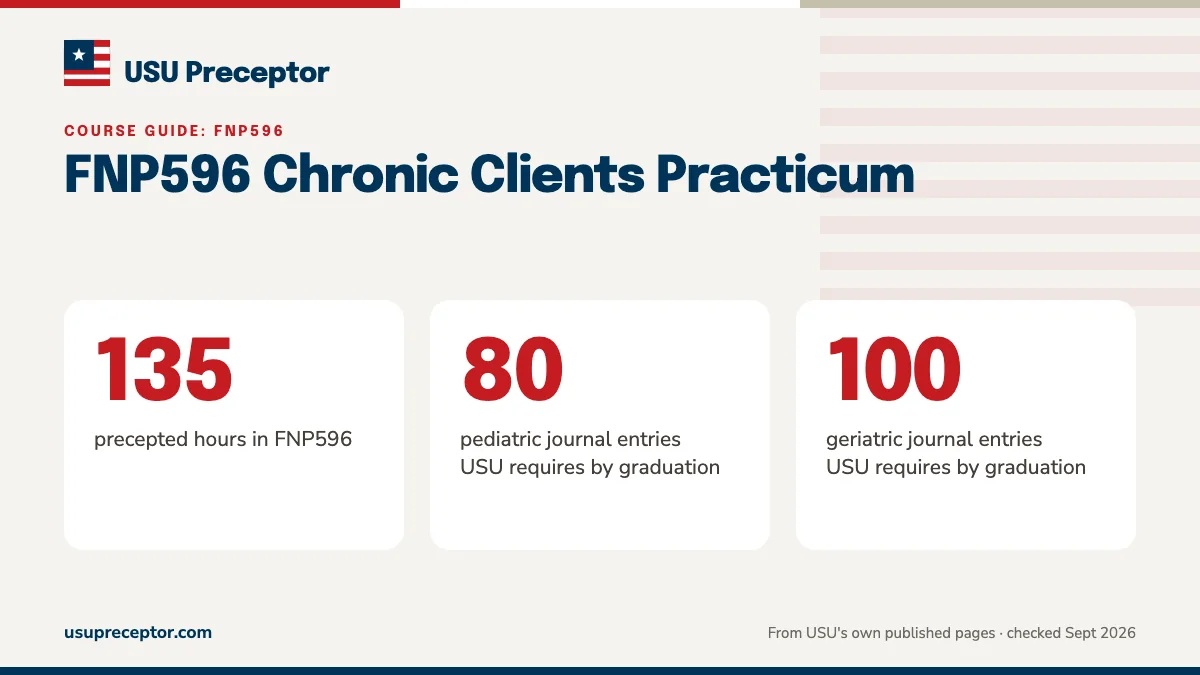
FNP596 at a glance
The catalog describes care of patients with chronic conditions in primary care, community clinics and skilled nursing facilities. On USU's 2020 degree plan, FNP596 opens semester 6, the final semester, with FNP597 after it.
| Item | FNP596 |
|---|---|
| Catalog title | Primary Healthcare of Chronic Clients/Families Across the Lifespan – Clinical Practicum |
| Credits and grading | 3 credits (CR/NC) |
| Clinical hours | 135 precepted hours |
| Length | One 8-week session |
| Prerequisites | FNP593 and FNP594 |
| Co-requisite | FNP595 Primary Healthcare of Chronic Clients/Families Across the Lifespan |
| Settings | Primary care, community clinics, skilled nursing (40-hour cap within geriatrics) |
| Rotations placed here | Pediatrics, women's health, geriatrics, and optional specialties up to 40 hours |
| Preceptor | Depends on the rotation; see the next table |
| Before day one | OFE Approval Letter; OFE may limit letters for specialty experiences |
Three population rotations in one course
Appendix I, USU's FNP Site & Preceptor Guidance, sets a different setting and ideal preceptor for each population. The journal minimums come from the FNP Clinical Handbook and are counted by the end of the program.
| Rotation | Acceptable setting | Ideal preceptor | Journal minimum by graduation |
|---|---|---|---|
| Pediatrics | Newborn to age 18, well and sick visits | Pediatrician MD/DO, or an FNP or PNP in a pediatrician's office | 80: 15 newborn or infant, 50 aged 1 to 12, 15 aged 13 to 17 |
| Women's health | OB/GYN, or a practice where at least 50% of care is women's care | OB/GYN MD/DO, FNP, WHNP or CNM | 40 |
| Geriatrics (65 and over) | Primary care, family practice or internal medicine; hospice or SNF 40 hours at most | AGPCNP, ANP, FNP, GNP, MD or DO | 100 |
| Optional specialties | College-approved specialty rotations, 40 hours combined | Board-certified NP or licensed MD/DO | None set |
Because the entries are measured at graduation, start by counting what you already have. Check your journal totals in Project Concert against the Appendix M Hours & Journals Breakdown Matrix before you decide how to split your 135 hours, and ask your clinical faculty if the matrix is unclear. The logging rules are on what counts as an FNP hour.
Women's health: where a CNM fits
USU's FNP handbook accepts a board-certified nurse-midwife (CNM) as a preceptor, but only for women's health hours. A CNM cannot precept your pediatric, geriatric or general primary care time, which must come from a board-certified NP or a licensed MD or DO. The general rules are on who can precept USU FNP students.
The site has its own limits. Appendix I accepts an OB/GYN practice or one where at least half of the care is women's health. Infertility clinics are not accepted, and students do not take part in births or surgeries. An inpatient labor and delivery unit is ruled out anyway, since USU never counts inpatient hours.
If your family practice preceptor also sees many women's health visits, ask your CPC how to log them. USU's Appendix H form is completed per student, site and specialty, so moving from one specialty to another can require a new form even with the same clinician.
Skilled nursing, hospice and optional specialties
The catalog names skilled nursing facilities as an FNP596 setting, but Appendix I limits hospice and SNF time within the geriatrics rotation to 40 hours. A SNF can supply part of your geriatric experience, not the whole course.
Optional specialties are capped too. The handbook allows “Up to 40 hours maximum in college-approved specialty rotation(s),” combined across the program. Since July 2024, using one before FNP597 needs Program Director approval, so a specialty in FNP596 means an extra sign-off on top of the usual Program Director approval of the preceptor. OFE may also limit the approval letters it issues for specialty experiences.
Telehealth stays capped at 40 hours for the whole program, and urgent care at 135. If you used either heavily in FNP594, check what is left before you plan FNP596.
Hospice and skilled nursing time is capped at 40 hours within geriatrics. Plan the rest of your geriatric hours in primary care, family practice or internal medicine.
Planning several placements for one 8-week course
Three rotations in 8 weeks puts pressure on USU's deadlines. The Appendix G Interest Form asks for at least three preceptors or sites per specialty setting, so a full FNP596 plan can mean several sets of leads 6 months ahead. Each preceptor then needs an Appendix H packet, and every approval must be on file 16 weeks before the course.
If your practicums run back to back, 16 weeks before FNP596 is roughly the week FNP592 begins. In other words, your population rotations should be approved before your first clinical day. USU recommends no more than three preceptors in one 8-week course, so plan how the populations fit inside that limit, for example one site per population.
Week one works as it does in every clinical course: upload your OFE Approval Letter with the preceptor's acknowledgement form and start your hours that week. Keep to about 17 hours a week across all your sites, log within 48 hours, and expect a Clinical Site Supervisor to evaluate your sites and preceptors.
Why FNP596 students choose us
For FNP596, the placement desk searches for preceptors who match Appendix I for each rotation, near you and in person, and helps you build a separate packet for each one. USU's Program Director and OFE give the final approval, and each packet reaches them complete and matched to its rotation. After FNP596, FNP597 closes the program. Tell us which rotations you still need.
Questions USU students ask
Does USU FNP596 have to include pediatrics, women's health and geriatrics?
Appendix I of USU's FNP Clinical Handbook places those three rotations under FNP596, and the handbook sets journal minimums for each that you must reach by graduation: 80 pediatric, 40 women's health and 100 geriatric entries. How your course expects the 135 hours to be divided can vary, so check the FNP596 syllabus in D2L and the Appendix M matrix.
Can a certified nurse-midwife precept USU FNP596?
Yes, for women's health hours only. USU accepts a board-certified CNM for that population and no other. Pediatric, geriatric and general primary care hours in FNP596 must be precepted by a board-certified nurse practitioner or a licensed MD or DO, and the Program Director approves every preceptor before OFE issues your approval letter.
Can I complete FNP596 hours in a skilled nursing facility?
Some of them. The catalog lists skilled nursing facilities among FNP596 settings, but Appendix I caps hospice and SNF time at 40 hours within the geriatrics rotation. Inpatient hospital hours never count at USU. The rest of your geriatric experience should come from primary care, family practice or internal medicine.
Does USU accept a fertility clinic for the women's health rotation?
No. Appendix I excludes infertility clinics from women's health placements. USU accepts an OB/GYN practice or a practice where at least half of the care is women's health, and students do not take part in births or surgeries. The preceptor can be an OB/GYN physician, an FNP, a WHNP or a board-certified CNM.
What are the prerequisites for USU FNP596?
The catalog requires FNP593 and FNP594 before FNP596, and FNP595 Primary Healthcare of Chronic Clients/Families Across the Lifespan is its co-requisite in the same session. FNP596 is 3 credits, graded credit or no credit. Passing it, and its co-requisite, opens FNP597, the final residency.
Related pages
Last checked 2026-09-23
We check these pages against USU's own catalog, handbooks and disclosures. USU's current handbook and your Clinical Placement Coordinator have the final word.
Six months out is USU's rule. We start now.
Tell us your USU program, your state and when your next practicum opens. We look for preceptors who meet USU's rules and help you build the packet the Office of Field Experience and Program Director review.
- Preceptors matched to the course: family practice, pediatrics, women's health, urgent care within USU's caps
- Appendix H, license, CV and board certification gathered the way OFE asks
- In person near you; telehealth only inside USU's 40-hour limit
Start your placement plan
A placement advisor replies with what a USU-ready preceptor and site look like for you.