The USU clinical placement process, from first lead to week one
At United States University you find the preceptor and site, and the Office of Field Experience (OFE) works with you to get them approved. The path has seven checkpoints: leads, the preceptor packet, Program Director approval, the Affiliation Agreement, Complio, the OFE Approval Letter and a first-week start. All of it has to be finished before your clinical course begins.
Map your USU placement timeline
Tell us your track, course and start session. A placement advisor replies with what has to happen before USU's 16-week cutoff.
Who does what: you find, the OFE partners, USU approves
USU's 2026-27 General Catalog puts it plainly: “Students are responsible for identifying clinical placements and preceptors.” The same policy says you must actively partner with the OFE, and that the OFE will help if your preferred placements don't work out. That help is a backup, not a promise. USU doesn't commit to placing anyone, and priority goes to students whose documents were in on time.
Approval always sits with USU, never with you or your preceptor. The Program Director approves or denies each preceptor, the OFE sends the legal contract to the site, and Complio reviewers check your health and safety records. Your job is to feed the process good leads and finished paperwork early, then keep everything current once you're approved.
The seven steps, in USU's order
This is the FNP sequence from the Clinical Handbook. The other programs follow the same pattern with a few changes, covered further down. Each step links to the page that goes deeper.
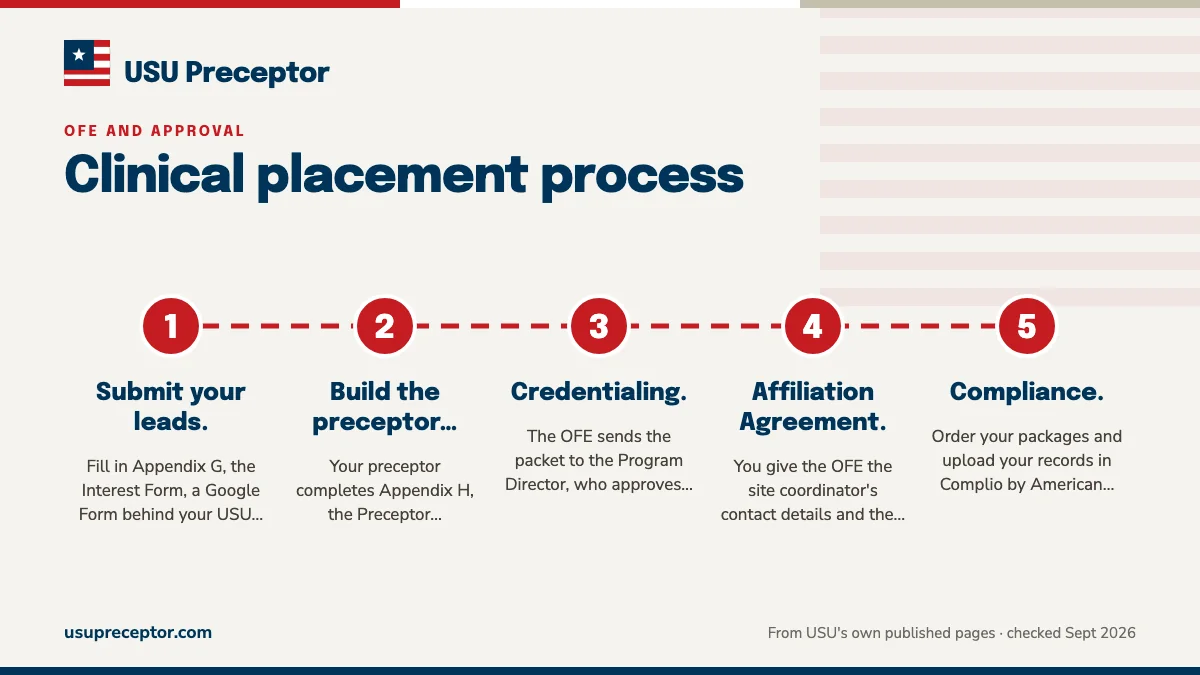
- Submit your leads. Fill in Appendix G, the Interest Form, a Google Form behind your USU Google login, with at least three preceptors or sites for each setting. Your CPC checks whether USU already has an agreement with each site or needs to reach out.
- Build the preceptor packet. Your preceptor completes Appendix H, the Preceptor Information and Acknowledgement Form, one per student, site and specialty. You email it to the OFE with their license verification, CV and, for APRNs, proof of board certification.
- Credentialing. The OFE sends the packet to the Program Director, who approves or denies the preceptor. The handbook puts this at 4–16 weeks on average, and the review itself has its own page.
- Affiliation Agreement. You give the OFE the site coordinator's contact details and the OFE sends the contract straight to the site. Stay out of it unless the OFE asks you to step in; the agreement page explains the legal review.
- Compliance. Order your packages and upload your records in Complio by American DataBank. Complio reviews each item in 2–5 business days, then the OFE updates your status within about 2 more.
- OFE Approval Letter. When preceptor, agreement and compliance are all approved, the OFE emails the approval letter. Until it arrives you can't be on site or log a single hour.
- Week one. Upload the letter with the preceptor acknowledgement form in the first week of each clinical course, and start your hours that same week. From then on, each clinical day goes into Project Concert within 48 hours.
The clocks run at the same time, so start them together
The steps are numbered, but you shouldn't work through them one after another. Program Director review takes 4–16 weeks on average, and the FNP handbook says to allow at least four to six months for a new Affiliation Agreement. Run in sequence, those two alone can outlast the time you have.
So the week a preceptor says yes, send Appendix H and hand the OFE the site coordinator's details together. Open your Complio account early too: reviews are quick, but the handbook warns that background checks in some states can take months. If your site already has an agreement with USU, step four may be short, and your CPC can tell you once they've checked your Interest Form.
The one thing nobody can speed up is an urgent request. The handbook says same-day or urgent requests for sites and preceptors can't be accommodated, and Complio doesn't offer rush reviews either.
Two deadlines that don't match: 6 months and 16 weeks
USU's current documents give two different deadlines, and you need to meet both. The 2026-27 catalog (p. 106) asks for at least three qualified preceptors with valid contact information 6 months before each clinical course starts. The FNP, DNP and practicum handbooks want every site, preceptor and health and safety approval on file with the OFE at least 16 weeks before the course.
The simplest reading is two checkpoints: names due at 6 months, approvals complete at 16 weeks. That leaves roughly ten weeks between them, which is less than a new agreement is expected to take. If your best lead is a site USU has never worked with, 6 months is already tight.
Both clocks apply to each clinical course, not only the first. FNP students take FNP592, FNP594, FNP596 and FNP597 as 8-week courses in year two, so the deadlines stack up fast. The USU clinical deadlines page lines them up against the session calendar.
Week one, and staying approved after it
The catalog says clinical hours must begin within the first week of each clinical course, and if they don't you may have to withdraw and retake it. That makes the approval letter, not the course start date, the real finish line. Upload it in week one, confirm your first clinical day with your preceptor, and log that day in Project Concert within 48 hours or the hours won't count.
Approval isn't permanent. Complio sends expiry notices 60, 45, 30 and 15 days before an item lapses and again on the day, and once anything expires you're on “clinical pause” with no clinicals and no hours. Preceptors face periodic re-review as well, and the OFE will ask yours to renew an expiring license. If you need a new preceptor or site later, the change needs approval at least 16 weeks before the course it affects.
Don't treat the course start date as your deadline. USU wants approvals on file 16 weeks earlier, and your hours have to start in week one.
How the other USU programs differ
DNP students run the same model with a Project Mentor in place of a preceptor, so the DNP handbook spells PAC as Project Mentor, Agreement, Compliance. Mentor identification starts in the program's second course, mentor approval takes 2–16 weeks, and documents are due 16 weeks before the immersion. The coordinator there is called the Practice Immersion Placement Coordinator (CPC).
The RN-BSN, MSN Nurse Educator and Health Care Leadership handbook uses the same partner model and puts the paperwork deadline 16 weeks before MSN578 or NUR378. RN-BSN students find their community agency leader themselves, and that leader sends a resume to the OFE. No separate date is stated for MSN587, and that handbook carries no version date, so confirm both with your CPC and read the current copy on USU's catalog site.
Why students choose us for the first two steps
We work on the first two steps: finding a preceptor and site that fit your USU course and state, and helping you assemble the Appendix H packet and the site details the OFE needs for an agreement. You submit everything through your own USU accounts, and your Clinical Placement Coordinator and the Program Director take it from there.
Your CPC and the Program Director make the call, and what reaches them from you is complete and matched to USU's rules. If you'd like a timeline built around your course, use the form below.
Questions USU students ask
Does USU find clinical placements for FNP students?
Not as a rule. The catalog makes you responsible for identifying preceptors and sites, with the OFE as your partner. If your own leads fall through, the OFE may offer a placement, but you have 24 business hours to accept, and declining or not answering means you place yourself for that rotation. Priority goes to students whose documents were in on time.
How long does USU clinical placement take from start to finish?
USU doesn't publish one end-to-end figure, so add up the parts. Program Director approval averages 4–16 weeks, a new Affiliation Agreement needs at least four to six months, and each Complio item takes up to about seven business days once you count the OFE's update. That's why the catalog wants names 6 months out and the handbooks want approvals 16 weeks out.
Can I start clinical hours while my approval is still pending?
No. The FNP handbook says you may not log hours or be on site until you hold the OFE Approval Letter. If your course is about to start and the letter hasn't come, email your CPC and your clinical faculty straight away, because the catalog also requires hours to begin in the first week of the course.
Do I need new paperwork for every FNP clinical course?
Often, yes. Appendix H is completed once per student, site and specialty, so a new site or a new specialty means a new form, and the approval letter is uploaded in week one of each clinical course. If you keep the same preceptor and site across courses, ask your CPC what, if anything, needs refreshing before each one.
What if I need to change preceptor or site partway through?
A change needs approval at least 16 weeks before the course it applies to, so it isn't a quick swap. If you change for your own reasons, the FNP handbook's Preceptor Fit section says you find the replacement yourself. If a preceptor can't continue for reasons outside your control, the OFE makes every reasonable attempt to find an alternative.
Related pages
Last checked 2026-09-23
We check these pages against USU's own catalog, handbooks and disclosures. USU's current handbook and your Clinical Placement Coordinator have the final word.
Six months out is USU's rule. We start now.
Tell us your USU program, your state and when your next practicum opens. We look for preceptors who meet USU's rules and help you build the packet the Office of Field Experience and Program Director review.
- Preceptors matched to the course: family practice, pediatrics, women's health, urgent care within USU's caps
- Appendix H, license, CV and board certification gathered the way OFE asks
- In person near you; telehealth only inside USU's 40-hour limit
Start your placement plan
A placement advisor replies with what a USU-ready preceptor and site look like for you.