USU's PAC checklist: Preceptor, Agreement, Compliance
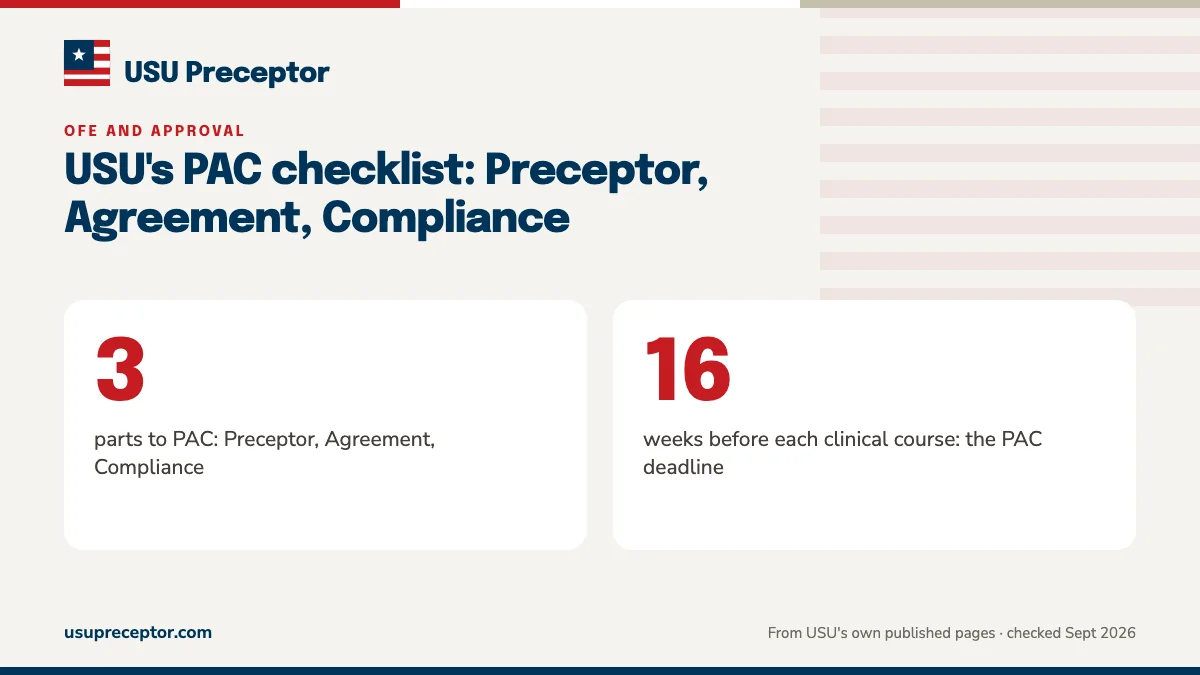
PAC is the Office of Field Experience's shorthand for the three things that must be in place before any clinical course: an approved Preceptor, a signed Agreement with the site, and your Compliance records. Appendix A of the FNP Clinical Handbook, the PAC for Clinicals - Health and Safety Checklist (November 2025), lists every item, and all of it is due at least 16 weeks before each clinical course.
Get your placement plan
Tell us your USU track and where you live. A placement advisor replies with what a USU-ready preceptor and site look like for you.
What PAC stands for in each handbook
In the FNP Clinical Handbook, PAC means Preceptor, Agreement, Compliance. The DNP Practice Immersion Handbook swaps the first letter for Project Mentor, and its Appendix A is the PAC For Practice Immersion Health and Safety Checklist. The RN-BSN, MSN Nurse Educator and Health Care Leadership handbook calls its Appendix A the Health & Safety Requirements Checklist and doesn't use the PAC label.
The logic is the same in all three. Without an approved preceptor or mentor, a signed agreement and clean compliance records, you don't start. The walk-through below follows the FNP version dated November 2025. In another program, open your own handbook's Appendix A on USU's catalog site; the RN-BSN/NE/HCL handbook shows no version date, so make sure you're reading the current copy.
P: the preceptor documents
Appendix A lists four preceptor items. You collect them, but the preceptor supplies nearly all of the content.
- Preceptor Information & Acknowledgement Form. Appendix H, completed and signed by the preceptor, one per student, site and specialty. The Appendix H page covers its Exhibits A and B.
- Preceptor Resume/CV. USU wants at least three years of the preceptor's employment history on file, which is where Exhibit B comes in for anyone newer to their job.
- Preceptor License Verification. Showing an active, unencumbered license in the state where your clinical takes place.
- Preceptor Proof of Board Certification (APRN only). Needed for NP and CNM preceptors, not for MD or DO preceptors.
These go to the OFE, which sends them to the Program Director. Approval averages 4–16 weeks, and whether a clinician qualifies in the first place is covered on the preceptor requirements page.
A: a fully executed Affiliation Agreement
The A item is a single line on the checklist, and often the slowest. Fully executed means signed by both USU and the site; a draft sitting with the site's legal department doesn't count. The OFE sends the contract directly to the site once you supply the site coordinator's contact details, and you're asked not to contact the site while it's in progress unless the OFE requests it.
USU's documents disagree on timing. The FNP handbook says to allow at least four to six months for a new agreement, while the Appendix A flyer says agreements may take 16 weeks. Plan on the longer figure. If your CPC finds USU already has an agreement with the site, this line may be done before you start. The Affiliation Agreement page explains the legal review.
C: your compliance items
The C list is yours alone. Most of it runs through Complio by American DataBank, which students pay for. USU's 2024 Complio guidance (Appendix D) said to order the Immunization package and the Background & Drug Screen package.
| Checklist item | What the handbook asks for |
|---|---|
| Release of Information Form | Listed on Appendix A but not described further. Ask your CPC for the current form. |
| Signed Medical Clearance Form | Appendix E, completed after a physical exam. |
| Student Acknowledgement of FNP Handbook Guidelines | Appendix B, your signed acknowledgement. |
| Signed HIPAA Confidentiality Agreement and Blood Borne Pathogens Training | Appendix C and the training are both done in the Nursing Caring Corner in D2L, with a quiz score of 80% or higher. |
| AHA CPR | American Heart Association BLS for the Healthcare Provider or Professional Rescuer. Online-only courses and ACLS alone aren't accepted. |
| Proof of Health Insurance Coverage | Verified coverage; a military or government ID doesn't meet it. |
| Immunizations | TB, Tdap within 10 years, MMR and varicella (two doses or titers), hepatitis B (three-shot series or titer; Heplisav-B doesn't count), annual flu and COVID-19. |
| Clear drug screen | A 10-panel screen that includes marijuana, on a random 24-hour authorization. |
| Clear background check | Must clear before your first rotation. No felonies are accepted; misdemeanors go to the Program Director. |
| Malpractice insurance | Your own policy of at least 1 million per incident and 6 million aggregate, stating NP Student, not through an employer or LLC. |
| Active, unencumbered nursing license | In your home state and every state where you do clinicals, and in the same state as your liability coverage. |
| Student Resume | Your own current resume. |
The detail behind each health item is on the health and safety requirements page.
The last line: your OFE Approval Letter
Appendix A ends with the OFE Approval Letter, and it's different from everything above it. You don't produce it; the OFE emails it once P, A and C are all approved. It's on the checklist because you need it in hand, and uploaded in week one of each clinical course, before you can log hours or set foot on site.
The OFE can also limit approval letters for specialty experiences, so don't assume one letter covers every setting you have in mind. If your course start is close and you haven't seen the letter, email your CPC right away rather than waiting for week one. What the letter allows, and what it doesn't, is on the OFE Approval Letter page.
Keeping the checklist current once it's done
Clearing PAC once isn't the end. Complio sends expiry notices at 60, 45, 30 and 15 days before an item lapses and again on the day, and an expired item puts you on clinical pause: no clinicals and no hours. Flu shots, BLS cards, TB tests and insurance policies all renew on their own cycles, so check each date against the end of your last clinical course, not the first.
Sites can add their own layer too. The handbook's example is a hospital that requires a background check different from USU's, and sites may also ask for fingerprints, OSHA training or an American Heart Association healthcare CPR lesson. Ask each site early what it needs beyond USU's list.
A simple tracker helps: one row per item, with the date you submitted it, the date it was approved and the date it expires.
Why students choose us for P and A
Of the three letters, we help with P and the groundwork for A. We look for a preceptor and site that fit your USU course and state, then help you pull together the preceptor's Appendix H, license verification, CV and board certification, plus the site contact the OFE needs to send an agreement. If a preceptor drops out later, we stay on call to look for a replacement, and the new one goes through the same P and A steps.
C is yours alone: your drug screen, malpractice policy and BLS class are personal items. All three letters count once the OFE and the Program Director approve them, and we make sure your P and A pieces reach them complete. If you'd like help with the P line, use the form below.
Questions USU students ask
Is the PAC checklist the same for every USU nursing program?
No. Each clinical handbook has its own Appendix A. The FNP version is the PAC for Clinicals checklist, the DNP version replaces the preceptor with a Project Mentor, and the RN-BSN, Nurse Educator and Health Care Leadership handbook uses a Health & Safety Requirements Checklist. Always work from the one in your own handbook.
Where do I upload each PAC item?
Each item has its own home. Immunizations, the background check and the drug screen go through Complio. The HIPAA agreement and Bloodborne Pathogens training are completed in the Nursing Caring Corner in D2L. Preceptor documents are emailed to the OFE. For anything the handbook doesn't place, such as the Release of Information Form, ask your CPC.
Can USU waive a PAC requirement?
Not for health and safety items. The catalog says USU can't make exceptions to waive them, and a student who refuses a required item or asks for a medical waiver has to find and secure their own placement. For a COVID-19 exemption request, the handbook points you to the USU Covid-19 declination form, uploaded in Complio.
Does my employer's malpractice coverage satisfy the checklist?
No. The FNP handbook wants a policy in your own name, at least 1 million per incident and 6 million aggregate, that describes you as a nurse practitioner student and doesn't list an employer or LLC. CONHS also carries its own liability policy on students, but that sits alongside yours rather than replacing it.
How far ahead should I start on the PAC checklist?
Start the P and A items as soon as you have a willing preceptor, because approval averages 4–16 weeks and a new agreement can take four to six months. Compliance items are reviewed in days, but some state background checks take months. Everything has to be on file with the OFE 16 weeks before the course.
Related pages
Last checked 2026-09-23
We check these pages against USU's own catalog, handbooks and disclosures. USU's current handbook and your Clinical Placement Coordinator have the final word.
Six months out is USU's rule. We start now.
Tell us your USU program, your state and when your next practicum opens. We look for preceptors who meet USU's rules and help you build the packet the Office of Field Experience and Program Director review.
- Preceptors matched to the course: family practice, pediatrics, women's health, urgent care within USU's caps
- Appendix H, license, CV and board certification gathered the way OFE asks
- In person near you; telehealth only inside USU's 40-hour limit
Start your placement plan
A placement advisor replies with what a USU-ready preceptor and site look like for you.