USU's DNP practice immersion and the Project Mentor
USU's DNP requires at least 1,000 post-baccalaureate practice immersion hours, and up to 500 can come from earlier graduate coursework. Five immersion courses, DNP707 through DNP712, list 540 hours between them, completed at a healthcare site with a doctorally prepared Project Mentor whom USU's Program Director approves.
Need a Project Mentor or site?
Tell us your DNP course, your project area and where you live. A placement advisor replies with what a search would involve.
The 1,000-hour rule and your prior hours
The catalog sets the minimum at 1,000 post-baccalaureate Practice Immersion Hours and lets you transfer up to 500 from previous graduate coursework. Immersion hours are tied to your DNP Project and take place in a real clinical setting.
Admissions sets your starting credit. If you finished a qualifying APRN graduate program at an accredited institution, USU recognizes you as entering with 500 prior practice hours. If you aren't an APRN, you start with 100 hours credited, and you may be able to apply up to 500 by verifying the practice hours from your master's program.
The DNP Practice Immersion Handbook adds its own floor: at least 500 immersion hours completed in the program. The program itself is 38 semester credits over 6 semesters, published as 24 months, with a 48-month limit on time to completion. Our DNP program page covers admission and the wider curriculum.
The immersion course sequence
Five courses carry immersion hours, and two 1-credit review courses sit alongside them with no hours stated. The catalog and the handbook give the same per-course figures.
| Course | Catalog title | Credits | Immersion hours |
|---|---|---|---|
DNP707 | DNP Project Design and Proposal with Immersion Experience | 3 | 135 |
DNP707P | Essentials Competency Scholarly Review Level I | 1 | None stated |
DNP708P | Organizational Project Review with Immersion Experience | 1 | 45 |
DNP710 | DNP Project I – Implementation with Immersion Experience | 3 | 135 |
DNP711 | DNP Project II – Analysis and Outcomes with Immersion Experience | 3 | 135 |
DNP711P | Essentials Competency Scholarly Review Level II | 1 | None stated |
DNP712 | DNP Project III – Dissemination and Defense with Immersion Experience | 3 | 90 |
| Total | Five immersion courses | 540 |
The project moves through the courses in order: design with an interdisciplinary team in DNP707, an implementation plan and proposal defense in DNP708P, implementation in DNP710, analysis and outcomes in DNP711, and dissemination with a final defense in DNP712. Immersion hours don't roll over from one course to the next, and each hour has to be logged in Project Concert within 48 hours.
Where USU's numbers don't add up
Set the figures side by side and one gap appears that USU's documents don't explain. 1,000 hours minus the most you can transfer, 500, leaves 500, which matches the handbook's in-program minimum. The courses list 540, which covers it.
The open question is the student credited with 100 hours. 100 plus 540 is 640, short of 1,000, and no USU source we found says how the rest is earned: through verified master's hours, extra immersion time or some other route. If that is your situation, get the answer in writing from admissions or your Practice Immersion Placement Coordinator before the immersion courses begin.
If you entered with fewer than 500 hours credited, ask USU how you reach 1,000 before DNP707 starts, not during it.
Your Project Mentor
In the DNP, the P in USU's PAC model stands for Project Mentor rather than preceptor. The handbook's rules for who can serve:
- A doctoral degree is required, and a DNP is strongly recommended
- An MD, a DO, or a PhD in nursing or a medical field is also accepted
- An EdD with a master's in a healthcare field can be put forward through Appendix G
- Not your spouse, domestic partner or first-degree relative
- Not your direct supervisor, unless no other doctorally prepared mentor is available
In the DNP handbook, Appendix G is the Project Mentor Information and Acknowledgement Form. The FNP handbook uses Appendix G for an interest form instead, so make sure you and your mentor are working from the DNP version. USU's Program Director approves each mentor, and the handbook puts that review at 2 to 16 weeks. Our page on Program Director approval covers what the review looks at.
Sites, and using your employer
An immersion site can be a healthcare system, hospital, public health agency, clinic or other healthcare organization. Because the catalog ties immersion hours to your DNP Project, choose a site where the project can actually be carried out.
The DNP rules on employers are looser than the MSN rules. The handbook says USU doesn't restrict you from using your current place of employment and doesn't restrict you from being paid by the site during the immersion. The mentor rule still applies there: your direct supervisor can mentor you only when no other doctorally prepared mentor is available. Our page on employer sites compares this with the FNP and MSN rules.
USU's admission process already points you this way. The DNP application asks for a letter of intent describing a potential clinical site or mentor and a project area, along with at least one reference.
What OFE needs, and when
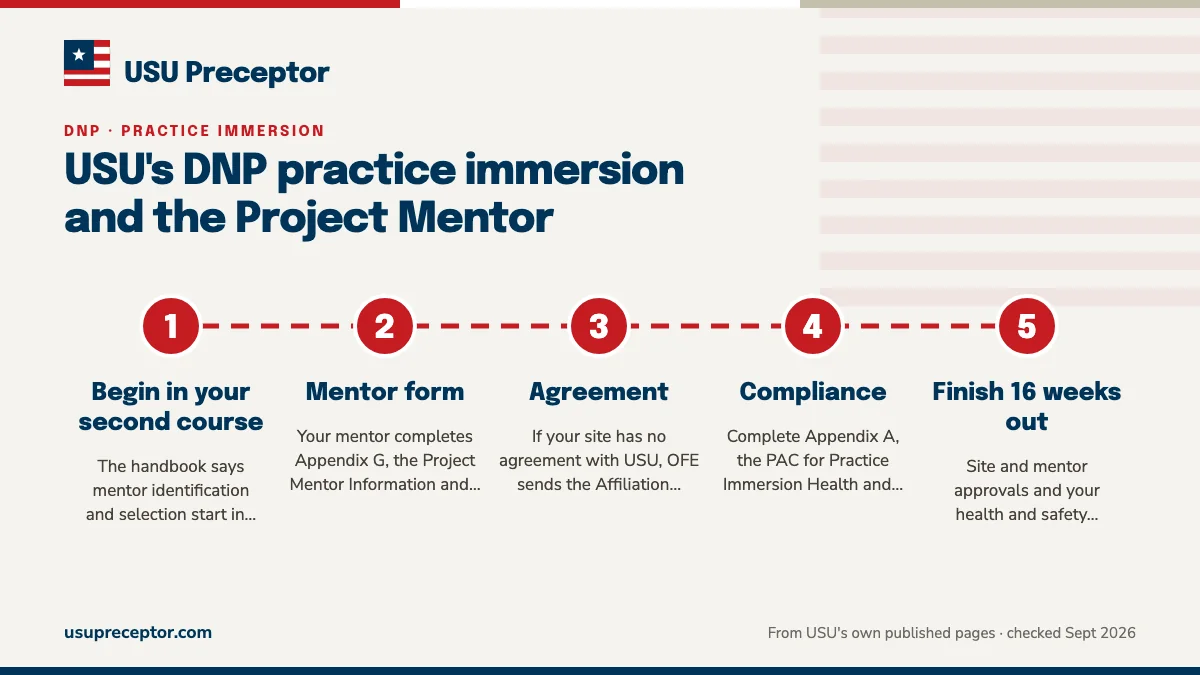
For DNP students, PAC stands for Project Mentor, Agreement, Compliance. The DNP handbook calls your coordinator the Practice Immersion Placement Coordinator (CPC).
- Begin in your second courseThe handbook says mentor identification and selection start in the program's second course, well ahead of the first immersion course.
- Mentor formYour mentor completes Appendix G, the Project Mentor Information and Acknowledgement Form, and the Program Director reviews it.
- AgreementIf your site has no agreement with USU, OFE sends the Affiliation Agreement to the site. Give OFE the contact and let it run the process.
- ComplianceComplete Appendix A, the PAC for Practice Immersion Health and Safety Checklist, through Complio.
- Finish 16 weeks outSite and mentor approvals and your health and safety documents must be finalized at least 16 weeks before your practice immersion.
- Log as you goEnter immersion hours in Project Concert within 48 hours of completing them.
The catalog's college-wide rule, three qualified preceptors six months before each clinical course, is written for preceptors. Ask your CPC how USU applies it to a mentor-based immersion.
Residencies and accreditation
Separate from the immersion, the DNP has two synchronous virtual residencies: one in DNP701 Introduction to the Doctor of Nursing Practice with Residency, and one in DNP706 Quality Improvement and Systems-Based Practice with Residency. USU says residency is required for course and degree completion but doesn't publish how long each one lasts.
USU's DNP is "not currently accredited by the Commission on Collegiate Nursing Education (CCNE)" (USU State Board of Nursing disclosure, May 2026). USU says the DNP will be reviewed during the college's next accreditation cycle. USU's baccalaureate and master's nursing degrees are CCNE-accredited, and the university is accredited by WSCUC.
The DNP is not open to residents of DC, Idaho, Maryland, New York, Oregon, Utah or Washington. See out-of-state clinicals for the full list by program.
Why DNP students choose us for a mentor search
USU lets DNP students use their employer, and a workplace with a doctorally prepared mentor outside your reporting line and room for your project is a strong place to start.
When your workplace can't supply one, we find a doctorally prepared mentor or a willing healthcare site, and we check each candidate's degree and relationship to you against USU's rules before Appendix G goes in. Your DNP Project stays your own work, and the Program Director approves mentors. Tell us your situation to start.
Questions USU students ask
Does my MSN clinical time count toward USU's 1,000 DNP hours?
It can. USU lets up to 500 hours transfer from previous graduate coursework. Graduates of a qualifying APRN program enter with 500 recognized hours; other applicants start with 100 and may apply up to 500 by verifying their master's practice hours. Admissions sets the figure, so get it confirmed before you plan your immersion.
Can my DNP Project Mentor be a physician?
Yes. USU requires a doctorate and strongly recommends a DNP, but it accepts an MD or DO, a PhD in nursing or a medical field and, through Appendix G, an EdD with a healthcare master's. The mentor can't be a relative or partner, and can be your direct supervisor only when no other doctorally prepared mentor is available.
Is USU's DNP CCNE-accredited?
Not at present. USU's own disclosures say the DNP isn't currently CCNE-accredited and will be reviewed in the college's next accreditation cycle. USU's baccalaureate and master's nursing degrees are CCNE-accredited, and the university holds WSCUC accreditation. If an employer or a state requirement depends on programmatic accreditation, check it before you enroll.
Are the DNP701 and DNP706 residencies in person?
The catalog calls both synchronous virtual residencies, required for course and degree completion. USU's DNP web page also mentions real-time face-to-face instruction during scheduled residency, supplemented by web conference, so the wording isn't fully consistent. USU doesn't publish the length of either residency; watch your D2L course for dates and format.
Can I be paid during my DNP immersion hours?
USU's DNP handbook doesn't restrict you from receiving compensation from your site during the immersion, and it doesn't stop you using your current employer. That differs from the FNP rules, where students can't be paid during clinical hours. Your mentor still can't be your direct supervisor unless no other doctorally prepared mentor is available.
Related pages
Last checked 2026-09-23
We check these pages against USU's own catalog, handbooks and disclosures. USU's current handbook and your Clinical Placement Coordinator have the final word.
- USU DNP Practice Immersion Handbook: practice immersion hours requirements
- USU DNP Practice Immersion Handbook: selection criteria for Project Mentor
- USU 2026-27 catalog: Doctor of Nursing Practice
- USU 2026-27 catalog: program-specific admission requirements
- USU State Board of Nursing disclosure (updated 5.19.2026)
Six months out is USU's rule. We start now.
Tell us your USU program, your state and when your next practicum opens. We look for preceptors who meet USU's rules and help you build the packet the Office of Field Experience and Program Director review.
- Preceptors matched to the course: family practice, pediatrics, women's health, urgent care within USU's caps
- Appendix H, license, CV and board certification gathered the way OFE asks
- In person near you; telehealth only inside USU's 40-hour limit
Start your placement plan
A placement advisor replies with what a USU-ready preceptor and site look like for you.