Can't find a preceptor for your USU clinical course
Most USU preceptor searches stall for a few predictable reasons: too few leads per setting, clinicians or sites that don't fit USU's rules, contracts that never get signed, and a late start. Name your reason, fix it this week, and bring your Clinical Placement Coordinator in early, because OFE's help favors students whose paperwork is on time.
Stuck on your search?
Tell us your USU course, session and state. A placement advisor will reply with next steps.
Why USU searches stall
A stalled search rarely means there are no clinicians near you. Usually the leads can't get through USU's review, or there are too few for each setting. Each of these five causes has its own fix.
| What's happening | The USU rule behind it | What to change |
|---|---|---|
| One or two leads per setting | At least three potential preceptors per specialty setting or course on the Interest Form (Appendix G) | Three or more for every setting, including each FNP596 rotation |
| Every lead is a physician | At least 135 of your 540 FNP hours must be with a nurse practitioner | Add NP leads now, ideally an FNP in family practice |
| Your leads are on a hospital unit | Inpatient hours are never approved for FNP students | Ask hospital contacts about outpatient primary care practices instead |
| A clinic said yes, then its legal team stalled | OFE sends the Affiliation Agreement; allow at least four to six months for a new one | Keep other leads moving and favor sites that already have a USU agreement |
| You started a few months out | Three qualified preceptors are due 6 months before each clinical course, and approvals 16 weeks before | Count back from your start date, then triage |
A willing clinician is only a lead if they fit USU's rules for that course. Sending OFE a physician assistant, an inpatient unit or your own manager uses up weeks you don't have.
Your plan for this week
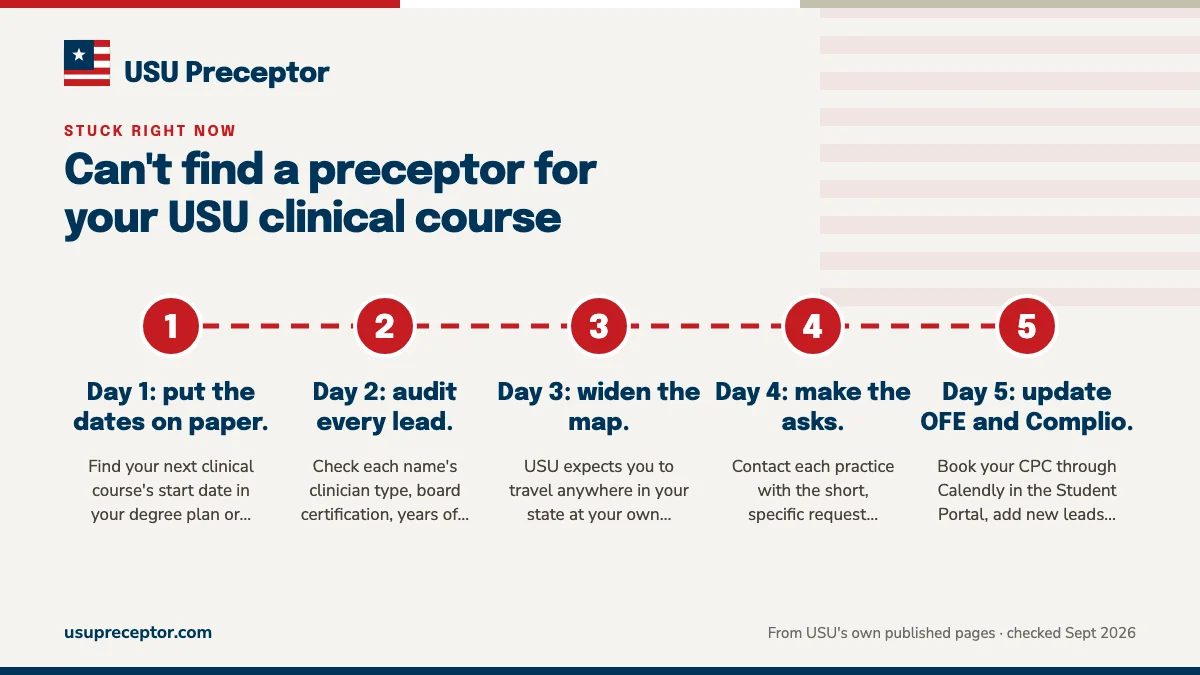
Treat the next five days as a sprint; none of it needs anyone's permission.
- Day 1: put the dates on paper.Find your next clinical course's start date in your degree plan or D2L. Count back 16 weeks and 6 months. If the 16-week date has passed, read need a preceptor fast first.
- Day 2: audit every lead.Check each name's clinician type, board certification, years of experience, license state and setting against USU's preceptor requirements. Drop anyone who fails, however keen they are.
- Day 3: widen the map.USU expects you to travel anywhere in your state at your own expense, so look past your own town. List family practice, internal medicine and pediatric practices you could reach about 17 hours a week.
- Day 4: make the asks.Contact each practice with the short, specific request described below. Aim for three yeses or maybes per setting by day five.
- Day 5: update OFE and Complio.Book your CPC through Calendly in the Student Portal, add new leads on the Interest Form, and clear any Complio item that's due. OFE gives priority to students whose documents are in on time.
How to ask a clinic so it can say yes
Busy clinicians turn down vague requests. Give them what they need to decide in one conversation: your course number, 135 hours over eight weeks, and roughly 17 hours a week on weekdays. USU's catalog says most FNP hours fall Monday to Friday, 8:00am to 5:00pm.
Then explain their part. The preceptor completes USU's Preceptor Information and Acknowledgement Form (Appendix H) through DocuSign and supplies a license verification, a CV and, for NPs, proof of board certification. They also need their employer's permission to precept. OFE handles the site's contract.
USU gives preceptors perks rather than pay: a 10% tuition discount, continuing education, library access and, at 135 service hours a year, an honorary faculty title.
What OFE can do, and where its help stops
OFE is a real safety net. USU's 2026-27 catalog says that if your preferred placements don't work out, OFE will help you get one, and it tries to place students in their own area. Your CPC can also tell you whether a site you've found already has an agreement with USU, which can save months.
The limits are plain too. Priority goes to students whose documents arrived on time, the FNP handbook says same-day or urgent requests can't be met, and nothing in USU's documents promises you a placement.
If OFE offers a site, you have 24 business hours to accept. A decline, or no answer, hands that rotation back to you, and accepting commits you to every hour. Distance isn't an accepted reason to refuse. The full rules are on how OFE placement support works.
When the calendar is against you
Timing is the one cause that effort alone can't fix. Program Director review takes 4 to 16 weeks on average, a new site agreement at least four to six months, and every approval is due 16 weeks before the course. A search that begins ten weeks out is fighting arithmetic, and OFE's priority for on-time students won't be on your side.
If you're past the 16-week date, write to your CPC and ask what is still possible this session and what moving to a later session would involve. Moving one FNP practicum moves the rest, since each is a prerequisite for the next. What a late clinical does to your graduation sets out the knock-on effects.
Why students with no leads choose us
Our specialty is USU's clinical process. A placement advisor looks for a clinician and site that match your course and the rules USU sets for preceptors, and in-person placements near home are our main route. A virtual arrangement is considered only inside USU's telehealth limit of 40 FNP hours.
Once someone agrees, we help you put together the file OFE and the Program Director will look at, from Appendix H and its exhibits to the site contact OFE uses for the contract. You send it in, and USU makes the decision. No hours start before your OFE Approval Letter, and if a preceptor later drops out, we search again.
The Program Director gives the final approval, and a wide search started early puts the strongest candidates in front of that review. See how the service works, then use the form below or the chat.
Questions USU students ask
Is USU supposed to find my preceptor for me?
No. USU's catalog makes identifying clinical placements and preceptors the student's job, with OFE as a partner. If your preferred placements fall through, OFE will help you obtain one, and students who met the document deadlines get priority. USU doesn't describe that help as a promise of placement.
How many preceptor leads should I send USU?
At least three per specialty setting or course, with valid contact details, which is what the Interest Form and the catalog ask for. For FNP students that means three for family practice and three for each FNP596 rotation: pediatrics, women's health and geriatrics. More qualified names help your CPC.
Can I do clinicals in another state if nothing is available at home?
You can ask. USU would rather you train in the approved state where you live, though you may request another state where it's approved, but it says that state's board may not accept those hours for licensure. You'd also need an active RN license there, and some states, such as California, add their own rules.
Should I pay a preceptor who asks for a fee?
That's your call. Some preceptors and sites charge, and USU's catalog says it neither sets nor regulates those fees. A paid preceptor still needs Program Director approval, and paying doesn't skip any step in USU's process.
What if a clinic says yes but its legal department won't sign?
Without a fully executed Affiliation Agreement, OFE can't issue your approval letter for that site. Leave the contract to OFE, since USU asks students not to contact the site while it's in progress, and move your next lead forward. Sites that already hold a USU agreement skip this step, so ask your CPC which of yours do.
Related pages
Last checked 2026-09-23
We check these pages against USU's own catalog, handbooks and disclosures. USU's current handbook and your Clinical Placement Coordinator have the final word.
Six months out is USU's rule. We start now.
Tell us your USU program, your state and when your next practicum opens. We look for preceptors who meet USU's rules and help you build the packet the Office of Field Experience and Program Director review.
- Preceptors matched to the course: family practice, pediatrics, women's health, urgent care within USU's caps
- Appendix H, license, CV and board certification gathered the way OFE asks
- In person near you; telehealth only inside USU's 40-hour limit
Start your placement plan
A placement advisor replies with what a USU-ready preceptor and site look like for you.