FNP597: Clinical Residency and Practice Management
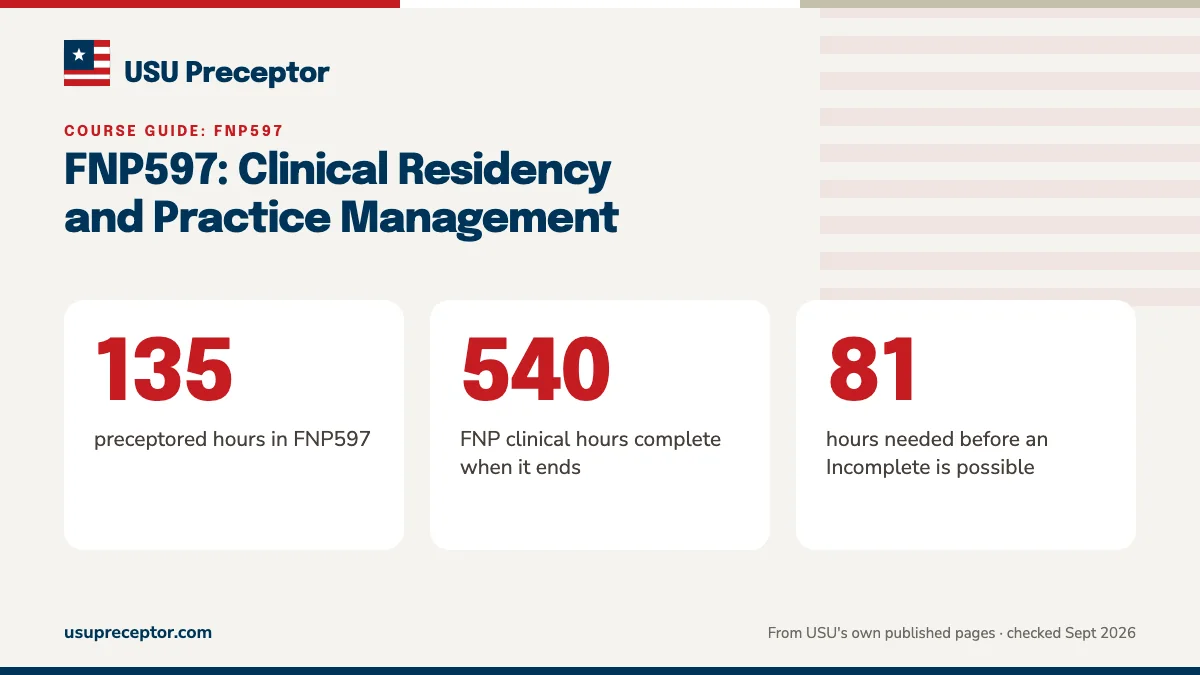
FNP597 is the last of USU's four FNP practicums: 3 credits and 135 preceptored hours in 8 weeks, taken with the MSN600 capstone after FNP595 and FNP596. The catalog expects you to “function independently as entry-level nurse practitioners” across the lifespan. It is also your final chance to close any gap in USU's program-wide hour and journal minimums.
Lining up your FNP597 residency?
Tell us your state, your start date and any hours you still need. A placement advisor replies with what a USU-ready residency match looks like.
FNP597 at a glance
The catalog pairs primary health care across the lifespan with practice management topics. On USU's 2020 degree plan it is the final session of semester 6, run alongside MSN600.
| Item | FNP597 |
|---|---|
| Catalog title | Clinical Residency and Practice Management |
| Credits and grading | 3 credits; credit or no credit |
| Clinical hours | 135 preceptored hours |
| Length | One 8-week session |
| Prerequisites | FNP595 and FNP596 |
| Co-requisite | MSN600 Evidence Based Capstone Project (2 credits, non-transferable) |
| Setting | Primary health care across the lifespan; optional specialties within the 40-hour cap |
| Preceptor | Board-certified NP or licensed MD/DO, ideally an FNP |
| Before day one | OFE Approval Letter, after the 16-week approval deadline |
| Week one | Upload the approval letter and begin the 135 hours |
MSN597 is not this course. It is the Forensic Nursing Practicum in an MSN track that is not accepting applicants.
What a residency asks of your preceptor
USU's general FNP rules apply: a board-certified NP or a licensed MD or DO, employed by the site and in active practice, with at least a year of experience, an unencumbered license in your clinical state and the employer's permission. The Program Director approves each one. The full list is on who can precept USU FNP students.
What changes in FNP597 is the level of independence the catalog expects. Look for a primary care preceptor who will let you lead visits, from history to plan, and review your decisions afterward. A 2024 USU preceptor onboarding document asks for hands-on direct care on site and suggests students see at least one to two patients an hour.
The course also covers practice management, so a preceptor willing to explain how the practice runs day to day suits it well. USU “highly recommends” spending most of your hours with FNP preceptors, and a family practice FNP meets both that recommendation and the NP floor.
Audit your totals before FNP597 approvals are due
USU measures several minimums at the end of the program, and FNP597 is the last course that can fill them. Run this check against your Project Concert records and the Appendix M matrix:
- At least 135 hours with a Nurse Practitioner preceptor.
- At least 135 family practice hours, not counting urgent care.
- Journal entries: 100 geriatric, 80 pediatric (15 newborn or infant, 50 aged 1 to 12, 15 aged 13 to 17) and 40 women's health.
- Urgent care hours used, against the 135-hour program cap.
- Telehealth hours used, against the 40-hour program cap.
- Optional specialty hours used, against the 40-hour combined cap.
Timing makes this harder than it looks. If your practicums run back to back, 16 weeks before FNP597 is roughly when FNP594 begins, so your residency placement must be approved before FNP596 has even started. Plan FNP597 around the gaps you expect, then confirm with your CPC once FNP596 ends. See what counts as an FNP hour for the logging rules.
Optional specialty hours in FNP597
USU allows up to 40 hours in college-approved specialty rotations across the whole FNP. Since July 2024, using a specialty before FNP597 requires Program Director approval, so FNP597 is the course where a specialty avoids that extra step.
Those 40 hours still need a preceptor who meets USU's rules and an OFE Approval Letter, and OFE may limit the letters it issues for specialty experiences. Inpatient settings remain excluded, even for a specialty: the handbook's words are “Inpatient hours are not approved and will not be counted.” Telehealth stays within its 40-hour program cap, with your preceptor physically beside you.
Before you commit hours to a specialty, check your audit. If you are short on NP hours or family practice hours, those gaps have to come first, because every hour spent in a specialty is an hour not spent closing them.
FNP597 and the MSN600 capstone together
MSN600 Evidence Based Capstone Project is a 2-credit, non-transferable co-requisite, so you carry a capstone and 135 clinical hours in the same 8 weeks. Build your clinical schedule first: about 17 hours a week, never more than 12 hours in a day, at least one clinical day each week. The catalog notes that most clinical hours fall Monday to Friday, 8:00 am to 5:00 pm.
Keep your compliance current to the last day. Complio sends expiry notices at 60, 45, 30 and 15 days and on the day itself, and any expired item puts you on clinical pause until it is fixed. Renew early rather than in the middle of the residency; see Complio at USU for the review times.
Log every encounter in Project Concert within 48 hours. In the final course there is no later practicum to absorb a shortfall.
If something goes wrong in the last course
If your preceptor stops for reasons outside your control, USU's catalog says OFE will make every reasonable attempt to find an alternative. If that fails, you may have to withdraw and retake the course at your own cost, and hours already logged are lost. If you change preceptors for other reasons, finding the replacement falls to you. Our page on a preceptor who drops out covers the options.
An Incomplete needs at least 81 hours already done. Without one, the catalog says unfinished hours “will be lost and need to be repeated the following term,” which pushes graduation back. USU gives the FNP a 60-month limit for completion. See what a late clinical costs in time before you decide between pushing on and retaking.
Why FNP597 students choose us
For FNP597, the placement desk looks for a primary care preceptor near you who is comfortable with a resident-level student, and, if you need them, placements that close a specific gap such as NP hours. We help you prepare the packet OFE and the Program Director review. They approve every preceptor, site and agreement, working from a packet we've checked line by line. Tell us what you still need.
Questions USU students ask
What is the co-requisite for USU FNP597?
MSN600 Evidence Based Capstone Project, a 2-credit course that cannot be transferred in, runs alongside FNP597. Before either, you must pass FNP595 and FNP596. Together they close the MSN FNP: once FNP597's 135 hours are logged and approved, you reach USU's 540 precepted clinical hours.
Can I spend FNP597 in a specialty practice?
Only part of it. USU caps optional specialty rotations at 40 hours across the whole FNP, so at least 95 of your FNP597 hours belong in primary health care across the lifespan. Specialty hours need an approved preceptor and an OFE Approval Letter, OFE may limit specialty letters, and inpatient settings never count.
What happens if I can't finish FNP597 hours in 8 weeks?
Talk to your clinical faculty as early as you can. USU requires at least 81 completed hours before an Incomplete can be considered. Below that, the catalog says unfinished clinical hours are lost and must be repeated the following term, which delays graduation. Hours cannot be carried over from FNP596, and logging after 48 hours does not count.
Is USU FNP597 the same as MSN597?
No. FNP597 Clinical Residency and Practice Management is the final Family Nurse Practitioner practicum. MSN597 is the Forensic Nursing Practicum, a 120-hour course in an MSN track that USU's catalog lists as not accepting applicants. If you are in the FNP, your clinical course numbers always start with FNP.
Do physician hours count in FNP597?
Yes. A licensed MD or DO is an acceptable FNP preceptor at USU, and their hours count toward your 540. They do not count toward the separate floor of 135 hours with a nurse practitioner, though. If your earlier rotations were mostly with physicians, choose an NP for FNP597.
Related pages
Last checked 2026-09-23
We check these pages against USU's own catalog, handbooks and disclosures. USU's current handbook and your Clinical Placement Coordinator have the final word.
Six months out is USU's rule. We start now.
Tell us your USU program, your state and when your next practicum opens. We look for preceptors who meet USU's rules and help you build the packet the Office of Field Experience and Program Director review.
- Preceptors matched to the course: family practice, pediatrics, women's health, urgent care within USU's caps
- Appendix H, license, CV and board certification gathered the way OFE asks
- In person near you; telehealth only inside USU's 40-hour limit
Start your placement plan
A placement advisor replies with what a USU-ready preceptor and site look like for you.