FNP592: Common Illnesses Across the Lifespan – Clinical Practicum
FNP592 is USU's first FNP clinical course: 3 credits and 135 precepted hours in 8 weeks, taken alongside FNP591 once MSN572 is complete. It is also the strictest about setting. Your preceptor must work in family practice, primary care or primary care internal medicine, and the Office of Field Experience must approve the whole placement before your first shift.
Need an FNP592 preceptor?
Tell us your state and the session FNP592 starts. A placement advisor replies with what a USU-ready family practice match looks like for you.
FNP592 at a glance
USU's catalog describes the course as primary care for “diverse clients with common health care problems across the life span.” On USU's 2020 degree plan it opens semester 5, the start of the program's second year, when FNP clinical hours begin.
| Item | FNP592 |
|---|---|
| Catalog title | Common Illnesses Across the Lifespan – Clinical Practicum |
| Credits and grading | 3 credits, credit/no credit |
| Clinical hours | 135 precepted hours |
| Length | One 8-week session |
| Prerequisite | MSN572 Advanced Health and Physical Assessment Across the Lifespan |
| Co-requisite | FNP591 Common Illnesses Across the Lifespan |
| Setting | Family practice, primary care or primary care internal medicine; no urgent care |
| Preceptor | Family practice, primary care or internal medicine MD/DO, FNP or AGNP in a practice with no specialty |
| Before day one | OFE Approval Letter, with every approval on file 16 weeks ahead |
| Week one | Upload the letter and start your hours |
The setting: family or primary care, nothing more specialized
The FNP Clinical Handbook makes your first rotation a generalist one. It must be family practice, primary care or primary care internal medicine, and the handbook is direct about the most common alternative: “Urgent care is not acceptable for FNP592.”
Appendix I, the FNP Site & Preceptor Guidance, lists what it accepts for FNP592: family practice, internal medicine, primary care, pediatric primary care, a health department, a retail clinic, or home care with a primary care focus. It rules out hospitals, emergency departments, specialty clinics, long-term care and hospice. Any inpatient setting is out at every stage of the program.
The two lists don't line up perfectly. If your proposed site is pediatric primary care, a retail clinic, a health department or home care, confirm with your Clinical Placement Coordinator that it satisfies the first-rotation rule before your preceptor fills in any paperwork. A family practice that sees all ages fits every version of the rule.
An urgent care clinic with a primary care feel still does not qualify for FNP592. Save urgent care for FNP594 or later.
The preceptor FNP592 calls for
Appendix I names the ideal FNP592 preceptor: a primary care, family practice or internal medicine MD, DO or FNP, working in a practice with no specialty. It also allows an AGNP for this course. Behind that sit the general rules in who can precept USU FNP students:
- A board-certified NP with national certification appropriate for FNP education, or a licensed MD or DO, employed by the clinical facility and in active practice.
- At least one year of experience at or above the level of licensure your program leads to.
- An active, unencumbered license in the state where you train, and the employer's permission to precept.
- Not your spouse, domestic partner, first-degree relative or direct supervisor.
- No more than two students at a time, counting NP students from other schools (one in New Jersey).
- PAs are not listed as eligible, and chiropractors, acupuncturists and naturopaths are not acceptable.
USU requires at least 135 hours with an NP preceptor across the program. An NP who precepts all of your FNP592 hours meets that floor in your first course, which gives you more room in later rotations. USU also recommends no more than three preceptors in one 8-week course.
What must be approved before your first FNP592 shift
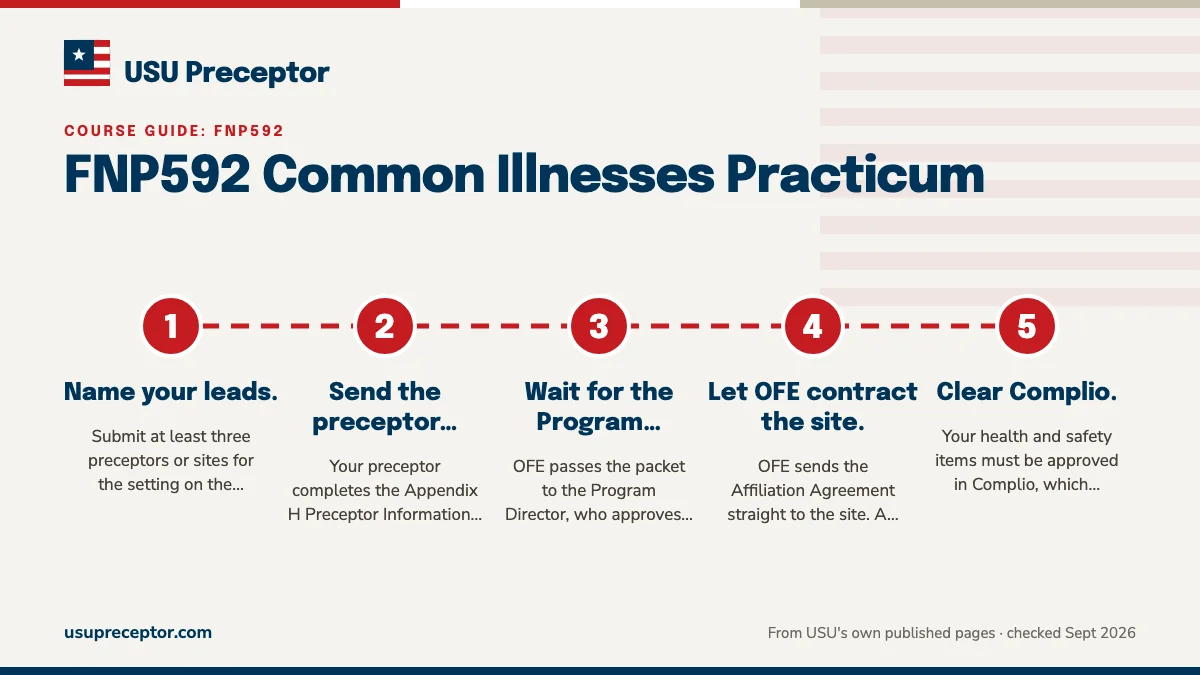
- Name your leads. Submit at least three preceptors or sites for the setting on the Appendix G Interest Form. Your CPC checks whether USU already has an agreement with each site.
- Send the preceptor packet. Your preceptor completes the Appendix H Preceptor Information and Acknowledgement Form, one per student, site and specialty. You email it to OFE with license verification, a CV or resume and, for an NP, board certification.
- Wait for the Program Director. OFE passes the packet to the Program Director, who approves or denies the preceptor. USU says this takes 4 to 16 weeks on average.
- Let OFE contract the site. OFE sends the Affiliation Agreement straight to the site. A new agreement can take 4 to 6 months, and you should not contact the site about it unless OFE asks.
- Clear Complio. Your health and safety items must be approved in Complio, which reviews them in 2 to 5 business days.
- Receive the approval letter. OFE emails your OFE Approval Letter. Until then you may not be on site or log any hours.
Working back from your FNP592 start date
Two USU deadlines apply, and both fall well before the course opens. The catalog asks for at least three qualified preceptors 6 months before each clinical course. The FNP handbook wants every site, preceptor and health and safety approval on file 16 weeks before it.
Take a student whose FNP592 begins with the Summer I 2027 session on 05/04/2027. Their three preceptor leads are due by early November 2026, and every approval by 01/12/2027. On the 2020 degree plan, with sessions running back to back, the 16-week mark falls about 8 weeks before MSN572 begins, so the paperwork has to be finished before you reach the course that unlocks FNP592.
The handbook goes further for new students: at enrollment you should have preceptors and sites confirmed, or at least three candidates per setting on the Interest Form. It also says OFE cannot handle same-day or urgent requests. Check your own session dates with your CPC, and see USU's clinical deadlines for how the 6-month and 16-week rules interact.
Week one of FNP592
USU's catalog is blunt: “Students must initiate clinical hours within the first week of each clinical course.” If you don't, you may have to withdraw, reapply and retake the course. In the same week you upload your OFE Approval Letter together with your preceptor's acknowledgement form.
From then on, each encounter goes into Project Concert within 48 hours or the hours do not count. Plan about 17 hours a week, never more than 12 in one day, with at least one clinical day every week. Your Complio items must stay current throughout; anything that expires puts you on clinical pause.
A Clinical Site Supervisor from USU's faculty will contact you through your USU email to arrange a site visit, held virtually unless an in-person visit is required. FNP592 is also one of the courses assessed with USU's College Practicum Evaluation Rubric. None of your 135 hours roll into FNP594, so finish them inside the 8 weeks.
Why FNP592 students choose us
For FNP592, the placement desk looks for a family practice or primary care preceptor near you whose practice has no specialty, and checks the fit against Appendix I before anything goes to USU. We help you assemble the Appendix H packet and stay on call if a preceptor withdraws. USU approves every preceptor, site and agreement. Tell us when your FNP592 starts.
Questions USU students ask
Can I do USU FNP592 at an urgent care clinic?
No. USU's FNP Clinical Handbook excludes urgent care from FNP592 and requires family practice, primary care or primary care internal medicine for this first rotation. Urgent care becomes an option from FNP594, but USU caps it at 135 hours across the whole program, and none of that time counts toward your 135-hour family practice minimum.
Can an AGNP or a pediatric office precept FNP592?
Appendix I allows an AGNP preceptor for FNP592, and it lists pediatric primary care among the acceptable sites. The handbook's first-rotation rule, however, names family practice, primary care and primary care internal medicine. Before you commit, ask your Clinical Placement Coordinator whether a pediatric-only practice satisfies the rule for your cohort. A family practice avoids the question.
What are the prerequisites for USU FNP592?
The catalog lists MSN572 Advanced Health and Physical Assessment Across the Lifespan as the prerequisite and FNP591 Common Illnesses Across the Lifespan as the co-requisite. MSN572 contains the FNP immersion, which you must complete. Separately, USU will not let you start hours until OFE has issued your approval letter for the placement.
Can I use telehealth for FNP592 hours?
Only a small amount, and only if approved. USU allows up to 40 telehealth hours for the entire FNP program, with your preceptor physically beside you, video visits, and patients located in the state of your address on file. Appendix I lists telehealth-only sites as inappropriate, so a telehealth practice cannot be your FNP592 placement.
What if my FNP592 preceptor backs out?
If the preceptor stops for reasons outside your control, USU's catalog says OFE will make every reasonable attempt to find an alternative. If that fails, you may need to withdraw and retake the course, and hours already logged are lost. If you change preceptors for other reasons, finding the replacement is your job, and changes need approval 16 weeks ahead.
Related pages
Last checked 2026-09-23
We check these pages against USU's own catalog, handbooks and disclosures. USU's current handbook and your Clinical Placement Coordinator have the final word.
- USU catalog: FNP592 course description
- USU FNP Clinical Handbook, Appendix I: FNP Site & Preceptor Guidance
- USU FNP Clinical Handbook: Selection Criteria for FNP Clinical Preceptors
- USU FNP Clinical Handbook: Clinical Placement
- USU catalog: Field Experience Policies, College of Nursing and Health Sciences
Six months out is USU's rule. We start now.
Tell us your USU program, your state and when your next practicum opens. We look for preceptors who meet USU's rules and help you build the packet the Office of Field Experience and Program Director review.
- Preceptors matched to the course: family practice, pediatrics, women's health, urgent care within USU's caps
- Appendix H, license, CV and board certification gathered the way OFE asks
- In person near you; telehealth only inside USU's 40-hour limit
Start your placement plan
A placement advisor replies with what a USU-ready preceptor and site look like for you.