USU's online RN-to-BSN, and the 90 hours it asks of you
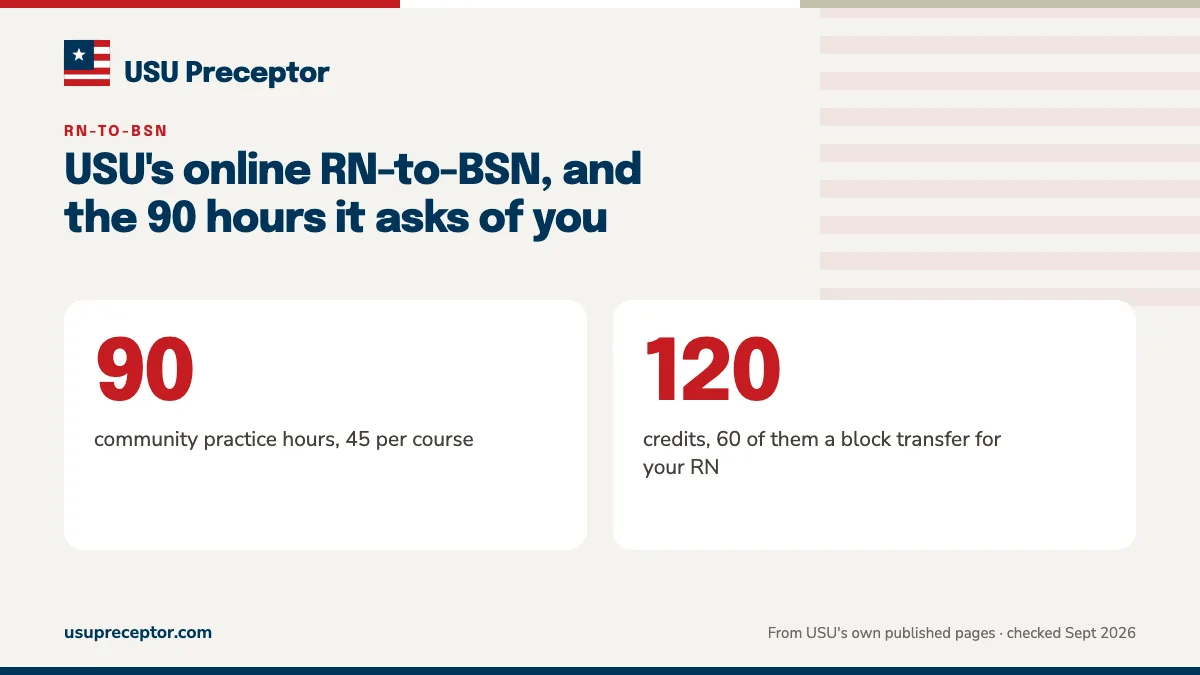
USU's RN-to-BSN is an online degree of about 12 months for registered nurses, with 90 hours of community practice split across two courses. You don't need a nurse practitioner or physician preceptor. You need a community agency that serves vulnerable people, and a leader there willing to work with you through both courses, lined up months before the first one starts.
Find a community agency near you
Tell us where you live and when NUR378 starts. A placement advisor replies with the kind of agency and leader USU's practicum handbook describes.
How the degree is put together
The catalog counts 120 credits. Your RN earns a 60-credit block transfer, you complete at least 30 credits at USU, and the nursing core is 33 credits: eleven 3-credit courses. USU describes the program as about 12 months over 3 semesters, and its time-to-completion policy allows 18 months, so on length its sources agree.
Eight of the core courses, NUR370 through NUR377, cover the professional and theory side of the degree, from caring science and evidence-based practice to informatics and ethics. The two practicum courses come last, and NUR300 Physical Examination and Health Assessment is required of Tennessee residents, who can also transfer in an equivalent.
Everything except the practicum hours is online, in 8-week courses. USU's baccalaureate nursing degree carries CCNE accreditation, and USU's disclosure notes that California's Board of Registered Nursing doesn't approve RN-to-BSN programs.
The 90 hours: two courses, one agency leader
USU's Board of Nursing disclosure calls this 90 hours of community-based nursing practice, and it applies to students enrolled on 8/30/22 or later. USU's degree page says the experience “can be completed near their own home,” with a focus on community health.
| Course | Hours | What the catalog asks | Comes after |
|---|---|---|---|
NUR378 Global and Community-Based Nursing | 45 | Community nursing practice with an agency or organization leader near where you live | NUR370 to NUR377 |
NUR499 Capstone in Evidence-based Professional Nursing Practice | 45 | Practice hours plus a poster or podium presentation | NUR378 |
The practicum handbook asks you to keep the same agency leader for both courses, with meetings in weeks 1, 4 and 8 of each. That makes the choice of agency a two-course commitment rather than a single 8-week one, so pick a place where the work of NUR378 can grow into your capstone. The full practicum detail is on the RN-to-BSN practicum page.
Your RN license, and when it has to be active
USU admits RN-to-BSN applicants with an ADN or RN diploma and a GPA of at least 2.0. You need a valid, unrestricted, unencumbered RN license, or an NCLEX-RN test date scheduled before the end of your first term, so a new graduate can start before passing the exam.
The practicum is where that flexibility ends. The handbook's health section requires an active license issued by the state where your practicum happens, and your health and safety documents have to be in place before hours begin. If you start without a license, pass the NCLEX well before your NUR378 paperwork is due, not in the weeks before the course.
If your license comes from a different state than the one you live in, or you plan to do your hours across a state line, check your RN license for clinicals before you choose an agency.
You can enroll with an NCLEX date, but the practicum needs an active RN license in the state where you'll do your hours.
Finding the agency and its leader
USU's practicum handbook makes this your task: RN-to-BSN students find the agency leader themselves. The agency must serve community-dwelling residents from vulnerable populations and be open to the public. The handbook's examples include food programs, shelters, senior centers and youth clubs, so think community services before you think clinical.
Your agency leader needn't hold a nursing license. The handbook asks for someone experienced in leading, who understands the vulnerable group the agency serves, ideally with a college degree. They send OFE a resume, and OFE orients them to the role, a point worth mentioning when you first ask.
When you approach an agency, explain the commitment in plain terms: 45 hours in each of two 8-week courses, the same leader throughout, three check-ins per course, and some paperwork for USU. Saying it up front avoids surprises halfway through NUR499.
Timing inside a one-year program
USU sets two dates. Its college-wide field experience policy wants three qualified leads, with working contact details, named 6 months before any clinical course, and the RN-to-BSN handbook wants the practicum paperwork finished 16 weeks before NUR378.
In a program of about 12 months, with NUR378 following the whole NUR370 to NUR377 sequence, the 6-month date can arrive soon after you start. List three agencies and leaders on Appendix G, the Preceptor & Clinical Practicum Placement Interest Form, early in your first semester; the Interest Form page explains how OFE uses it. Your chosen leader then completes Appendix H, the Preceptor Information and Acknowledgement Form.
Health and safety items follow the Appendix A checklist: AHA BLS, TB screening, immunizations, health insurance, your own liability coverage, a background check and a drug screen. USU's OFE page points students to Complio, but the RN-to-BSN handbook's health page doesn't name a vendor, so confirm the system with your Clinical Placement Coordinator. Session dates are on the course calendar.
States where USU's RN-to-BSN isn't open
USU doesn't enroll RN-to-BSN students living in Maryland, the District of Columbia, Washington, American Samoa or the Northern Mariana Islands. Unlike the Washington question for USU's non-FNP MSN, both of USU's lists agree on excluding Washington here. For the practicum itself, USU encourages clinical hours in your state of residence, which suits an agency close to home.
Some states open to this program are closed to one or more of USU's graduate nursing programs. New York, Kansas and New Hampshire residents can take the RN-to-BSN but not the MSN FNP, and Idaho, Oregon and Utah residents can take it but not the DNP. If a USU graduate degree is your next step, check that program's state list now, since USU won't let you complete a program after moving to a state where it isn't offered.
Why RN-to-BSN students choose us
This practicum needs a community agency and a willing leader rather than a clinical preceptor, and a food bank, shelter or senior center near you may say yes to a direct request.
Students come to us when they've asked around and heard nothing, when the agencies you know aren't open to the public or don't serve a vulnerable population, or when the 6-month or 16-week date is close. The placement desk can put together a handful of nearby agencies that match USU's description, confirm each one is public-facing and serves a vulnerable group, and approach the leader with a plain account of the two-course commitment.
USU approves the agency leader and the arrangement, and the leader we approach already knows what the two courses ask. If you want a hand, use the form below.
Questions USU students ask
How long does USU's RN-to-BSN take?
USU describes the program as about 12 months across 3 semesters, built from 8-week courses, and its time-to-completion policy sets an 18-month limit. The two practicum courses, NUR378 and NUR499, each run one 8-week session. Because unfinished practicum hours are lost and repeated the following term, a late start in NUR378 can stretch your year.
How many credits can I transfer into USU's RN-to-BSN?
Your RN brings a 60-credit block transfer toward the 120 credits the degree requires, and at least 30 credits must be earned at USU. The nursing core itself is 33 credits. How any other credits from your transcripts transfer is decided in USU's evaluation, so ask admissions for it before you plan your year.
Can I start USU's RN-to-BSN before I pass the NCLEX?
Yes, if you have an NCLEX-RN test date scheduled before the end of your first term; that is one of USU's admission routes. The practicum is stricter: once hours begin, you need a current nursing license in the state where you'll complete them, so plan to be licensed well before NUR378 begins.
Does USU offer a traditional or accelerated BSN?
No. USU's 2026-2027 catalog lists the RN-to-BSN as its only bachelor's nursing program, and its nursing course list has no prelicensure clinical courses. USU also doesn't appear on the California Board of Registered Nursing's list of approved prelicensure RN programs. The RN-to-BSN is for nurses who already hold, or are about to hold, an RN license.
Can I do USU's RN-to-BSN and then its MSN FNP?
The two programs exist separately, and USU's MSN admission asks for a BSN from an accredited school plus an RN license in your state of residence, which the RN-to-BSN can supply. Check the state lists first: Washington residents can take USU's FNP but not its RN-to-BSN, while Kansas, New Hampshire and New York residents face the reverse.
Related pages
Last checked 2026-09-23
We check these pages against USU's own catalog, handbooks and disclosures. USU's current handbook and your Clinical Placement Coordinator have the final word.
Six months out is USU's rule. We start now.
Tell us your USU program, your state and when your next practicum opens. We look for preceptors who meet USU's rules and help you build the packet the Office of Field Experience and Program Director review.
- Preceptors matched to the course: family practice, pediatrics, women's health, urgent care within USU's caps
- Appendix H, license, CV and board certification gathered the way OFE asks
- In person near you; telehealth only inside USU's 40-hour limit
Start your placement plan
A placement advisor replies with what a USU-ready preceptor and site look like for you.