USU's MSN Nurse Educator and its 100-hour teaching residency
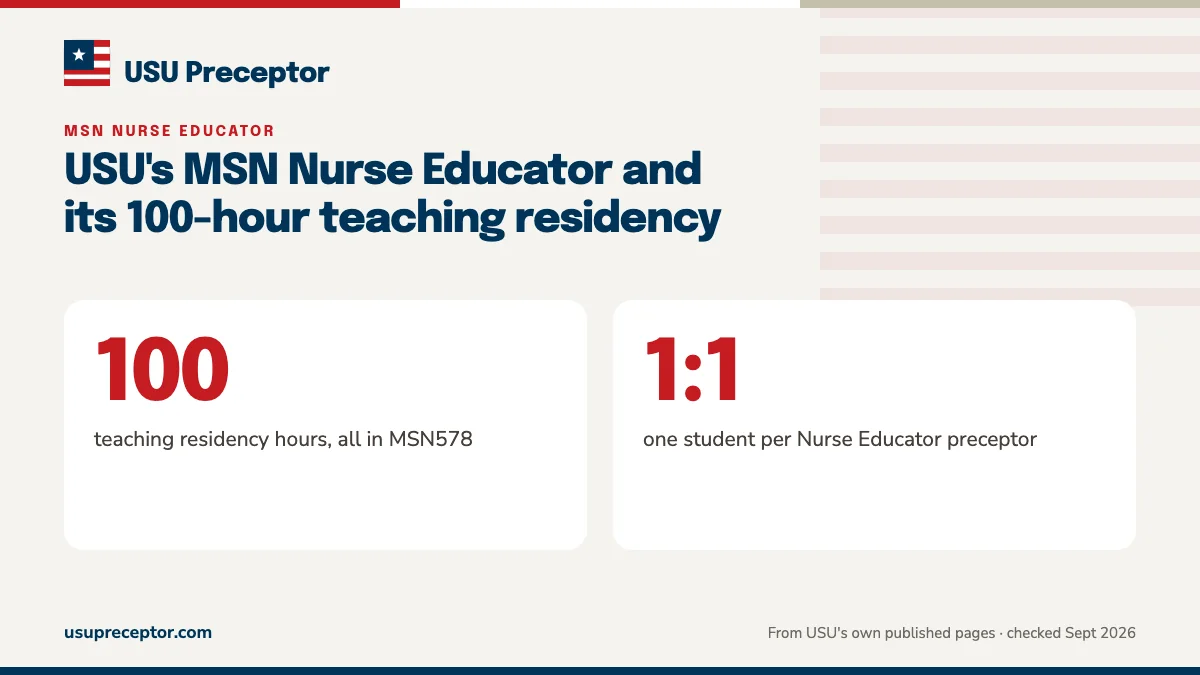
USU's Nurse Educator MSN is 30 online credits with a single practicum: MSN578, 100 hours of teaching guided by a nurse with an MSN or doctorate, one student per preceptor. The residency comes in your last session, but your preceptor leads are due about 6 months before it, which on the 12-month pathway is only a few months after you start.
Find your teaching residency preceptor
Tell us your specialty, your residency session and where you live. A placement advisor replies with what a USU-ready Nurse Educator preceptor looks like near you.
What the 30 credits are
Almost the whole program is online coursework with no clinical hours attached. These are the courses USU's 2026-2027 catalog gives for the Nurse Educator concentration; only one of them carries practicum hours.
| Course | Title | Credits | Practicum hours |
|---|---|---|---|
MSN560, MSN561, MSN563, MSN565 | MSN core | 3 each | 0 |
MSN570 | Advanced Pathophysiology Across the Lifespan | 3 | 0 |
MSN571 | Advanced Pharmacology Across the Lifespan | 3 | 0 |
MSN553 | Advanced Health and Physical Assessment Across the Lifespan | 3 | None stated |
MSN530 | Curriculum Development and Teaching Strategies | 3 | 0 |
MSN577 | Test Construction, Assessment and Evaluation of Learning Outcomes | 2 | 0 |
MSN578 | Teaching Residency for Nurse Educators | 2 | 100 |
MSN600 | Evidence Based Capstone Project | 2 | None stated |
Unlike USU's Health Care Leadership track, this one includes advanced pathophysiology, pharmacology and assessment, and MSN553 asks you to perform a comprehensive head-to-toe exam. None of that time counts toward the residency's 100 hours.
Program length: three published answers
USU gives three different lengths for this degree. The catalog's program entry says 3 to 6 semesters and 12 to 22 months. The time-to-completion table treats 22 months as standard and sets a 55-month limit. USU's website says the program is designed for 24 months, with an accelerated pathway that can be completed within 12.
Which one applies to you decides when the preceptor search starts. Because the catalog puts MSN578 in the last session, a residency that is your final 8-week session gives roughly this timeline:
| Milestone | 24-month plan | 12-month pathway |
|---|---|---|
MSN578 begins | Around month 22 | Around month 10 |
| Three preceptor leads due (6 months before) | Around month 16 | Around month 4 |
| Paperwork complete (16 weeks before) | Around month 18 | Around month 6 |
One more inconsistency is worth settling early. The catalog also lists MSN578 as a prerequisite for the MSN600 capstone, which sits awkwardly with a residency taken last. Ask your advisor for your actual course order before you count back from it.
What the teaching residency involves
USU's practicum handbook describes MSN578 as 100 clock hours of teaching activities under a “university approved specialty nurse educator preceptor.” It fits into one 8-week session, so expect roughly 12 to 13 hours a week. You report hours weekly in Project Concert, and because the course is non-transferable, it has to be taken at USU.
The setting can be clinical or academic. The handbook's examples run from acute care areas such as med-surg, ICU, oncology and psychiatric care to outpatient and chronic care such as dialysis and hospice, and it recommends academic settings, naming ADN and prelicensure BSN programs. Choose a setting that matches the specialty you want to teach in, because your preceptor's experience has to match it too.
The one firm exclusion is your own job. Teaching that belongs to your current position or work role doesn't count as practicum time, so the in-service sessions or orientations you already run at work won't qualify. How employer sites are handled is on clinicals at your employer, and the course detail is on the MSN578 teaching residency page.
The preceptor you're looking for
Four tests apply to a Nurse Educator preceptor. They hold a nursing MSN or doctorate. They have worked as an RN for at least a year in the specialty your residency covers. Their RN license is current and unencumbered, or they practice on a multistate privilege. And they work in a healthcare or academic setting. Relatives, partners and your direct supervisor are excluded, and USU sets the ratio at one preceptor to one student.
The specialty requirement is the one to check first. A nurse with an MSN and years on a cardiac unit fits a cardiac teaching residency well; the same person is a weaker match for a residency in pediatrics. Students in Tennessee have an extra condition, covered in the questions below.
These rules sit alongside very different ones for FNP, leadership and DNP students; the comparison is on USU preceptor requirements. Once you have a candidate, list them with at least two others on the Appendix G Interest Form, then ask the one you choose to complete Appendix H, the Preceptor Information and Acknowledgement Form, which OFE takes through USU's approval.
States, licenses and approvals
USU won't enroll Nurse Educator students who live in Maryland, the District of Columbia, American Samoa or the Northern Mariana Islands. Washington is unsettled. USU's Board of Nursing list says it enrolls only FNP students there, while its state authorization list does not exclude the non-FNP MSN, so treat Washington as closed unless USU admissions confirms otherwise in writing.
Elsewhere the picture is simpler. New York residents can take this track even though USU's FNP and DNP are closed to them, and USU's approvals on file in Idaho and Utah name the Nurse Educator. USU's disclosure also notes that California's Board of Registered Nursing doesn't approve non-FNP MSN programs.
For the residency itself, USU's practicum handbook asks for an active RN license in the state where you'll do it, and USU encourages clinical hours in your state of residence. If your preceptor or site is across a state line, read clinicals outside your state first.
Why Nurse Educator students choose us
If a graduate-prepared nurse in your specialty, outside your reporting line, is ready to take you, we can check the fit and help with the paperwork. Students most often come to us when their employer's only candidates supervise them, your specialty has no local educator with an MSN, or the 6-month date is close and your leads have gone quiet.
In those cases the placement desk looks for MSN- or doctorally prepared nurses in hospitals, clinics and nursing programs near you who can give a single student 100 hours across one session, and checks their specialty experience and license against USU's rules before you list them. We can help gather what the preceptor sends to OFE and stay available if the arrangement falls through.
USU approves the preceptor, the site and any agreement, and we make sure each candidate arrives with the credentials USU asks for. Tell us your specialty and residency session in the form below.
Questions USU students ask
Is USU's Nurse Educator MSN fully online?
The coursework is online; the catalog gives it the same delivery line as the FNP, online for students accepted on or after 05/06/2024. The 100 residency hours are different. They take place in a healthcare or academic setting with an approved preceptor, and we found no USU description of a virtual teaching residency, so ask your CPC before planning one.
Does the Nurse Educator track include advanced pathophysiology and pharmacology?
Yes. The catalog includes MSN570 Advanced Pathophysiology, MSN571 Advanced Pharmacology and MSN553 Advanced Health and Physical Assessment, with a head-to-toe exam in the assessment course. USU's Health Care Leadership MSN has none of the three, which is one practical difference between two programs of the same 30-credit size.
Does my Nurse Educator preceptor need to work in my specialty?
In effect, yes. The preceptor needs a year or more of RN experience in your practicum's specialty area, so their clinical background should match what you'll teach. Tennessee-based students have a tighter rule: the residency itself must sit in a nursing clinical specialty, and the preceptor needs both expertise in it and a teaching background.
Is USU's MSN Nurse Educator accredited?
Yes, at the degree level. USU says its MSN, which includes the Nurse Educator concentration, holds CCNE accreditation, and WSCUC accredits the university as a whole. The two USU nursing programs listed as lacking CCNE accreditation are the DNP and the closed Post-Master's FNP. California's nursing board approval, by contrast, covers only USU's FNP.
Can I take USU's Nurse Educator MSN if I live in New York?
Yes, according to USU's Board of Nursing disclosure. New York is closed to USU's FNP and DNP because of state requirements, but the non-FNP MSN, including the Nurse Educator, is approved there. Your residency would normally be in New York as well, since USU encourages clinical hours in your state of residence.
Related pages
Last checked 2026-09-23
We check these pages against USU's own catalog, handbooks and disclosures. USU's current handbook and your Clinical Placement Coordinator have the final word.
- USU General Catalog 2026-2027: Master of Science in Nursing
- USU catalog: MSN578 Teaching Residency for Nurse Educators
- USU practicum handbook: selection criteria for MSN or BSN preceptors
- USU practicum handbook: selection criteria for MSN or BSN sites
- USU State/Territory Boards of Nursing Program Approvals (updated 5.19.2026)
Six months out is USU's rule. We start now.
Tell us your USU program, your state and when your next practicum opens. We look for preceptors who meet USU's rules and help you build the packet the Office of Field Experience and Program Director review.
- Preceptors matched to the course: family practice, pediatrics, women's health, urgent care within USU's caps
- Appendix H, license, CV and board certification gathered the way OFE asks
- In person near you; telehealth only inside USU's 40-hour limit
Start your placement plan
A placement advisor replies with what a USU-ready preceptor and site look like for you.