USU's DNP: what to settle before your first immersion hour
USU's DNP is a 38-credit, 24-month online doctorate for nurses who already hold an MSN. You need 1,000 post-baccalaureate practice hours, up to 500 of them credited from earlier graduate work, a site where your DNP Project can run, and a doctorally prepared Project Mentor you start looking for in your second course. The DNP is not currently accredited by CCNE.
Find a DNP mentor or site
Tell us your project area, your first immersion course and where you live. A placement advisor replies with what a USU-ready mentor and site look like near you.
Accreditation, stated plainly
USU's own disclosures say its DNP is not currently accredited by the Commission on Collegiate Nursing Education (CCNE). The same statement appears in USU's Board of Nursing disclosure, updated 5.19.2026, and its Global Disclosure of 8/7/2026, and it also covers the closed Post-Master's FNP certificate. USU says both will be reviewed in the College of Nursing and Health Sciences' next accreditation cycle; we found no date for that review.
USU's master's and baccalaureate nursing degrees do carry CCNE accreditation, and the university as a whole is accredited by WSCUC. The gap is specific to the DNP.
What this means for you depends on your plans, not on anything USU states. If an employer's tuition benefit, a faculty appointment or a later program matters to you, check their accreditation rules before you enroll rather than after.
USU's DNP is not currently CCNE-accredited. USU says it will be reviewed in the college's next accreditation cycle.
How the program is built
The catalog describes the DNP as a “100% online, hybrid curriculum”: 38 semester credits across 6 semesters, published as 24 months, with no more than 48 months allowed to finish. The hybrid part is two live online residencies, held inside DNP701 and DNP706. Both are needed to pass those courses and to graduate, and USU gives no length for either.
Most of the coursework carries no hours: DS700 on doctoral writing, then DNP703, DNP704, DNP705, DNP708 and DNP709. The hours live in five immersion courses, DNP707, DNP708P, DNP710, DNP711 and DNP712, which add up to 540, with two 1-credit scholarly review courses, DNP707P and DNP711P, running beside them.
Unlike the Nurse Educator and Health Care Leadership MSNs, the DNP has one published length, and USU's sources don't contradict each other on it. The conflict is in the hours, covered next. For the course-by-course hours, see the DNP practice immersion page.
Your hour count starts at admission
USU requires 1,000 post-baccalaureate practice hours and lets up to 500 transfer in from earlier graduate coursework. How many you're credited with depends on your background, and the numbers don't close in every case:
| Your background | Credited at entry | Still needed for 1,000 | What USU's sources show |
|---|---|---|---|
| Graduate of a qualifying APRN program | 500 | 500 | Covered by the 540 immersion hours and the handbook's 500-hour in-program minimum |
| Non-APRN who verifies master's practice hours | Up to 500 | 500 to 900 | Covered by the 540 immersion hours only if at least 460 are credited |
| Non-APRN without verified hours | 100 | 900 | 540 immersion hours leave 360 unexplained |
If you're in the last row, or unsure which row you're in, ask admissions or your Practice Immersion Placement Coordinator in writing how you will reach 1,000 before DNP707 starts. Immersion hours are logged in Project Concert within 48 hours and don't roll over from one course to the next.
The mentor and site you're looking for
USU calls the person who supervises your immersion a Project Mentor rather than a preceptor, and the bar is a doctorate. A DNP is the strong preference. Physicians (MD or DO) and PhDs in nursing or a medical field also qualify, and an EdD holder with a master's in a healthcare field may be put forward. Relatives and partners are out, and your own manager is allowed only as a last resort, when no other doctorally prepared mentor exists.
USU's list of sites is broad: health systems, hospitals, public health agencies, clinics and other healthcare organizations. What narrows it is your project. The catalog ties immersion hours to the DNP Project, so choose an organization that will let you implement and measure it, not just observe.
Employers get easier treatment here than in USU's MSN programs. The handbook places no restriction on using your current workplace, or on being paid by the site while you log immersion hours. That makes your own organization a natural first place to look; see clinicals at your employer for how the DNP rules differ.
When: from your application to 16 weeks before immersion
The search starts before you're admitted. Your application includes a letter of intent that sketches a possible site or mentor and the area your project will address, plus at least one reference.
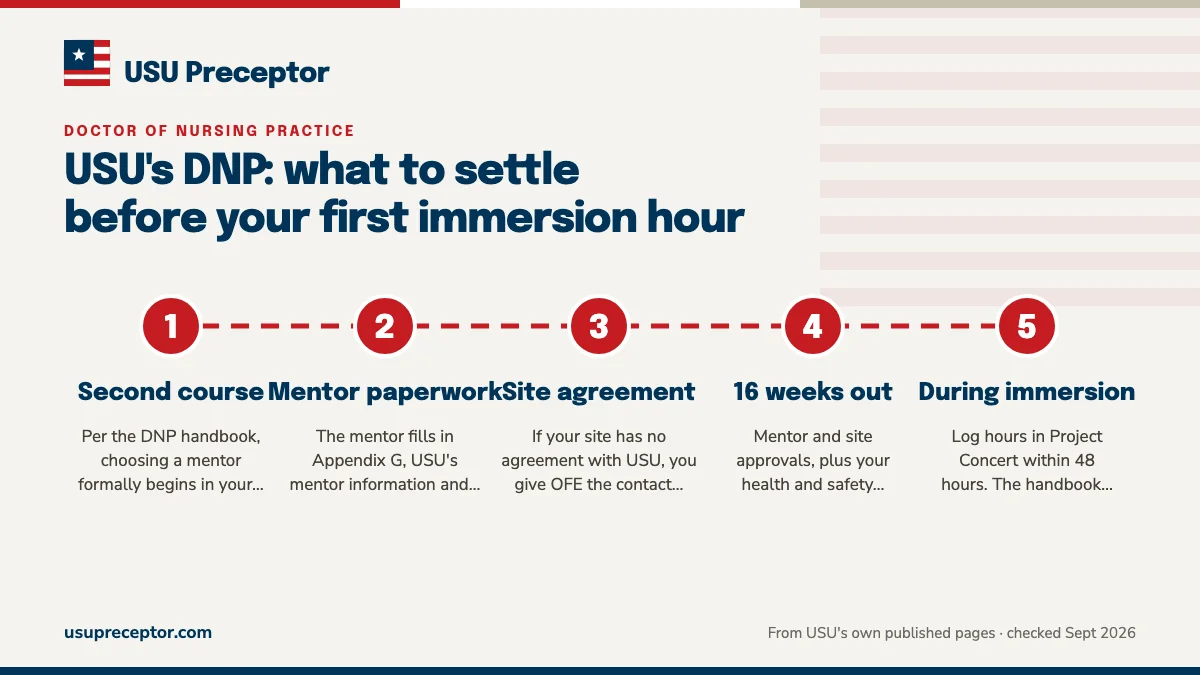
- Second coursePer the DNP handbook, choosing a mentor formally begins in your program's second course, long before
DNP707. - Mentor paperworkThe mentor fills in Appendix G, USU's mentor information and acknowledgement form, and the Program Director decides. Allow anywhere from 2 to 16 weeks; see Program Director approval.
- Site agreementIf your site has no agreement with USU, you give OFE the contact and OFE sends the contract. New agreements can take months.
- 16 weeks outMentor and site approvals, plus your health and safety clearance, need to be final no later than 16 weeks before the immersion course begins.
- During immersionLog hours in Project Concert within 48 hours. The handbook adds that travel within your state may be required.
States where the DNP isn't offered
USU's DNP is closed to more states than its MSN or RN-to-BSN programs. USU doesn't enroll DNP students living in the District of Columbia, Idaho, Maryland, New York, Oregon, Utah or Washington, or in American Samoa and the Northern Mariana Islands.
The reasons vary. Maryland and DC require board of nursing approval that USU hasn't obtained. USU's Board of Nursing list opens Idaho and Oregon to most of its nursing programs but not the DNP or the RN-to-MSN, opens New York to all but the DNP and the FNP programs, and marks Utah as ineligible for the DNP per the state board. In Washington, USU's Board of Nursing list says only the MSN FNP enrolls.
Some of those states stay open for other USU programs. A New York nurse, for example, can take the RN-to-BSN or a non-FNP MSN, and Idaho and Utah residents can take the MSN FNP. If a move is possible during your DNP, remember the catalog rule: relocating to a state where your program isn't offered leaves you unable to finish it. See clinicals outside your state.
Why DNP students choose us
If your own organization has a doctorally prepared leader outside your reporting line who can host your project, start there. USU permits it, and that person may already be named in your letter of intent.
We come in when that route is closed: nobody at work holds a doctorate, the only candidate is your manager, or your project needs a setting your employer doesn't have. The placement desk looks for a doctorally prepared mentor or a healthcare organization near you, and checks the candidate's degree and relationship to you against USU's mentor rules before the mentor form is filled in. Your DNP Project remains your own scholarly work from start to finish.
USU's Program Director approves every mentor, and OFE handles every agreement; our checks mean each candidate reaches them ready for review. If you'd like a search, share your project area and first immersion course in the form below.
Questions USU students ask
Can I enter USU's DNP with a BSN?
No. USU's DNP is a post-master's program. Admission asks for an MSN or higher from a CCNE-, ACEN-, NLNAC- or CNEA-accredited school with a GPA of at least 3.0, plus a valid, unrestricted and unencumbered RN and/or APRN license, a letter of intent and at least one reference.
Do I have to be a nurse practitioner to do USU's DNP?
No. The license requirement reads RN and/or APRN, so nurses with an MSN in a non-APRN role can apply. The difference shows up in your hours: APRN graduates of qualifying programs are recognized with 500 prior practice hours, while non-APRNs begin with 100 credited and can seek up to 500 by documenting practice hours from their master's program.
What goes in the DNP letter of intent at USU?
USU's DNP admission asks for a letter of intent naming a possible clinical site or mentor and a project area. So you sketch your site, mentor and project before you're admitted, even though formal mentor selection waits until your second course and the Program Director approves the final choice. A clear sketch makes that later search faster.
How long does USU's DNP take?
The catalog lists 38 semester credits over 6 semesters, or 24 months, and USU's time-to-completion policy sets a 48-month limit. Two synchronous virtual residencies sit in DNP701 and DNP706, and USU doesn't publish their length. Immersion hours don't roll over between courses, so an unfinished immersion course can push your timeline back.
Can I take USU's DNP if I live in New York?
No. USU's Board of Nursing disclosure lists New York as open to its nursing programs except the DNP, the MSN FNP and the closed Post-Master's FNP. New York residents can still take the RN-to-BSN or a non-FNP MSN such as Nurse Educator or Health Care Leadership.
Related pages
Last checked 2026-09-23
We check these pages against USU's own catalog, handbooks and disclosures. USU's current handbook and your Clinical Placement Coordinator have the final word.
- USU General Catalog 2026-2027: Doctor of Nursing Practice
- USU DNP Practice Immersion Handbook: hours requirements
- USU DNP Practice Immersion Handbook: selection criteria for Project Mentor
- USU program-specific admission requirements
- USU State/Territory Boards of Nursing Program Approvals (updated 5.19.2026)
Six months out is USU's rule. We start now.
Tell us your USU program, your state and when your next practicum opens. We look for preceptors who meet USU's rules and help you build the packet the Office of Field Experience and Program Director review.
- Preceptors matched to the course: family practice, pediatrics, women's health, urgent care within USU's caps
- Appendix H, license, CV and board certification gathered the way OFE asks
- In person near you; telehealth only inside USU's 40-hour limit
Start your placement plan
A placement advisor replies with what a USU-ready preceptor and site look like for you.