USU's RN-to-BSN community practicum: NUR378 and NUR499
USU's RN-to-BSN has 90 practice hours: 45 in NUR378 Global and Community-Based Nursing and 45 in NUR499 Capstone in Evidence-based Professional Nursing Practice. You complete both near home at a community agency that serves vulnerable populations and is open to the public, working with an agency leader you find yourself.
Stuck finding a community agency?
Tell us when NUR378 starts and where you live. A placement advisor replies with what a search would involve.
The two practicum courses
Both courses are 3 credits and 8 weeks long, and each carries 45 hours. The 90-hour total applies to students who enrolled on 8/30/22 or later, and USU's Board of Nursing disclosure describes it as community-based nursing practice.
| Course | Catalog title | Credits | Hours | Prerequisite |
|---|---|---|---|---|
NUR378 | Global and Community-Based Nursing | 3 | 45 | NUR370 to NUR377 |
NUR499 | Capstone in Evidence-based Professional Nursing Practice | 3 | 45 | NUR378 |
| Total | Two practicum courses | 6 | 90 |
The catalog describes the NUR378 hours as community nursing practice with an agency or organization leader near where you live. NUR499 adds a poster or podium presentation on top of its 45 practice hours. USU's website frames the whole requirement as a community experience you can complete near your own home, with a focus on community health.
What counts as a practicum agency
The practicum handbook asks for an agency that serves community-dwelling residents from vulnerable populations. It must be open to the public and readily accessible for students. The handbook's own examples:
- Red Cross
- Salvation Army
- Soup kitchens
- Homeless shelters
- Senior centers
- Church outreach programs
- Boys and Girls Clubs
- Meals-on-Wheels
These are community settings, not hospital units. A setting that is closed to the public doesn't meet the handbook's test, however worthwhile its work. The handbook's MSN and BSN site criteria also say practicum hours can't be part of your current employment position or work-related role, so your usual shifts don't count. The catalog's college-wide policy expects travel anywhere in your state at your own expense, while the NUR378 description asks for an agency near your locale; if the two pull in different directions, ask your CPC.
The agency has to be open to the public. A program limited to members or referrals may not pass, so ask your CPC before you list one.
The agency leader you find
USU's handbook puts this step on you: RN-to-BSN students find the agency leader themselves. The leader isn't a nurse practitioner or physician preceptor. The handbook describes a volunteer agency or organization leader who has:
- Expertise and experience in leadership
- Knowledge of vulnerable populations
- Preferably, an earned college degree
The leader submits a resume to OFE. The same leader works with you in both NUR378 and NUR499, so ask whether they can commit to two 8-week courses before you name them. The practicum handbook's preceptor rules also exclude a spouse, partner, first-degree relative or direct supervisor.
Agencies you already know, such as one where you volunteer, are a sensible place to start. Whoever you approach, explain the commitment up front: both courses, meetings at weeks 1, 4 and 8, and a resume for OFE.
How each 8-week course runs
45 hours over eight weeks averages a little under 6 hours a week, so one regular session a week at the agency can cover it. Agree on the pattern with the leader before the course opens, and plan for the same arrangement to carry into NUR499.
The handbook sets meetings with your agency leader at weeks 1, 4 and 8 of each course. Hours must begin within the first week; the catalog warns that missing this can lead to withdrawal, reapplication and a retake.
If hours are incomplete when a course ends, the catalog says they are lost and repeated the following term. USU tracks clinical hours and evaluations in Project Concert, and your D2L course shows how and when to log for NUR378 and NUR499.
What OFE needs, and when
The practicum handbook sets the RN-to-BSN paperwork deadline at 16 weeks before NUR378. The catalog's college-wide policy asks for at least three qualified preceptors, with valid contact information, six months before each clinical course. In a program with a standard length of one year, six months before NUR378 can arrive soon after you start, so check your degree plan early.
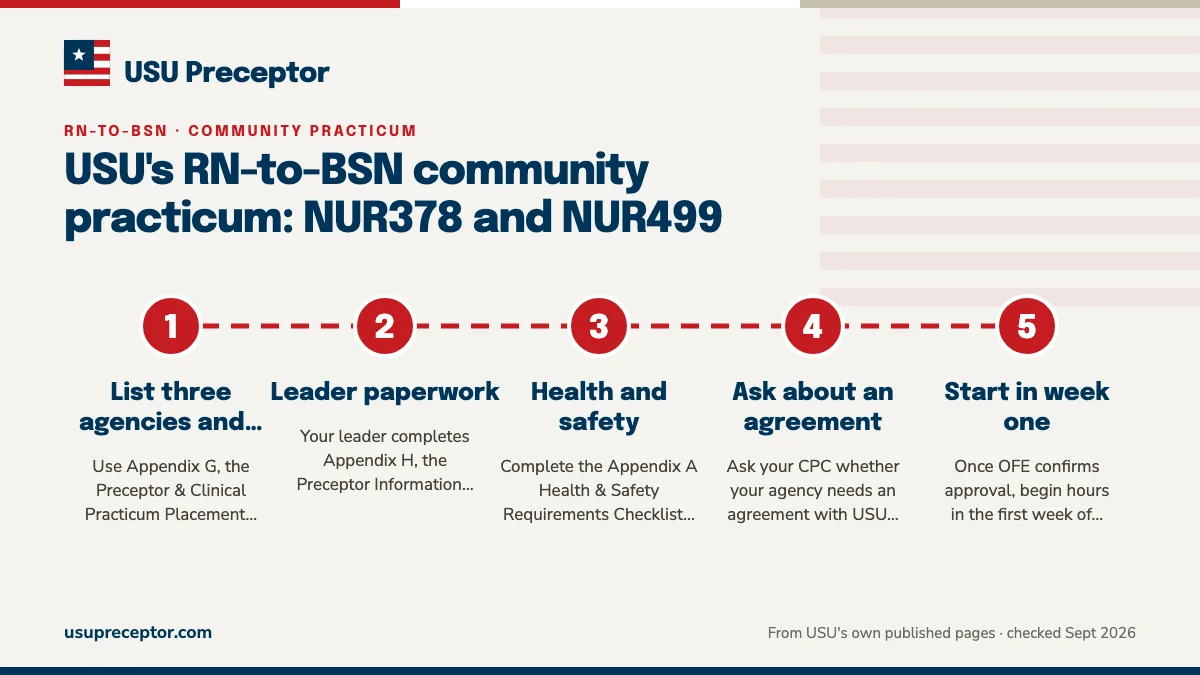
- List three agencies and leadersUse Appendix G, the Preceptor & Clinical Practicum Placement Interest Form, and talk it through with your Clinical Placement Coordinator (CPC). The Interest Form guide shows what OFE does with it.
- Leader paperworkYour leader completes Appendix H, the Preceptor Information and Acknowledgement Form, and sends a resume to OFE.
- Health and safetyComplete the Appendix A Health & Safety Requirements Checklist in Complio. You pay the Complio fees, and every item has to stay current through both courses.
- Ask about an agreementAsk your CPC whether your agency needs an agreement with USU. Where one is needed, OFE sends it to the site; you don't negotiate it.
- Start in week oneOnce OFE confirms approval, begin hours in the first week of NUR378.
Timing inside a one-year program
USU lists the RN-to-BSN at about 12 months across 3 semesters, with an 18-month limit on time to completion. You bring a 60-credit block transfer for your RN, complete at least 30 credits at USU and take a 33-credit core of eleven 3-credit courses, for 120 credits in all.
NUR378 comes after NUR370 through NUR377, which cover transitions, caring science, evidence-based practice, policy and finance, system change, interprofessional communication, technology and informatics, and cultural diversity and ethics. NUR499 follows NUR378. Tennessee residents also need NUR300 Physical Examination and Health Assessment or a transferred equivalent.
USU's 8-week sessions overlap, and the calendar doesn't say which starts admit RN-to-BSN students. Find your NUR378 date with your advisor, then count back from it on the course calendar.
Why students bring us their RN-BSN practicum
This practicum calls for a community agency and a leader willing to work with you across two courses, not a nurse practitioner or physician preceptor, and many students start with contacts in their own area.
When those contacts come up short, or the six-month or 16-week date is close, we run a focused search: a short list of agencies near you that fit the handbook's description, a check that each is open to the public and serves a vulnerable population, and a direct request to the leader to commit to both courses. We also help organize the leader's resume and USU forms. USU and OFE give the final approval on the agency and the leader, and what reaches them from you is complete. To get started, send us your dates.
Questions USU students ask
Can I do my RN-to-BSN practicum at the hospital where I work?
Not as part of your job. USU's site criteria for MSN and BSN practicums say hours can't come from your current employment position or work-related role, and the RN-to-BSN hours belong at a community agency that serves vulnerable populations and is open to the public. If your employer runs a public community program, describe it to your CPC before you list it.
Does the agency leader need to be a nurse?
USU's handbook doesn't say so. It asks for leadership expertise and experience, knowledge of vulnerable populations and, preferably, an earned college degree. The leader sends a resume to OFE and USU decides whether they qualify, so pick someone whose resume shows those three things plainly. Confirm with your CPC if you're unsure about a particular person.
Can I use different agencies for NUR378 and NUR499?
Plan on one. USU's handbook describes both courses running with the same agency or organization leader, so you need someone who can commit to 90 hours across two 8-week courses. If that leader can't continue, tell your CPC straight away, because any change is USU's decision and unfinished hours don't carry over.
Which states can take USU's RN-to-BSN?
USU doesn't enroll nursing students who live in DC or Maryland, where Board of Nursing approval wasn't obtained, and both of USU's disclosures rule out Washington for the RN-to-BSN. American Samoa and the Northern Mariana Islands aren't authorized. New York residents can take it. Check out-of-state clinicals before you move or plan hours elsewhere.
Do I need an RN license before the practicum starts?
USU admits RN-to-BSN students who hold a valid, unrestricted, unencumbered RN license, or who have an NCLEX-RN date scheduled before the end of their first term. Your clinical documents in Complio must stay current throughout your practicum courses, so ask your CPC which license records OFE wants on file before NUR378.
Related pages
Last checked 2026-09-23
We check these pages against USU's own catalog, handbooks and disclosures. USU's current handbook and your Clinical Placement Coordinator have the final word.
Six months out is USU's rule. We start now.
Tell us your USU program, your state and when your next practicum opens. We look for preceptors who meet USU's rules and help you build the packet the Office of Field Experience and Program Director review.
- Preceptors matched to the course: family practice, pediatrics, women's health, urgent care within USU's caps
- Appendix H, license, CV and board certification gathered the way OFE asks
- In person near you; telehealth only inside USU's 40-hour limit
Start your placement plan
A placement advisor replies with what a USU-ready preceptor and site look like for you.