USU's FNP: preceptors and sites for all 540 clinical hours
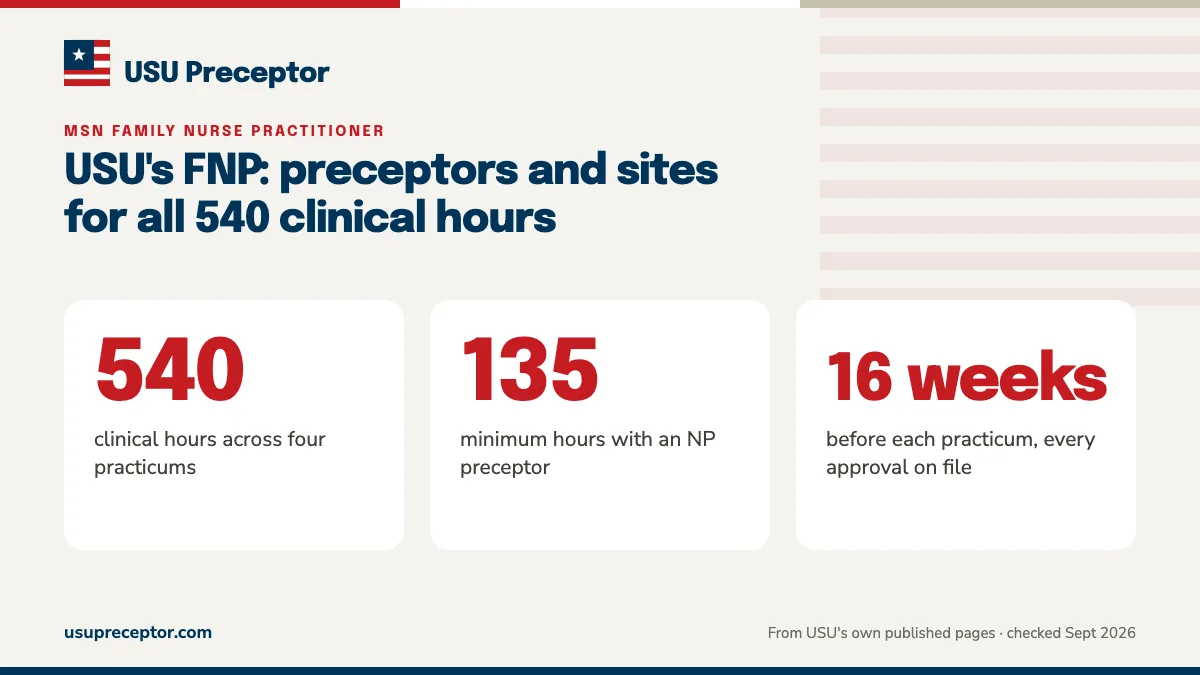
USU's online MSN FNP puts all 540 clinical hours in the second year: four 8-week practicums of 135 hours each, precepted by board-certified nurse practitioners or physicians you are responsible for finding. Leads for each course are due 6 months ahead and approvals 16 weeks ahead, so the search really begins in your first year.
Plan your four FNP practicums
Tell us your start term and where you live. A placement advisor replies with what USU-ready FNP preceptors and sites look like near you.
How USU's online FNP is laid out
The catalog lists the MSN FNP at 48 semester credits, 540 clinical hours, 6 semesters and 24 months. Students accepted on or after 05/06/2024 take it online; earlier admits are on an online hybrid version. Every course runs in an 8-week session, and USU's time-to-completion policy allows up to 60 months.
The first four semesters are coursework with no clinical hours: the MSN core (MSN560, MSN561, MSN563, MSN565), then FNP590, MSN570, MSN571 and MSN572. The catalog says clinical hours start in the second year; on the degree plan they begin in semester 5, where each practicum runs beside a didactic course. On length, USU's sources agree for once: 24 months in the catalog, 24 in the time-to-completion table, and twelve 8-week terms on the degree plan, although that plan dates from 2020.
MSN572 Advanced Health and Physical Assessment carries the required immersion, virtual if you were admitted on or after 05/06/2024 and in person in Phoenix for earlier admits. It earns no clinical hours, and it is the prerequisite for your first practicum; see the MSN572 immersion page.
Plan your job around year two now. The catalog warns that “most clinical hours are completed Monday through Friday from 8:00 am – 5:00 pm.”
The four practicums and what each one needs
Each practicum is a 3-credit, credit/no-credit course with exactly 135 precepted hours, and hours never carry over from one course to the next. That works out to about 17 hours a week for 8 weeks, never more than 12 hours in one day.
| Practicum | Taken with | Settings USU accepts | Watch for |
|---|---|---|---|
FNP592 Common Illnesses | FNP591 | Family practice, primary care or primary care internal medicine | No urgent care and no specialty practice |
FNP594 Acute Clients/Families | FNP593 | Primary care that sees acute visits, or urgent care with a primary care focus | Urgent care is capped at 135 hours for the whole program |
FNP596 Chronic Clients/Families | FNP595 | Pediatric, women's health and geriatric rotations, plus optional specialties | May need two or three preceptors; hospice or SNF 40 hours at most |
FNP597 Clinical Residency | MSN600 capstone | Primary care across the lifespan | Your last chance to meet program-wide minimums |
Two rules cut across all four courses. Inpatient hours never count, and telehealth is limited to 40 hours for the entire program. By graduation you also need 135 family practice hours and minimum journal entries in geriatrics, pediatrics and women's health, so plan the four placements as one set rather than one at a time.
Who can precept you, and the 135-hour NP floor
USU's FNP Clinical Handbook accepts two kinds of preceptor: a board-certified nurse practitioner, or a licensed MD or DO. Either must be employed by the site where you train, have at least a year of experience and hold a license in your clinical state. A certified nurse-midwife may precept women's health hours only, and physician assistants are not on the list.
The rule that shapes planning is the NP minimum: at least 135 of your 540 hours with a nurse practitioner, which is one whole course. USU also “highly recommends” spending most hours with FNP preceptors. A plan built mostly around physicians can still work, as long as the NP hours are placed on purpose rather than left to the last course.
Limits that catch students out
- No more than two students per preceptor at once, counting NP students from other schools, and only one in New Jersey.
- USU recommends no more than three preceptors in a single 8-week course.
- Family (a spouse, domestic partner or first-degree relative) and your direct supervisor are ruled out.
- Your employer can host you if you disclose it in writing, keep clinical hours separate from your job and take no pay for them.
The full rules, and how the Program Director reviews each preceptor, are on who can precept USU FNP students.
States where USU won't enroll you in the FNP
USU doesn't enroll FNP students who live in the places below, according to its Board of Nursing disclosure (updated 5.19.2026) and its state authorization list (09/11/2026). If you move to one of them during the program, you can't finish it.
| Where you live | USU's reason |
|---|---|
| Kansas | The FNP doesn't meet Kansas's APRN clinical-hour rule: 500 role-specialty hours if admitted on or before 3/1/2025, 750 if admitted after |
| New Hampshire | Board approval for out-of-state APRN programs has not been obtained |
| New York | USU doesn't offer New York's required coursework on prescription and record-keeping law |
| Maryland and the District of Columbia | Board of nursing approval is required and has not been obtained, so no USU nursing program is open |
| American Samoa and the Northern Mariana Islands | Not authorized for distance education |
Three other states come with conditions. Washington residents can take the FNP, which USU's Board of Nursing list names as its only nursing program open there. Texas's separate in-state FNP track is closed, but the general FNP is open. California's in-state track is closed too, while the Board of Registered Nursing approves USU's California placements under 16 CCR 1486, which requires California licenses for you and your preceptor. USU also wants your hours in your home state; see clinicals outside your state.
Your deadline map: 6 months and 16 weeks, four times
USU sets two deadlines for every practicum. Six months out, the catalog expects three or more qualified preceptors named; 16 weeks out, the FNP handbook expects every approval, for preceptor, site and health and safety, to be on file. Laid over USU's 2020 degree plan, with sessions running back to back, they land roughly here:
| Practicum | Three leads due (6 months) around | Approvals on file (16 weeks) around |
|---|---|---|
FNP592 | The end of FNP590 | The start of MSN571 |
FNP594 | The end of MSN570 | The start of MSN572 |
FNP596 | The end of MSN571 | The start of FNP592 |
FNP597 | The end of MSN572 | The start of FNP594 |
Read down the columns and the pattern is plain. Leads for all four practicums are due before your first clinical day, and the last two need full approval while you're in the first two. Program Director review takes 4 to 16 weeks on average, and a new Affiliation Agreement at least 4 to 6 months, so a site with no agreement has to be named early.
For new students the handbook sets an even earlier bar: by enrollment, either confirmed preceptors and sites or three or more possible ones for each setting, listed on the Interest Form. Sessions overlap and your dates may differ, so check them against USU's clinical deadlines with your Clinical Placement Coordinator (CPC).
Where USU FNP students look for sites
Nearly every FNP hour happens in outpatient care. The search centers on family practices, internal medicine offices, community health centers, health departments and retail clinics, adding pediatric, OB/GYN and geriatric primary care for FNP596 and urgent care only from FNP594. Hospitals matter only through their outpatient clinics, because inpatient time never counts.
Start with sites USU already has a contract with. OFE says it holds thousands of affiliation agreements and lists over 7,000 potential preceptors (its own figures, as of April 2024), but the database isn't published. Your CPC can tell you whether a practice you're considering already has an agreement, which can save months.
California shows the range of site types. Federally qualified health center networks such as AltaMed in Los Angeles or Clinica Sierra Vista in the Central Valley run many primary care clinics, and HRSA counted 170 reporting health center awardees in the state for 2025. Large systems can be harder to enter: UC San Diego Health says students may not submit affiliation agreement requests, and Kaiser Permanente Southern California requires a current school affiliation agreement. These are examples of site types, not USU partners.
Wherever you live, expect to drive. USU says travel time within your state isn't a reason to turn down a placement.
Why FNP students choose us
USU's catalog is direct: “Students are responsible for identifying clinical placements and preceptors.” OFE partners with you and may offer a placement if your own leads fail, but it doesn't promise one. Hiring help is a third route alongside those two.
The placement desk searches for an in-person preceptor and site near you that match the course you're entering, checked against Appendix I and USU's NP, ratio and license rules before anything reaches OFE. We help you put together the Appendix H packet, license verification, CV, board certification and the site contact OFE needs for an agreement, and we stay on call if a preceptor drops.
Every search is in person, because USU doesn't accept teleprecepting, and USU gives the final approval on each preceptor and date. Because the four deadlines overlap, it usually makes sense to plan every practicum in one conversation. Tell us your start term and where you live in the form below.
Questions USU students ask
Does USU find FNP preceptors for you?
Not as a rule. Under USU's catalog, you find your preceptors and OFE partners with you. When your own leads don't work out, OFE may put a placement in front of you, and students who met their document deadlines get priority. That offer must be accepted within 24 business hours; silence or a no means you place yourself, and a yes commits you to every hour there.
Can I keep working full time during USU's FNP clinicals?
Only if your job can bend. Each practicum needs about 17 hours a week for 8 weeks, with at least one clinical day every week, and your preceptor's schedule comes first. Hours at your own employer are possible, but they must be separate from your normal duties and unpaid, and you must disclose the arrangement to your CPC and clinical instructor in writing.
Is USU's MSN FNP accredited?
USU states that its master's degree in nursing is accredited by the Commission on Collegiate Nursing Education, and the California Board of Registered Nursing approves the FNP program. USU says graduates are eligible for national certification through AANP or ANCC. The programs USU lists as not currently CCNE-accredited are the DNP and the closed Post-Master's FNP certificate.
Can USU FNP clinical hours be done by telehealth?
Only a small share. Telehealth is capped at 40 hours for the entire FNP and needs approval. You and your preceptor sit together at the site, the visit has to be on video (telephone-only calls don't count), and every patient must be located in the state on your USU address record. Supervision from somewhere else, called teleprecepting, isn't approved.
Can I transfer into USU's FNP and skip MSN572?
No. The catalog lists MSN572 as non-transferable, so you take the immersion course at USU even if other credits transfer. MSN600, the capstone taken with FNP597, is non-transferable too. USU's handbook also tells students who bring transfer credit to arrive with a firm idea of their clinical site and preceptor.
Related pages
Last checked 2026-09-23
We check these pages against USU's own catalog, handbooks and disclosures. USU's current handbook and your Clinical Placement Coordinator have the final word.
- USU General Catalog 2026-2027: Master of Science in Nursing
- USU FNP Clinical Handbook: Clinical Hour Requirements
- USU FNP Clinical Handbook: Appendix I, FNP Site & Preceptor Guidance
- USU Field Experience Policies, College of Nursing and Health Sciences
- USU State/Territory Boards of Nursing Program Approvals (updated 5.19.2026)
Six months out is USU's rule. We start now.
Tell us your USU program, your state and when your next practicum opens. We look for preceptors who meet USU's rules and help you build the packet the Office of Field Experience and Program Director review.
- Preceptors matched to the course: family practice, pediatrics, women's health, urgent care within USU's caps
- Appendix H, license, CV and board certification gathered the way OFE asks
- In person near you; telehealth only inside USU's 40-hour limit
Start your placement plan
A placement advisor replies with what a USU-ready preceptor and site look like for you.