Who can precept a USU nursing student
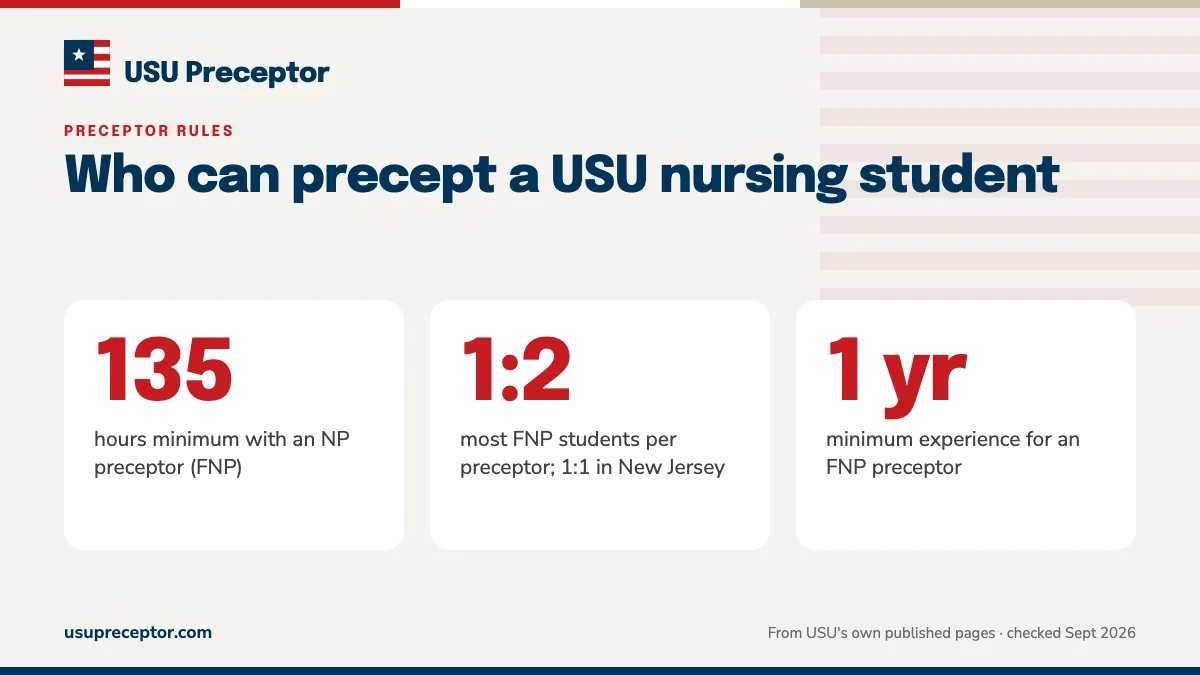
For USU's MSN FNP, your preceptor must be a board-certified nurse practitioner or a licensed MD or DO with at least a year of experience, and at least 135 of your 540 hours must be with an NP. Nurse Educator, Health Care Leadership, RN-to-BSN and DNP students each follow a different set of rules, summarized below. The Program Director makes the final call on every preceptor.
Looking for a preceptor who fits USU's rules?
Tell us your program, course and state. A placement advisor will reply with next steps.
FNP preceptors: who USU accepts
USU's FNP Clinical Handbook accepts a board-certified NP or a licensed MD or DO who supervises you while employed by the clinical facility. A certified nurse-midwife is allowed for one slice of the program only. Everyone else is either unlisted or ruled out.
| Preceptor | Accepted for FNP? | Limits |
|---|---|---|
| Board-certified nurse practitioner (NP) | Yes | National board certification appropriate for FNP education |
| Licensed MD or DO | Yes | Employed by the clinical facility where you train |
| Board-certified nurse-midwife (CNM) | Women's health only | May precept women's health hours, nothing else |
| Physician assistant (PA) | Not listed | USU neither names PAs nor bans them outright |
| Chiropractor, acupuncturist, naturopath | No | Appendix I lists them as not acceptable |
USU also "highly recommends" that most of your hours be with FNP preceptors, and it recommends no more than three preceptors in one 8-week course. Each extra preceptor means another Appendix H form, another approval and another set of evaluations to manage.
Experience, license and employer permission
Beyond the preceptor's title, USU checks the person's record. For FNP preceptors the handbook and Appendix H ask for:
- At least one year of work experience at or above the level of licensure of your program. USU's 2024 onboarding document calls this one year of postgraduate experience.
- Current national board certification for NPs, shown on Exhibit A of Appendix H.
- Active clinical practice.
- An active, unencumbered license in the state where your clinical takes place.
- Permission from their employer to precept, which the preceptor confirms on Appendix H.
- Three years of employment history on file. A preceptor who has been with their current employer for under three years completes Exhibit B.
States can add to these rules. USU's handbook says state requirements on preceptor eligibility and ratios take precedence over university policy. California is the clearest case: under 16 CCR 1486, a preceptor there needs a California license, and so do you. See clinicals outside your home state.
The 135-hour NP minimum
The handbook expects you to spend at least "135 hours with a Nurse Practitioner preceptor" across the program. That equals one full practicum, since each of FNP592, FNP594, FNP596 and FNP597 carries 135 hours. The rest can be with MD or DO preceptors, or with a CNM for women's health.
Plan the NP hours early rather than hoping they fall into place. If your first two rotations land with physicians, the later courses have to carry the NP requirement, and the pediatric, women's health and geriatric rotations in FNP596 already narrow who can precept you. An NP in family practice for FNP592 meets the rule at the start and matches USU's stated preference for FNP preceptors.
Two students per preceptor, one in New Jersey
USU's current handbook says the ratio "may not exceed 1:2, with the exception of NJ placements," which must be 1:1. NP students from other schools count toward that limit. A preceptor already teaching one student from another program can take only one USU student, and in New Jersey none at all.
Hours logged while the ratio is exceeded do not count, so ask your preceptor how many students they expect during your 8-week course, not just this month. An older 2021 handbook is quoted in search results as requiring 1:1 everywhere; the November 2025 handbook is the one that applies now. Clinics that host students from several schools are where you most need to ask.
Relatives, partners and your manager
Your FNP preceptor may not be your spouse, domestic partner, first-degree relative or direct supervisor. USU's handbook is not consistent on this. The preceptor criteria state it as a flat ban, while the Clinical Hour Requirements page says the relative or spouse restriction can be waived with written Program Director permission. The 2024 onboarding document also rules out a friend or any other conflict of interest.
If a relative is your only lead, raise it with your Clinical Placement Coordinator by USU email before anyone fills in paperwork, and don't count on the waiver. Training at your own workplace is a separate question with its own conditions: disclosure, separate hours and no pay. See clinicals at your employer.
Matching the preceptor to the course
Appendix I, the FNP Site & Preceptor Guidance (a few handbook pages call it Appendix J), says which preceptors suit each rotation. Inpatient hospital settings never count, in any course.
| Course or rotation | Setting | Preceptors Appendix I lists |
|---|---|---|
FNP592 | Family practice, internal medicine or primary care with no specialty; no urgent care | Primary care, family practice or internal medicine MD, DO or FNP; AGNP also allowed |
FNP594 | The same primary care settings plus urgent care with a primary care focus | Family and primary care preceptors as above |
FNP596 pediatrics | Newborn to 18, well and sick visits | Pediatrician MD or DO, or an FNP or PNP in a pediatrician's office |
FNP596 women's health | OB/GYN or a practice with at least 50% women's care | OB/GYN MD or DO, FNP, WHNP or CNM |
FNP596 geriatrics | Patients 65 and older; hospice or SNF capped at 40 hours | AGPCNP, ANP, FNP, GNP, MD or DO in primary care, family practice or internal medicine |
FNP597 | Primary care across the lifespan | Not listed separately; confirm with your CPC |
The FNP594 catalog description mentions emergency departments, but Appendix I's site list for that course does not, so check any ED lead with your CPC first. Urgent care can supply at most 135 hours overall. The hour-log rules cover the other caps.
Nurse Educator, Health Care Leadership, RN-to-BSN and DNP
The other programs use different titles and qualifications, and each still needs OFE paperwork and university approval.
| Program and course | Who supervises | Key rules |
|---|---|---|
Nurse Educator, MSN578 (100 h) | Nurse preceptor with an MSN or doctorate | One year as an RN in the specialty; works in a healthcare or academic setting; unencumbered RN license or multistate privilege; 1:1; hours from your own job don't count |
Health Care Leadership, MSN587 (100 h) | Nurse leader preceptor with a graduate degree (MSN, MHA or MBA; PhD, DNP, EdD or DNS preferred) | One year of leadership experience and one year as an RN; unencumbered RN license where they practice; 1:1 |
RN-to-BSN, NUR378 and NUR499 (45 h each) | An agency or organization leader you find yourself | Agency serves vulnerable community populations and is open to the public; leader sends a resume to OFE; same leader for both courses |
DNP, DNP707 to DNP712 | Project Mentor with a doctorate (DNP strongly recommended; MD, DO or PhD accepted) | Not a relative; your direct supervisor only if no other doctorally prepared mentor is available |
Nurse Educator preceptors can't be your direct supervisor or a relative either, and Tennessee students must teach in a clinical specialty with a preceptor who has that expertise and teaching experience. DNP students may use their employer and may be paid by the site, which FNP students may not. Course detail is on the DNP practice immersion page.
Why students choose our screening
The placement desk searches for preceptors who already meet these criteria for your course and state, and checks the points USU screens for: preceptor type, board certification, license state, student load and setting. We then help you gather the Appendix H packet for OFE.
The Program Director's review gives the final approval, and our screening means each candidate reaches it already meeting these criteria.
Questions USU students ask
Can a physician assistant be my FNP preceptor at USU?
Physician assistants aren't among the preceptor types in USU's FNP criteria, and USU publishes no statement allowing them. Treat a PA lead as unlikely to be approved. Ask your Clinical Placement Coordinator before the PA fills in any paperwork, so neither of you spends weeks on a packet the Program Director may turn down.
Can an adult-gerontology NP precept a USU FNP student?
In the right rotation, yes. Appendix I allows an AGNP for FNP592 in family or primary care, and it lists AGPCNPs and ANPs among suitable preceptors for geriatrics. For pediatric hours it points to pediatricians, or to FNPs and PNPs in a pediatrician's office, so an adult-focused NP won't fit there. The Program Director still decides each case.
Does my preceptor need a license in the state where I live?
Your preceptor needs an active, unencumbered license in the state where the clinical takes place, and USU encourages that to be your state of residence. You also need an RN license in any state where you do clinicals. If you cross a border to train, both of you need licenses that are valid in the clinical state.
Do Nurse Educator preceptors need teaching experience?
USU's practicum handbook asks for an MSN or doctorate, a year as an RN in the specialty and employment in a healthcare or academic setting. It doesn't list teaching experience as a general requirement, though the course calls for a specialty nurse educator preceptor. Tennessee students do need a preceptor with teaching experience. Academic settings such as ADN and prelicensure BSN programs are recommended.
Does USU pay preceptors?
No. USU's Preceptor Resources Hub offers preceptors a 10% tuition discount on some USU programs, continuing education, library access and an Honorary Clinical Faculty title for 135 service hours a year, which it describes as unpaid. Some preceptors and sites charge students their own fees; USU says it does not set or regulate them.
Related pages
Last checked 2026-09-23
We check these pages against USU's own catalog, handbooks and disclosures. USU's current handbook and your Clinical Placement Coordinator have the final word.
- USU FNP Clinical Handbook: Selection Criteria for FNP Clinical Preceptors
- USU FNP Clinical Handbook: Appendix I, FNP Site & Preceptor Guidance
- USU FNP Clinical Handbook: Clinical Hour Requirements
- USU RN-BSN, MSN NE and HCL Practicum Handbook: Preceptor Selection Criteria
- USU DNP Practice Immersion Handbook: Selection Criteria for Project Mentor
Six months out is USU's rule. We start now.
Tell us your USU program, your state and when your next practicum opens. We look for preceptors who meet USU's rules and help you build the packet the Office of Field Experience and Program Director review.
- Preceptors matched to the course: family practice, pediatrics, women's health, urgent care within USU's caps
- Appendix H, license, CV and board certification gathered the way OFE asks
- In person near you; telehealth only inside USU's 40-hour limit
Start your placement plan
A placement advisor replies with what a USU-ready preceptor and site look like for you.