Virtual clinical options at USU, and their limits
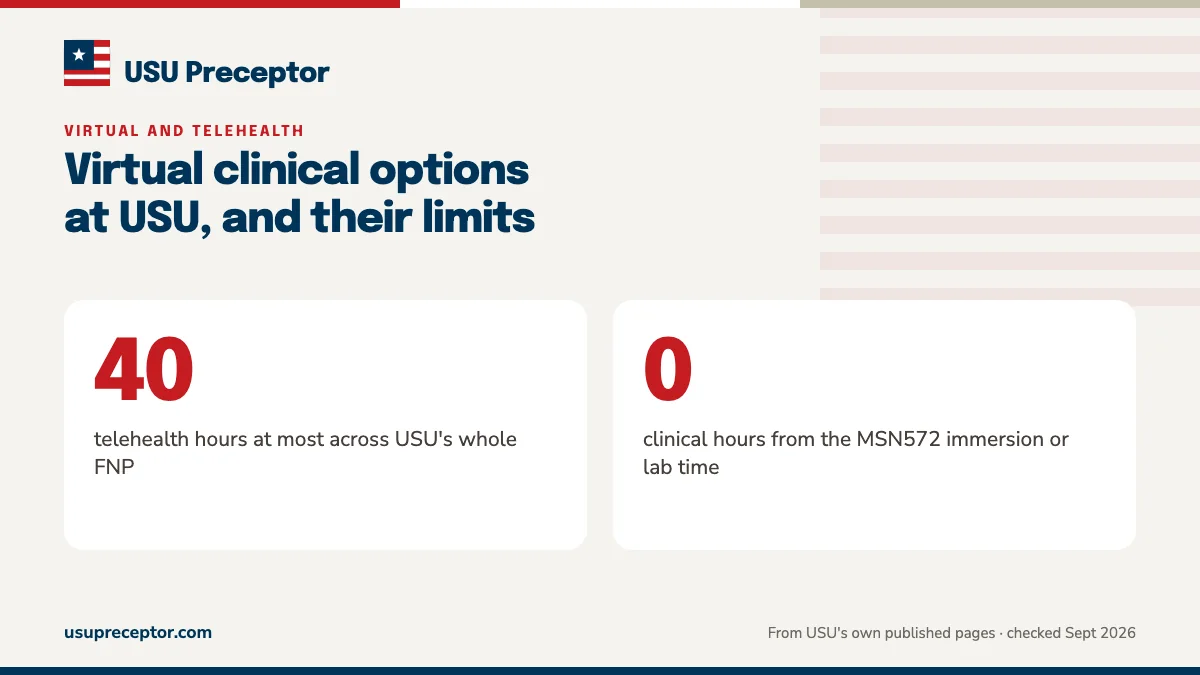
USU's clinical hours are in person. FNP students can count up to 40 telehealth hours across the whole program, only with approval, with the preceptor in the room and patients in their state on file. Immersion and lab hours never count, and remote teleprecepting isn't approved.
Get your placement plan
Tell us your USU track and where you live. A placement advisor replies with what a USU-ready preceptor and site look like for you.
What “virtual” can mean at USU
At USU the word covers four different things, and only one of them produces clinical hours. Mixing them up is how students end up planning around hours that will never count.
| What | Who it applies to | Counts toward clinical hours? |
|---|---|---|
| Telehealth visits at an approved site | FNP students | Yes, up to 40 hours in the whole program, with approval |
Virtual immersion in MSN572 | FNP students admitted on or after 05/06/2024 | No |
Synchronous virtual residencies in DNP701 and DNP706 | DNP students | No: they're course requirements, separate from practice immersion hours |
| Faculty site visits | FNP students in clinical courses | No: the visit evaluates your site and preceptor, and may be virtual |
The rest of this page takes each one in turn, starting with the only kind that counts, then covers USU's other programs.
USU's telehealth rule for FNP students
Telehealth can count, inside a tight box. Appendix I of the FNP Clinical Handbook, the FNP Site & Preceptor Guidance, sets the conditions, and every one has to hold for the hours to count:
- No more than 40 telehealth hours across the whole program, and only if approved
- Your preceptor is physically with you during the visit
- The visit uses video; telephone-only visits don't count
- Patients are located in the state of your address on file with USU
- You hold a nursing license in that state
The handbook also asks you to declare telehealth on a Preceptor Nomination Form, which doesn't appear in the FNP appendix list. Ask your Clinical Placement Coordinator (CPC) in writing which document that means before you log any telehealth hours. How telehealth sits beside USU's other caps is on what counts as a clinical hour, and the state rule is explained under out-of-state clinicals.
Teleprecepting and telehealth-only sites don't qualify
USU does not approve teleprecepting, where you and your preceptor are in different places. That rules out the usual meaning of a “virtual preceptor”: a clinician who logs in from another city while you see patients, or who reviews your notes remotely. Hours arranged that way won't count, whatever the preceptor's credentials. If anyone offers you that arrangement, treat it as a warning sign rather than a shortcut.
Appendix I also lists telehealth-only sites among the settings that aren't appropriate for FNP students. A practice that sees every patient by video can't be your clinical site, even for the 40 hours. In practice, the telehealth hours that do count come from an in-person practice that also runs video visits, with you and your preceptor side by side.
A preceptor on the other end of a video call is teleprecepting, and USU doesn't count those hours.
Immersion, lab and simulation hours
If you were admitted on or after 05/06/2024, the FNP immersion inside MSN572 Advanced Health and Physical Assessment Across the Lifespan is virtual; students admitted earlier went to Phoenix. Neither version adds clinical hours. USU's FNP handbook excludes immersion and lab hours from the count, so your 540 still start at zero in FNP592. USU presents the virtual immersion's details inside your MSN572 course in D2L.
We found no USU allowance for counting simulation toward FNP clinical hours either. DNP students have two synchronous virtual residencies, in DNP701 and DNP706, that USU requires for the degree, but USU describes practice immersion hours as taking place in a real-world clinical setting with a Project Mentor. The MSN572 guide covers the FNP immersion itself.
Nurse Educator, Leadership and RN-to-BSN practicums
USU's practicum handbook for these programs sets preceptor qualifications, ratios and hour totals, and we found no telehealth or remote-hours allowance in it. MSN578 and MSN587 are 100-hour residencies with one student per preceptor, and the RN-to-BSN practicum is 90 hours with a leader at a community agency that serves vulnerable populations and is open to the public.
Don't assume remote hours are fine because the work sounds office-based. Some teaching and leadership work happens online, but whether that time counts toward your residency is USU's decision, not the preceptor's. Ask your CPC or course faculty in writing before you plan around it, and keep the reply. Nurse Educator students should also remember that hours which are part of their own job don't count.
What virtual can't replace
At most 40 of the FNP's 540 hours can be telehealth, under 8% of the program. The other 500 or more happen in person at an approved site, with your preceptor there, across the settings each course requires: family practice and primary care, then pediatrics, women's health and geriatrics.
A 2024 USU preceptor onboarding document says NP clinical courses require hands-on, direct patient care on site, with students seeing at least one to two patients an hour. Physical exams and procedures need a patient in the room. A search that starts from “virtual only” runs into USU's rules within the first course.
What does run online is the administration around your hours. Preceptors sign Appendix H through DocuSign, you book your CPC through Calendly and log hours in Project Concert, and faculty site visits may be virtual. None of that is clinical time.
How we handle virtual requests
In person near you is the main route, and every search starts there. If you want some telehealth in an FNP rotation, we look for a preceptor whose in-person practice runs video visits and who will have you in the room, with patients in your state on file. You then get USU's approval for those hours through your CPC and keep the total at or under 40. USU's rules set no telehealth minimum, so if no suitable practice is near you, in-person hours can cover the program.
Every arrangement we make is one USU counts: in-person rotations, with telehealth only inside the 40-hour cap and your preceptor in the room. Where a rule's application to your course is unclear, we'll say so and point you to your CPC. Tell us your course and state to start.
Questions USU students ask
Can I do my USU FNP clinicals online?
No. At most 40 telehealth hours in the whole program can count, and only with approval, your preceptor physically present, video, and patients in your state on file. The remaining hours of your 540 happen in person at an approved site, and USU encourages you to complete them in your state of residence.
Does the virtual MSN572 immersion count as telehealth?
No. The immersion is part of a course and adds no clinical hours at all, whether you attended in Phoenix or online. Telehealth is a separate allowance for patient visits during FNP practicums, capped at 40 hours and tied to an approved site with your preceptor present.
Can I see telehealth patients located in another state?
Not for USU clinical hours. Appendix I says telehealth patients must be in the state of your address on file with USU, and you must hold a license there. Travel nurses are asked to update their USU address to wherever they will do clinicals, and that address decides which patients count.
Can a preceptor supervise my hours over Zoom?
No. That's teleprecepting, where you and your preceptor are in different places, and USU's FNP handbook doesn't approve it. Even approved telehealth hours need your preceptor physically beside you while you see the patient by video. Hours supervised from a distance won't count, however they're logged in Project Concert.
Are any parts of USU's DNP virtual?
Yes: the synchronous residencies in DNP701 and DNP706. Practice immersion hours are different. USU places them in a real-world clinical setting with a Project Mentor, at a site such as a health system, clinic or public health agency. Ask your CPC before planning any remote immersion work.
Related pages
Last checked 2026-09-23
We check these pages against USU's own catalog, handbooks and disclosures. USU's current handbook and your Clinical Placement Coordinator have the final word.
- USU FNP Clinical Handbook: Appendix I, FNP Site & Preceptor Guidance
- USU FNP Clinical Handbook: Clinical Hour Requirements
- USU FNP Clinical Handbook: Clinical Attendance and Participation
- USU Catalog: MSN572 Advanced Health and Physical Assessment Across the Lifespan
- USU Catalog: Doctor of Nursing Practice
Six months out is USU's rule. We start now.
Tell us your USU program, your state and when your next practicum opens. We look for preceptors who meet USU's rules and help you build the packet the Office of Field Experience and Program Director review.
- Preceptors matched to the course: family practice, pediatrics, women's health, urgent care within USU's caps
- Appendix H, license, CV and board certification gathered the way OFE asks
- In person near you; telehealth only inside USU's 40-hour limit
Start your placement plan
A placement advisor replies with what a USU-ready preceptor and site look like for you.