USU's RN-to-MSN: what the records show, and what they don't
USU's Board of Nursing disclosure lists an RN-to-MSN bridge program in five specializations, none of them FNP. The 2026-2027 catalog has no RN-to-MSN program at all, and no curriculum or clinical hours for one, so before you plan a practicum, get USU to confirm the program is open to you and which practicum course it uses.
Plan around a confirmed practicum
Tell us your specialization, the practicum course USU gave you and where you live. A placement advisor replies with what a USU-ready preceptor looks like near you.
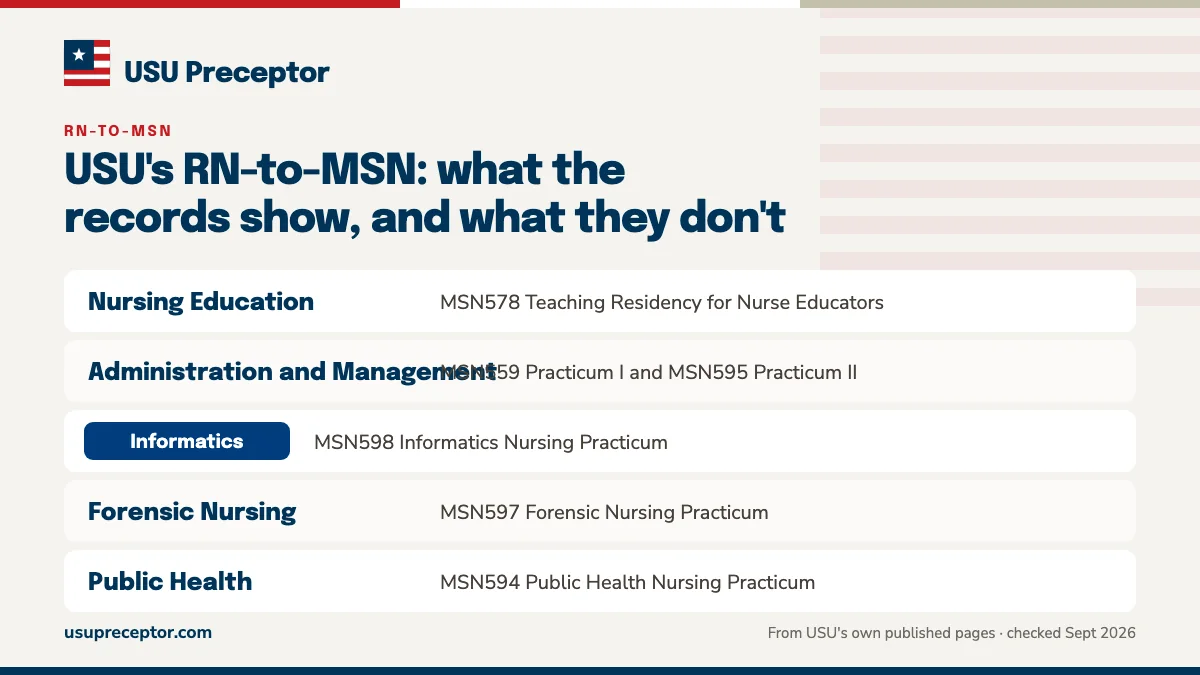
What USU's documents list
In the USU sources we reviewed, this program appears only in the state disclosures. The State/Territory Boards of Nursing Program Approvals, updated 5.19.2026, lists an “RN to Master of Science in Nursing Bridge Program (RN-MSN)” with five specializations:
- Administration and Management
- Forensic Nursing
- Informatics
- Nursing Education
- Public Health
There is no Family Nurse Practitioner specialization, and none appears in any USU source we reviewed. USU's state authorization disclosure refers to the RN-to-MSN as well, and between them the two documents are how the state exclusions below are known. The Board of Nursing disclosure gives hours for USU's other nursing programs, such as 540 for the MSN FNP and 90 for the RN-to-BSN, but we found none for the RN-to-MSN. That is the full extent of what USU publishes about it: a program name, five specialization names and a list of states.
What the catalog doesn't show
The RN-to-MSN is absent from the 2026-2027 catalog's list of programs, and it isn't on the 2024-2025 catalog's MSN page either. Neither the catalog nor USU's degrees page gives a curriculum, bridge courses, a length or clinical hours for it. Whether it is admitting, closed or in teach-out is not stated anywhere we found.
Four of the five names (Administration & Management, Informatics, Forensic Nursing and Public Health) match MSN concentrations that the current catalog marks as closed to applicants. The fifth, Nursing Education, matches the Nurse Educator concentration, which is open, but the catalog offers it only as an MSN, and USU's MSN admission asks for a BSN.
Put together, the records suggest a program that USU still reports to state boards but no longer describes to students. That is our reading, not a USU statement, and it is exactly why the answer has to come from USU admissions in writing.
No USU source we found gives RN-to-MSN course numbers or practicum hours. Don't plan dates until USU tells you which practicum course you'll take.
Practicum hours by specialization, as far as the catalog goes
The closest evidence is the practicum each specialization carries as an MSN track. These are MSN-track courses; no USU source says an RN-to-MSN student takes the same ones, or adds any bachelor's-level community hours such as the RN-to-BSN's.
| Specialization | MSN-track practicum in the catalog | Hours | MSN track status |
|---|---|---|---|
| Nursing Education | MSN578 Teaching Residency for Nurse Educators | 100 | Accepting students |
| Administration and Management | MSN559 Practicum I and MSN595 Practicum II | 140 (40 + 100) | Not accepting applicants |
| Informatics | MSN598 Informatics Nursing Practicum | 120 minimum | Not accepting applicants |
| Forensic Nursing | MSN597 Forensic Nursing Practicum | 120 minimum, 20 or more in direct care | Not accepting applicants |
| Public Health | MSN594 Public Health Nursing Practicum | 120 minimum, 20 or more in direct care | Not accepting applicants |
If you are already enrolled in one of the four closed specializations, the course detail is on the closed MSN tracks. For Nursing Education, the open MSN route is described on the MSN Nurse Educator page.
States where the RN-to-MSN isn't offered
USU's disclosures exclude more states for the RN-to-MSN than for its regular MSN. Residents of Idaho, Maryland, Oregon, Utah, Washington, the District of Columbia, American Samoa and the Northern Mariana Islands can't enroll in any RN-to-MSN specialization.
Idaho, Oregon and Utah are the distinctive part of that list. USU's Board of Nursing disclosure opens those states to its nursing programs except the RN-to-MSN (all specializations), the DNP and the closed Post-Master's FNP, so a nurse there can take USU's RN-to-BSN or a non-FNP MSN, just not the bridge. Washington is excluded because USU's Board of Nursing list says only the MSN FNP enrolls there.
Whatever USU program you're weighing, compare your state against clinicals outside your state before applying. A later move to a state your program doesn't cover would stop you from finishing.
If your goal is to become an FNP
USU has no RN-to-MSN FNP, so a nurse without a BSN can't bridge straight into its nurse practitioner track. USU's MSN admission asks for a BSN from a CCNE-, ACEN-, NLNAC- or CNEA-accredited school, a GPA of at least 2.5 and an unencumbered RN license in your state of residence.
The documented route at USU is two separate programs. The online RN-to-BSN takes about 12 months and includes 90 community practicum hours. The MSN FNP then takes 24 months, with 540 clinical hours in its second year; see USU's FNP for how those practicums work.
Watch the state lists, because they don't match. A Washington nurse could enter USU's FNP with a BSN earned elsewhere, but can't use USU's RN-to-BSN to get one. Nurses in Kansas, New Hampshire and New York have the opposite problem: the RN-to-BSN is open to them and the FNP is not.
What to ask USU, in writing
Because so little is published, the useful step is a short, specific email to USU admissions or your advisor, from your USU email address if you're enrolled. Ask:
- Is the RN-to-MSN admitting students in my specialization and my state?
- Which catalog year and which courses govern my program?
- Which practicum course numbers and hours will I complete, and in which session?
- Which clinical handbook applies to me, and do the 6-month and 16-week deadlines apply?
- Is there any bachelor's-level practicum before the MSN courses?
- What is my time-to-completion limit?
Keep the reply. If you later need to show OFE or a preceptor what your practicum involves, a written answer from USU carries more weight than anything on a third-party site, including this one.
Why RN-to-MSN students choose us
Whether USU's RN-to-MSN is open is USU's to confirm. Once USU confirms your practicum course and hours, the search looks like any MSN practicum: a preceptor who meets the course's stated qualifications, at a site near you, approved through OFE.
If USU tells you the practicum matches an MSN track's, the qualifications are the ones listed for that course: a nurse with an MSN or doctorate for MSN578, for example, or a nurse executive preceptor for MSN595. At that point the placement desk can look for candidates, check their degree, license and relationship to you against what USU requires, and help you gather the paperwork OFE asks for. USU approves every preceptor, site and agreement. Send us the course USU gave you in the form below.
Questions USU students ask
Can an ADN-prepared nurse become an FNP through USU?
Yes, but not through a bridge. USU has no RN-to-MSN FNP, and its MSN requires a BSN. The route is USU's RN-to-BSN, about 12 months with 90 community hours, followed by the MSN FNP, 24 months with 540 clinical hours. Check both programs' state lists first, because they differ.
Is USU's RN-to-MSN program accepting students?
USU's published sources don't say. The program appears in USU's Board of Nursing disclosure with five specializations, but not in the 2026-2027 catalog, and four of the five match MSN tracks the catalog lists as not accepting applicants. Ask USU admissions directly, in writing, before you plan around it.
How many practicum hours does USU's RN-to-MSN require?
USU doesn't publish a number for the RN-to-MSN itself. The matching MSN tracks carry 100 hours for Nursing Education, 140 for Administration and Management, and at least 120 each for Informatics, Forensic Nursing and Public Health. Whether RN-to-MSN students take those same practicums, or anything extra, is not shown in USU's sources.
Can I do USU's RN-to-MSN if I live in Idaho, Oregon or Utah?
No. USU's Board of Nursing disclosure excludes the RN-to-MSN in all specializations for residents of Idaho, Oregon and Utah, along with the DNP. Those states remain open to USU's RN-to-BSN and to its non-FNP MSN concentrations, and to the MSN FNP.
Is the RN-to-MSN Nursing Education specialization the same as USU's MSN Nurse Educator?
USU's sources don't say. The MSN Nurse Educator is a 30-credit concentration with one 100-hour teaching residency, MSN578, and it requires a BSN for admission. The RN-to-MSN's Nursing Education specialization is named only in a state disclosure, with no courses or hours, so ask USU how the two relate.
Related pages
Last checked 2026-09-23
We check these pages against USU's own catalog, handbooks and disclosures. USU's current handbook and your Clinical Placement Coordinator have the final word.
Six months out is USU's rule. We start now.
Tell us your USU program, your state and when your next practicum opens. We look for preceptors who meet USU's rules and help you build the packet the Office of Field Experience and Program Director review.
- Preceptors matched to the course: family practice, pediatrics, women's health, urgent care within USU's caps
- Appendix H, license, CV and board certification gathered the way OFE asks
- In person near you; telehealth only inside USU's 40-hour limit
Start your placement plan
A placement advisor replies with what a USU-ready preceptor and site look like for you.