FNP594: Primary Health of Acute Clients/Families Across the Lifespan – Clinical Practicum
FNP594 is USU's second FNP practicum: 3 credits and 135 precepted hours in 8 weeks, taken with FNP593 after you pass FNP591 and FNP592. It centers on acute presentations and is the first course where USU accepts urgent care with a primary care focus. Because it follows FNP592 so closely, its approvals fall due before your first practicum has begun.
Planning FNP594 now?
Tell us your state and both practicum start dates. A placement advisor replies with what an acute-care match that fits USU's caps looks like.
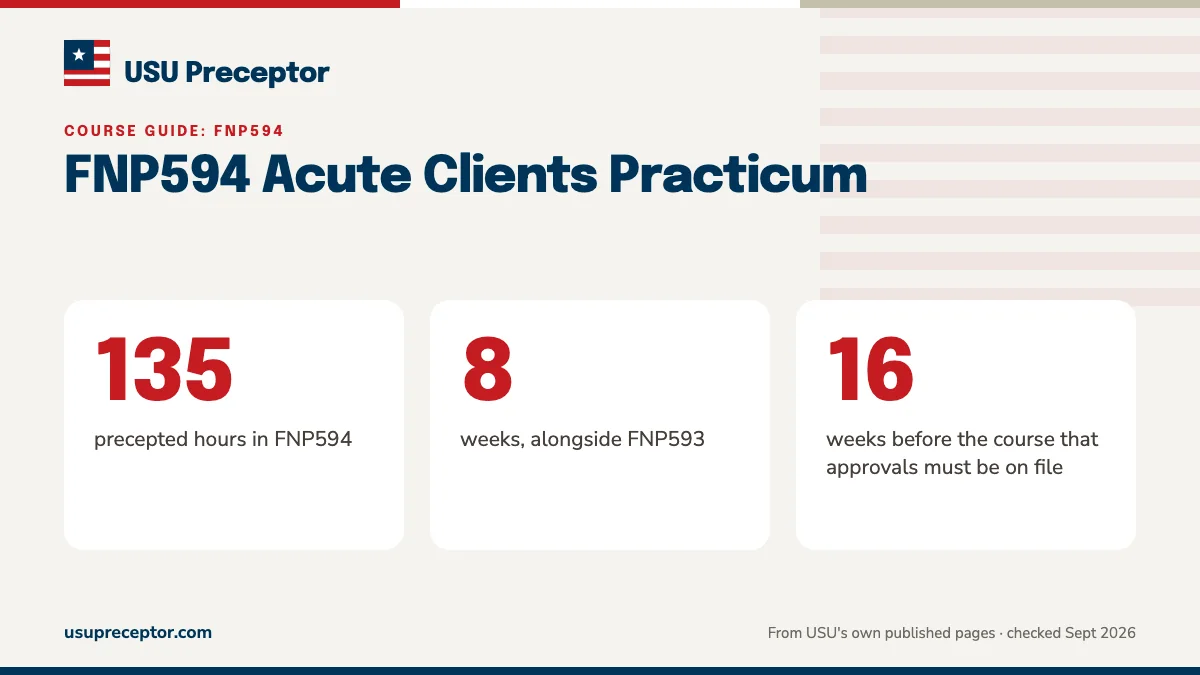
FNP594 at a glance
USU's catalog frames the course around a culturally diverse population with “acute presentation in a variety of primary care settings, urgent care or emergency department.” On the 2020 degree plan, FNP594 fills the second half of semester 5, straight after FNP592.
| Item | FNP594 |
|---|---|
| Catalog title | Primary Health of Acute Clients/Families Across the Lifespan – Clinical Practicum |
| Credits and grading | 3 credits, graded credit/no credit |
| Clinical hours | 135 precepted hours |
| Length | One 8-week session |
| Prerequisites | FNP591 and FNP592 |
| Co-requisite | FNP593 Primary Health of Acute Clients/Families Across the Lifespan |
| Setting | Primary care seeing acute visits, or urgent care with a primary care focus |
| Preceptor | Board-certified NP or licensed MD/DO; PAs are not listed |
| Before day one | OFE Approval Letter; approvals due 16 weeks before the session |
| Week one | Letter and acknowledgement form uploaded, first hours logged |
Urgent care is allowed now, but it draws on a fixed allowance
Appendix I, USU's FNP Site & Preceptor Guidance, keeps the primary care settings accepted for FNP592 and adds urgent care with a primary care focus for FNP594.
The trade-off sits in the FNP Clinical Handbook. Since March 2024, urgent care is capped at 135 hours for the whole program, which is exactly one course. Spend all of FNP594 there and you have no urgent care hours left for FNP596 or FNP597. Urgent care time also does not count toward USU's 135-hour family practice minimum.
Before you choose, compare your Project Concert totals with the Appendix M matrix. If your FNP592 hours were logged as family practice, that floor may already be met. If not, a split works: part of FNP594 in a primary care office that sees acute visits and part in urgent care, within USU's recommended maximum of three preceptors per course.
Urgent care is capped at 135 hours across the entire FNP. One full course in urgent care uses the whole allowance.
Emergency departments and other settings to check first
The catalog description mentions the emergency department, but the handbook is stricter. It calls any inpatient hospital setting “not an appropriate clinical site for FNP students at any point,” and Appendix I lists emergency departments among the sites it treats as inappropriate. No USU source clearly approves an ED for FNP594, so get written confirmation from your Clinical Placement Coordinator before you propose one.
A few other settings need the same care. Appendix I also lists university health services and telehealth-only practices as inappropriate. Telehealth within an approved in-person site is limited to 40 hours for the whole program, with your preceptor physically beside you. The full list of caps is on USU clinical hours by program, and the logging rules are on what counts as an FNP hour.
The preceptor FNP594 calls for
FNP594 uses USU's general FNP preceptor rules rather than a course-specific list. The preceptor must be a board-certified NP or a licensed MD or DO, employed by the site, in active practice, with at least a year of experience and an unencumbered license in your clinical state. Their employer must agree to the arrangement, and the Program Director gives final approval. Details are on who can precept USU FNP students.
Two rules matter more in acute settings. USU's handbook does not list PAs as eligible FNP preceptors, so propose an NP or physician. And a preceptor may supervise no more than two students at once, counting NP students from other schools, or one in New Jersey. Hours logged while that ratio is exceeded do not count.
If your FNP592 practice also sees acute visits, you may want to stay. Appendix H is completed per student, site and specialty, and you upload an OFE Approval Letter in week one of every clinical course, so ask your CPC whether your existing approval extends to FNP594 or needs a new packet.
Your FNP594 approvals overlap with FNP592
USU's 16-week rule applies course by course. When FNP594 follows FNP592 directly, 16 weeks before FNP594 is 8 weeks before FNP592 starts. You are securing two placements at once, and the catalog's 6-month rule for three preceptor leads puts FNP594 on your list even earlier.
Here is how that works on USU's 2026-2027 calendar. Suppose FNP592 runs in Summer I 2027 from 05/04/2027 and FNP594 in Summer II from 06/29/2027. Your FNP592 approvals are due by 01/12/2027. Leads for FNP594 are due even sooner, by late December 2026, and every FNP594 approval by 03/09/2027, eight weeks before your first practicum begins.
Changing a preceptor or site also needs approval 16 weeks before the course where the change applies. If a placement you secured for FNP594 falls through, see changing preceptors at USU and talk to your CPC the same week.
Week one and the eight weeks after
The start rule is the same as in every USU clinical course. Upload your OFE Approval Letter with your preceptor's acknowledgement form in week one, and begin clinical hours that week. A late start can force a withdrawal and a retake.
If your site runs long shifts, the handbook still sets a limit: “Students should not spend more than 12 hours in a clinical day.” Aim for about 17 hours a week, with at least one clinical day every week. Log every encounter in Project Concert within 48 hours, and remember that none of your FNP592 surplus carries over.
FNP594 is assessed with the College Practicum Evaluation Rubric, and a Clinical Site Supervisor will arrange a site visit through your USU email. When the course ends, FNP596 is next, with pediatrics, women's health and geriatrics to plan.
Why FNP594 students choose us
For FNP594, the placement desk looks for a primary care office that sees acute visits or an urgent care with a primary care focus near you, and checks that the urgent care hours fit what remains of your 135. We help you prepare the preceptor packet for OFE and stay on call if the preceptor withdraws. USU's Program Director and OFE make every approval decision. Send us your practicum dates.
Questions USU students ask
Can I do all of USU FNP594 in urgent care?
You can, if the urgent care has a primary care focus and OFE approves it, but it uses your whole urgent care allowance. USU caps urgent care at 135 hours for the program, and those hours do not count toward the 135-hour family practice minimum. Splitting the course between urgent care and a primary care office keeps some of the allowance for later.
Is an emergency department allowed for FNP594?
Treat it as unlikely until USU confirms it in writing. The catalog description mentions the emergency department, but the FNP Clinical Handbook rules out inpatient hospital settings at every stage, and Appendix I lists emergency departments among inappropriate sites. Ask your Clinical Placement Coordinator before a physician or NP in an ED completes any forms for you.
What are the prerequisites for USU FNP594?
The catalog requires FNP591 Common Illnesses Across the Lifespan and FNP592, the first clinical practicum, before you enter FNP594. The didactic course FNP593 is the co-requisite, so you take both in the same session. FNP594 is 3 credits, graded credit or no credit, and the 135 clinical hours are required to pass.
Can I keep my FNP592 preceptor for FNP594?
Possibly, if the practice sees enough acute presentations and your CPC agrees. USU's Appendix H form is completed for each student, site and specialty, and you upload an OFE Approval Letter in the first week of every clinical course. Ask early whether your existing approval covers FNP594, because any change needs approval 16 weeks ahead.
Can a physician assistant precept FNP594 at USU?
USU's FNP Clinical Handbook lists board-certified nurse practitioners and licensed MDs and DOs as acceptable preceptors, plus certified nurse-midwives for women's health hours only. Physician assistants are not on that list. If the clinician you would work with at an urgent care is a PA, ask the site whether an NP or physician can precept you instead.
Related pages
Last checked 2026-09-23
We check these pages against USU's own catalog, handbooks and disclosures. USU's current handbook and your Clinical Placement Coordinator have the final word.
Six months out is USU's rule. We start now.
Tell us your USU program, your state and when your next practicum opens. We look for preceptors who meet USU's rules and help you build the packet the Office of Field Experience and Program Director review.
- Preceptors matched to the course: family practice, pediatrics, women's health, urgent care within USU's caps
- Appendix H, license, CV and board certification gathered the way OFE asks
- In person near you; telehealth only inside USU's 40-hour limit
Start your placement plan
A placement advisor replies with what a USU-ready preceptor and site look like for you.