The OFE Approval Letter: your clearance to start hours
USU's Office of Field Experience emails an approval letter once your preceptor, site agreement and compliance are all approved. Until you have it, you may not be on site or log a single clinical hour. In week one of each clinical course you upload it with your preceptor acknowledgement form, and your hours have to begin that same week.
Worried the pieces won't be ready in time?
Tell us your course and start date. A placement advisor will reply with next steps.
What the letter is
The OFE Approval Letter is the last item on USU's PAC checklist, Appendix A. PAC stands for Preceptor, Agreement, Compliance, and the letter confirms all three are done: the Program Director has approved your preceptor, the site's affiliation agreement is fully executed, and your health and safety items have cleared Complio and OFE review.
OFE sends it by email once everything is approved. You don't apply for it separately; it follows from a complete file. So if the course is getting close and no letter has come, the gap is in one of the three PAC pieces, and your Clinical Placement Coordinator can tell you which. Think of the letter as OFE's sign-off that the file for that placement is complete.
Nothing counts before it
USU's FNP handbook is plain: without the approval letter, you may not log hours or be on site. The rule covers being at the site at all, not only seeing patients, so an early orientation day or a meet-the-team visit has to wait too. If a preceptor suggests starting informally while the paperwork catches up, the answer under USU's rules is no.
The letter also sits alongside USU's other timing rules. You can't log hours before the course starts or during holiday breaks without approval, hours don't roll over from one course to the next, and every encounter must be entered in Project Concert within 48 hours or its hours don't count.
An early start with your preceptor, however well meant, produces hours USU won't accept.
Week one: upload it and start
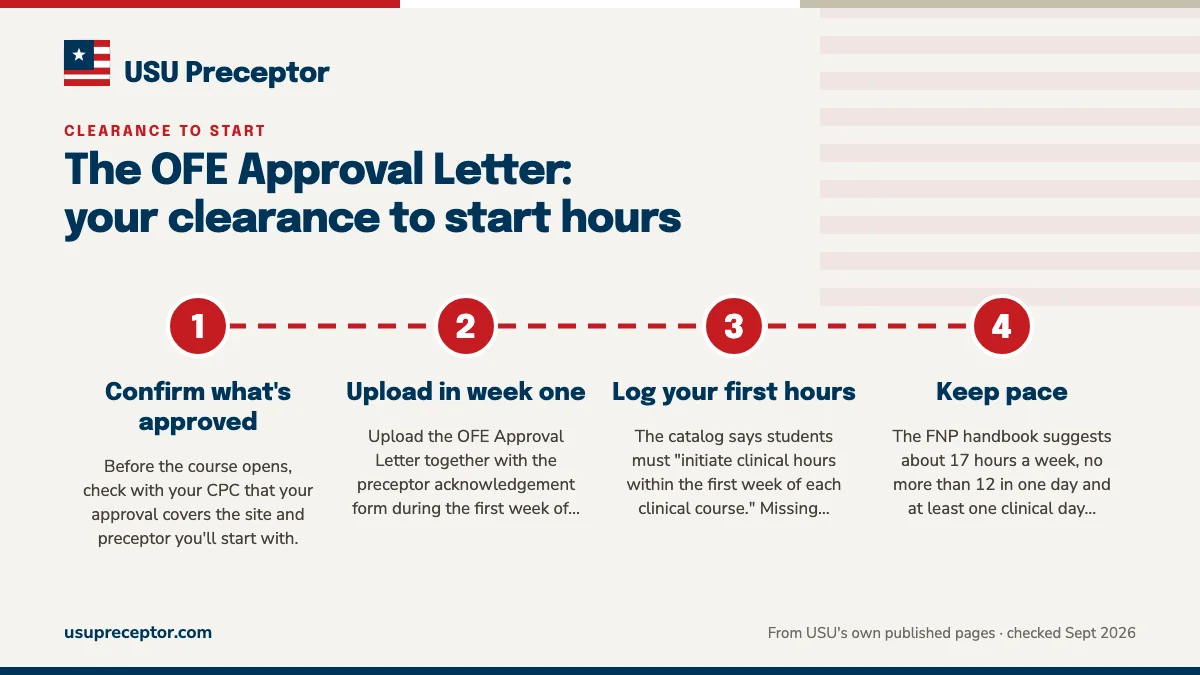
- Confirm what's approvedBefore the course opens, check with your CPC that your approval covers the site and preceptor you'll start with.
- Upload in week oneUpload the OFE Approval Letter together with the preceptor acknowledgement form during the first week of each clinical course. The handbook doesn't name the upload location, so check your course in D2L Brightspace or ask your faculty.
- Log your first hoursThe catalog says students must "initiate clinical hours within the first week of each clinical course." Missing that can mean withdrawal, reapplication and a course retake.
- Keep paceThe FNP handbook suggests about 17 hours a week, no more than 12 in one day and at least one clinical day each week, to reach 135 hours in 8 weeks.
The upload happens in each of FNP592, FNP594, FNP596 and FNP597, not just the first practicum.
Specialty experiences and the limits on letters
The handbook says OFE may limit approval letters for specialty experiences. It doesn't spell out how. The caps below are the published FNP limits any specialty approval has to sit within.
| Setting | Limit | Condition |
|---|---|---|
| Optional specialties | 40 hours combined | Before FNP597 only with Program Director approval (effective July 2024) |
| Urgent care | 135 hours in total | Not allowed in FNP592; cap in effect as of March 2024 |
| Hospice or SNF | 40 hours | Within the geriatrics rotation |
| Telehealth | 40 hours for the program | Approved in advance; preceptor physically with you; video required |
| Inpatient or hospital | 0 hours | Never approved, including for specialty rotations |
Two points don't line up. Appendix I lists optional specialties with the FNP596 rotations, while the hours rule needs Program Director approval before FNP597, so ask before planning one in FNP596. The telehealth rules also say to declare telehealth on a Preceptor Nomination Form that isn't in the handbook's appendix list; ask your CPC which form they mean. More on telehealth is under virtual clinical options.
Keeping your clearance valid
The letter clears you to start, but it doesn't freeze your status. Complio sends expiry notices at 60, 45, 30 and 15 days before an item expires and on the day itself. Once anything lapses, you show as not compliant in Project Concert and go on "clinical pause": no clinical attendance and no logged hours until the renewal clears, which takes 2–5 business days in Complio plus about two for OFE.
Your preceptor's side matters too. Hours logged while the preceptor has more than two students (one in New Jersey) don't count, and OFE asks preceptors to renew expiring licenses. An annual flu shot that runs out in the middle of FNP594 is exactly the kind of gap the notices are there to catch, so renew at the first one.
If the course is close and there's no letter
USU's handbook says same-day or urgent requests for sites and preceptors can't be accommodated, and Complio rush requests aren't possible either. What helps is finding the missing piece quickly:
- Email your CPC from your USU account and ask which PAC item is still open. Replies are expected within 24 business hours.
- Check Complio for items still pending or rejected.
- Ask whether the affiliation agreement is fully executed or still with the site's legal team.
- If preceptor approval is the gap, confirm OFE has every document, including Exhibit A or Exhibit B where needed.
If the letter can't arrive in time for a week-one start, talk to your faculty and CPC before the course begins. Missing that start may mean withdrawing and retaking the course; delayed graduation explains what that costs in time.
How we get your pieces ready for the letter
We work on the preceptor and the site: finding ones that meet USU's rules and assembling the preceptor packet and site contact details OFE needs. The letter itself comes only from OFE, after the Program Director, the site and Complio have all cleared you. Because it arrives only once every piece is cleared, we get our pieces, the preceptor and the site, ready as early as possible. Contact the placement desk with your course and start date if you want to line up the pieces early.
Questions USU students ask
Can I shadow my preceptor before the OFE Approval Letter arrives?
Not under USU's rules. The FNP handbook says you may not be on site before you have the letter, and time spent there can't be logged later either. If your preceptor invites you in early, thank them and explain that USU needs the letter first. Use the wait to finish Complio items and read the course's clinical requirements.
Do I get a new approval letter for each FNP course?
USU asks you to upload the approval letter in week one of each clinical course, but the handbook doesn't say whether one letter can cover more than one course. If your preceptor or site changes between courses, that change needs approval at least 16 weeks ahead. Ask your CPC which letter to upload for each course.
How long after approval does OFE send the letter?
USU doesn't publish a turnaround for the letter itself. It follows once the preceptor, agreement and compliance pieces are all approved, and the slowest of those sets the date: Program Director review averages 4–16 weeks, and a new agreement can take four to six months. Aim to have everything done by the 16-week deadline.
Does the approval letter apply to Nurse Educator, HCL or DNP courses?
The approval letter rules described here come from the FNP Clinical Handbook. The DNP handbook uses the same PAC model with a Project Mentor in place of a preceptor, and the RN-to-BSN, Nurse Educator and Health Care Leadership handbook has its own checklist and 16-week deadline. Ask your CPC what clearance you need before starting MSN578, MSN587, NUR378 or immersion hours.
What if my approval letter arrives partway through week one?
You can start once you have it, and USU's rule is that hours begin within the first week of the course. If the letter lands late in week one, schedule a clinical day before the week ends if your preceptor can, and tell your clinical faculty. If that isn't possible, contact your faculty and CPC right away about the withdrawal risk.
Related pages
Last checked 2026-09-23
We check these pages against USU's own catalog, handbooks and disclosures. USU's current handbook and your Clinical Placement Coordinator have the final word.
Six months out is USU's rule. We start now.
Tell us your USU program, your state and when your next practicum opens. We look for preceptors who meet USU's rules and help you build the packet the Office of Field Experience and Program Director review.
- Preceptors matched to the course: family practice, pediatrics, women's health, urgent care within USU's caps
- Appendix H, license, CV and board certification gathered the way OFE asks
- In person near you; telehealth only inside USU's 40-hour limit
Start your placement plan
A placement advisor replies with what a USU-ready preceptor and site look like for you.