How our placement help works, in USU's order
You tell us your USU program, course and session, and you get a written quote before any search begins. Then we look for a preceptor and site near you that fit USU's rules, and help you assemble what the Office of Field Experience (OFE) and your Program Director review. You submit it, USU decides, and no hours count before your OFE Approval Letter.
Get your placement plan
Tell us your USU track and where you live. A placement advisor replies with what a USU-ready preceptor and site look like for you.
Built around USU's placement process
We cover the two jobs USU leaves with you: the search and the preceptor paperwork. USU's 2026-27 catalog makes students responsible for identifying their own clinical placements and preceptors, with the OFE as a partner. The OFE runs its PAC model (Preceptor, Agreement, Compliance), and the Program Director approves each preceptor.
So the split is simple. We look for a preceptor and site that fit your course and USU's preceptor rules, and we get the preceptor's documents into the shape the OFE asks for. We work alongside your Clinical Placement Coordinator (CPC) and the OFE, who keep the Affiliation Agreement, your Complio record and every approval, and the full sequence is on our clinical placement process page.
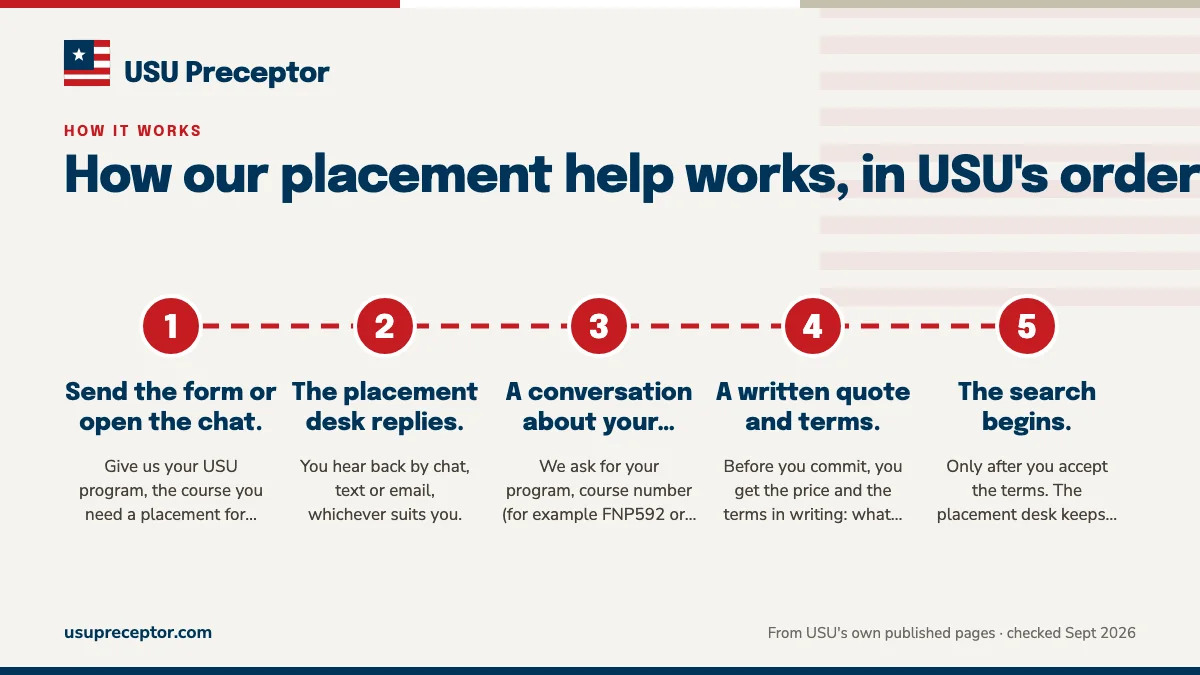
How it starts: five steps before any search
- Send the form or open the chat. Give us your USU program, the course you need a placement for and your state. A few lines is enough to begin.
- The placement desk replies. You hear back by chat, text or email, whichever suits you.
- A conversation about your course. We ask for your program, course number (for example
FNP592orMSN578), the session it opens, the state of your address on file with USU, and any leads you've already tried or listed on USU's Interest Form. - A written quote and terms. Before you commit, you get the price and the terms in writing: what the search covers, how it fits USU's approval steps, and what happens if a preceptor drops.
- The search begins. Only after you accept the terms. The placement desk keeps you updated in the channel you picked.
Nothing goes to USU at this stage. The conversation makes sure the search aims at the right course, setting and state from day one.
The search: in person near you first
Almost all USU clinical hours are in person, so the main route is a preceptor and site within reach of home. USU's catalog also says you must be willing to travel anywhere in your state at your own expense, so near you means the closest workable fit, not a promise of a short drive.
We match to the course, not just the specialty. FNP592 needs family practice, primary care or primary care internal medicine with no specialty focus. FNP594 can add urgent care with a primary care focus, and FNP596 covers pediatrics, women's health and geriatrics. Nurse Educator, Health Care Leadership, RN-to-BSN and DNP students each need a different kind of preceptor or mentor.
What an FNP preceptor is checked against
- Board-certified NP, or licensed MD or DO, with at least a year of experience
- An active license in the state where you'll train, and the employer's permission to precept
- Room under USU's ratio: two students at most, one in New Jersey, counting other schools' NP students
- Not your spouse, partner, first-degree relative or direct supervisor
The complete rules are on USU's preceptor requirements. Virtual time is possible only inside USU's telehealth limits, set out under virtual clinical options.
The packet the OFE and Program Director review
Once a preceptor agrees, the paperwork starts, and USU's side of it moves slowly. Program Director review averages 4–16 weeks, and the FNP handbook says to allow four to six months for a new Affiliation Agreement. We help you gather each piece so nothing waits on a missing page:
- Appendix H, the Preceptor Information and Acknowledgement Form, filled in by the preceptor: one per student, site and specialty
- Exhibit A (board certification, APRN preceptors) and Exhibit B (employment history, if they've been with their employer under three years)
- The preceptor's license verification and CV or resume
- The site coordinator's contact details, so the OFE can send the Affiliation Agreement
You email the packet to the OFE yourself, from your USU account. The OFE sends the agreement straight to the site and manages the legal review, and USU asks students not to contact the site during that stage unless the OFE requests it. Our Appendix H guide explains the form section by section.
From the approval letter to week one
Your OFE Approval Letter is the green light. USU says you may not be on site or log hours before you have it, and you upload it in week one of the clinical course along with the preceptor acknowledgement form. Hours must start in that first week, or you may have to withdraw and retake the course.
After that, the clinical work belongs to you and your preceptor. Hours and journal entries go into Project Concert within 48 hours, and an expired Complio item puts you on clinical pause until it's renewed. We stay on call through the course in case the placement runs into trouble.
Hours logged before your OFE Approval Letter don't count, even with an approved preceptor beside you.
If a preceptor drops out
Tell your CPC the same day, then tell us. USU's catalog says that when a preceptor can't continue for reasons outside your control, the OFE makes every reasonable attempt to find an alternative. If none works out, you may have to withdraw and retake the course at your own cost.
We search again alongside the OFE, starting from the same course and setting so the new preceptor fits the hours you still owe. A replacement goes through USU's approval just as the first one did, and a planned change of preceptor or site needs approval at least 16 weeks before the course it affects. The preceptor dropped out page has the step-by-step plan.
Your part, and why our terms come in writing
Our quote and terms come in writing so you know exactly what the search covers, what happens if a preceptor drops and how cancellation works. USU gives the final approval; we make sure what reaches the Office of Field Experience is complete and fits USU's rules the first time.
USU's requirements stay with you, and USU reviews your preceptor the same way whoever found them. The catalog asks students who hire one to pass USU's requirements along to it, and you remain responsible for deadlines, Complio, submissions, hour logs and every rule in your handbook. How we price the work is on the cost page, and you can start with the form.
Questions USU students ask
How early should I contact you before a USU practicum?
As early as you can. USU wants three qualified preceptors named six months before each clinical course and every approval on file 16 weeks before it starts. A brand-new Affiliation Agreement can take longer than the gap between those two dates, so a search that begins inside the 16-week window has very little room to work with.
Do you submit my paperwork to the OFE?
You do, from your USU email, and the OFE passes preceptor documents to the Program Director. Our part comes first: we gather and check Appendix H, its exhibits, the license verification and the CV with you, so the packet you send is complete.
Do you work with USU programs other than the FNP?
Yes. The same steps apply to the Nurse Educator residency in MSN578, the Health Care Leadership residency in MSN587, the RN-to-BSN practicum in NUR378 and NUR499, and DNP practice immersion with a Project Mentor. The preceptor rules differ for each program, and the first conversation settles which ones apply to you.
What if the Program Director doesn't approve the preceptor?
Then that preceptor can't supervise your hours, and you need another. Ask your CPC for the reason in writing, because it tells you what the next preceptor has to look like. USU's handbook sets out what it checks, such as preceptor type, board certification, license state, experience and relationship to you.
Related pages
Last checked 2026-09-23
We check these pages against USU's own catalog, handbooks and disclosures. USU's current handbook and your Clinical Placement Coordinator have the final word.
Six months out is USU's rule. We start now.
Tell us your USU program, your state and when your next practicum opens. We look for preceptors who meet USU's rules and help you build the packet the Office of Field Experience and Program Director review.
- Preceptors matched to the course: family practice, pediatrics, women's health, urgent care within USU's caps
- Appendix H, license, CV and board certification gathered the way OFE asks
- In person near you; telehealth only inside USU's 40-hour limit
Start your placement plan
A placement advisor replies with what a USU-ready preceptor and site look like for you.