The affiliation agreement between USU and your clinical site
USU must have a signed agreement with a site before you start clinical hours there. You supply the site coordinator's contact details, OFE sends the contract, and the two legal teams work through it; USU's handbook says to allow at least four to six months for a new one. While that happens, you keep your other leads moving and leave the site alone unless OFE asks.
Need a site that can work with USU's contract process?
Tell us your course, term and area. A placement advisor will reply with next steps.
What the agreement is and why it comes first
The affiliation agreement is the legal contract between USU and the clinical site. USU's FNP handbook is direct about the order: the university needs "an agreement with the site prior to the student beginning field experiences." It's the A in OFE's PAC model (Preceptor, Agreement, Compliance), and a fully executed agreement is an item on the Appendix A PAC checklist.
An approved preceptor isn't enough on its own. The contract is with the site, not the clinician, so a preceptor who works at two clinics needs an agreement in place at whichever one you'll attend. USU doesn't publish its agreement template or the terms inside it, and the handbooks don't say how long a signed agreement stays in force.
How the contract moves
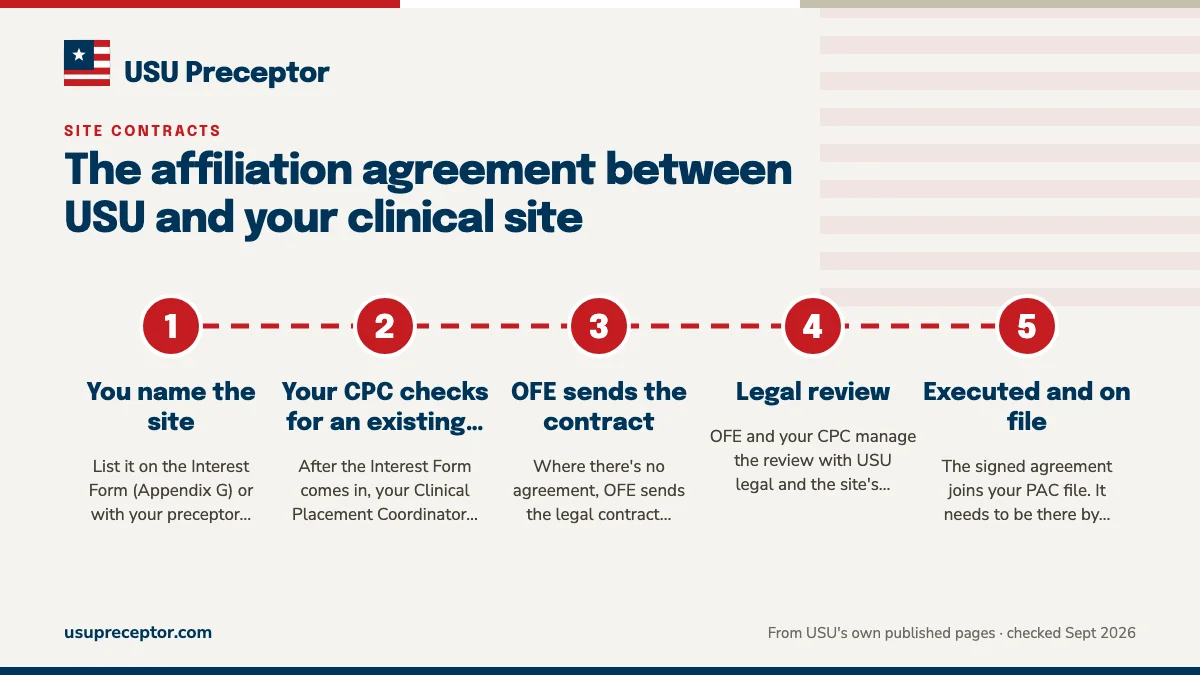
- You name the siteList it on the Interest Form (Appendix G) or with your preceptor packet, and give OFE the site coordinator's contact details.
- Your CPC checks for an existing agreementAfter the Interest Form comes in, your Clinical Placement Coordinator checks whether USU already has an agreement with the site or whether outreach is needed.
- OFE sends the contractWhere there's no agreement, OFE sends the legal contract directly to the site.
- Legal reviewOFE and your CPC manage the review with USU legal and the site's legal department.
- Executed and on fileThe signed agreement joins your PAC file. It needs to be there by the 16-week deadline, alongside preceptor approval and health and safety compliance.
How long it takes, and the conflicting figures
USU gives two numbers. The FNP handbook's Affiliation Agreements page says to allow "at least four to six months" for a new agreement. The Appendix A PAC flyer says agreements "may take 16 weeks." Plan on the longer figure, since the site's legal department sets part of the pace.
Read alongside the 16-week deadline, the arithmetic is tight. Four to six months is roughly 17 to 26 weeks; add the 16 weeks and a new site should be named about eight to ten months before the clinical course starts. That is earlier than the catalog's 6-month point for listing three qualified preceptors, which is one reason to put sites that already have a USU agreement at the top of your list.
Large systems can take longer still. UC San Diego Health, for example, says an executed agreement with an out-of-state NP program may take about 6 to 12 months, and that students can't request one themselves.
Why you don't contact the site
USU's handbook tells students not "to reach out to the site during this process unless requested by OFE." That can feel odd when the site is your own lead, but the contract is between two institutions, and OFE runs that conversation. What you can do instead:
- Ask your CPC for a status update by USU email or a Calendly appointment; OFE aims to answer email within 24 business hours.
- Keep working your other leads, so a slow contract at one site doesn't leave you with nothing.
- Finish your Complio items so the agreement isn't sitting beside other open pieces at the deadline.
- If OFE does ask you to help with the site, reply quickly. That's the one exception the handbook allows.
Sites that already have an agreement
OFE says it holds "thousands of affiliation agreements nationwide" and lists more than 7,000 potential preceptors, based on map data current as of April 2024. The list itself isn't public: USU's handbook says its database of approved sites and preceptors is not publishable, so your CPC is the way to find out which clinics near you are already covered.
A site with an existing agreement skips the contract step, the one with the longest lead time USU publishes. It's worth asking your CPC about a clinic before you approach it cold. Your employer can be a clinical site too, provided you disclose it in writing to your CPC and clinical instructor; see clinicals at your employer.
Extra requirements a site or state can add
Sites can set conditions beyond USU's own list. The handbook's example is a hospital requiring a background check different from the one you completed through Complio. Students are expected to give sites what they ask for, such as fingerprints, OSHA training or an American Heart Association Healthcare CPR lesson.
Some states add paperwork as well. USU's Board of Nursing disclosure notes that Alabama requires documents from out-of-state APRN programs doing clinicals there, and Delaware and Wyoming require filings for programs with clinical or preceptor components. In California, 16 CCR 1486 requires a written agreement between the agency, the preceptor and the program. The state rules are on out-of-state clinicals.
How our search sets up the agreement
When we search for a site, we look for clinics willing to work through USU's contract process, and we collect the site coordinator's details OFE needs so the contract goes to the right person the first time. OFE sends the agreement and handles the legal review directly with the site, and both institutions sign off.
If you'd like a search that allows for the agreement's lead time, see how it works or use the form below.
Questions USU students ask
Can I use a clinic that already hosts students from other schools?
Yes, but USU still needs its own agreement with that clinic; another school's contract doesn't cover you. Ask your CPC whether USU already has one. Also check the preceptor's student load, since other schools' NP students count toward USU's limit of two students per FNP preceptor, or one in New Jersey.
What happens if a site won't sign USU's affiliation agreement?
USU doesn't publish a procedure for that case. It's one reason the Interest Form asks for at least three preceptors or sites per setting. If you hear that a site is hesitating, tell your CPC straight away, and keep your Complio items current so a replacement site is the only missing piece rather than one of several.
Does my employer need an affiliation agreement with USU?
USU's handbook requires an agreement with the site before field experiences begin and doesn't carve out an exception for employers. FNP students may train at their workplace if they disclose it in writing to their CPC and clinical instructor, keep clinical hours separate from their normal duties, and aren't paid by the site or preceptor during those hours.
Do USU affiliation agreements expire?
USU doesn't publish agreement terms or renewal dates. If a clinic hosted a USU student some time ago, ask your CPC whether the agreement is still active before you count on it. USU's own network map data is dated April 2024, so treat any list or map as a starting point rather than proof of a current contract.
Is the affiliation agreement the same as the preceptor form?
No. Appendix H, the Preceptor Information and Acknowledgement Form, is about the person: license, board certification, employment history and employer permission. The affiliation agreement is a legal contract between USU and the site. You need both, plus cleared Complio items, before OFE emails the approval letter that lets you start hours.
Related pages
Last checked 2026-09-23
We check these pages against USU's own catalog, handbooks and disclosures. USU's current handbook and your Clinical Placement Coordinator have the final word.
Six months out is USU's rule. We start now.
Tell us your USU program, your state and when your next practicum opens. We look for preceptors who meet USU's rules and help you build the packet the Office of Field Experience and Program Director review.
- Preceptors matched to the course: family practice, pediatrics, women's health, urgent care within USU's caps
- Appendix H, license, CV and board certification gathered the way OFE asks
- In person near you; telehealth only inside USU's 40-hour limit
Start your placement plan
A placement advisor replies with what a USU-ready preceptor and site look like for you.