Appendix H: the Preceptor Information and Acknowledgement Form
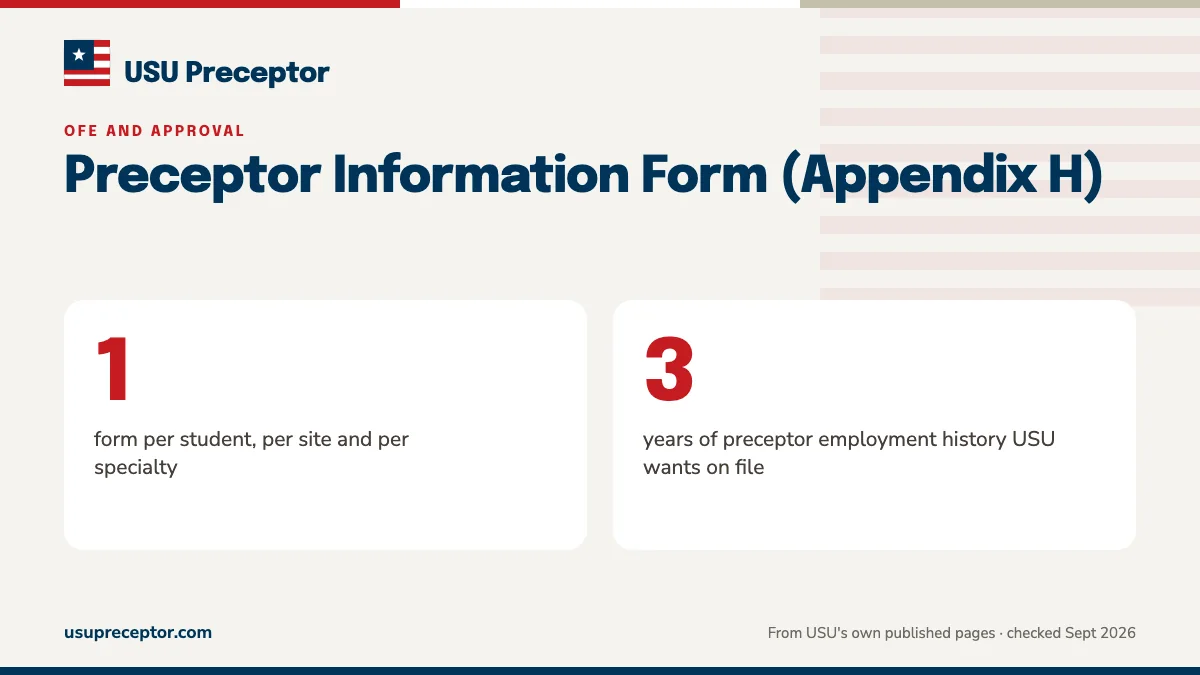
Appendix H is the form your preceptor completes so USU can credential them, and the current version is dated November 2025. You need a separate one for each student, site and specialty. The preceptor fills it in and signs, with DocuSign as USU's main e-signature tool, and you send it to the Office of Field Experience with their license verification, CV and, for APRNs, proof of board certification.
Found a preceptor? Get the packet right
Tell us your USU course and state. A placement advisor replies with how we'd help your preceptor through Appendix H and the documents that go with it.
What Appendix H does
Appendix H is the core of the P in USU's PAC model. The FNP handbook's appendix list calls it the Preceptor Information and Acknowledgement Form (Preceptor Form), and when the catalog mentions a Preceptor Form, this is the one. The preceptor uses it to give USU their details and to sign an acknowledgement, which includes confirming that their employer or site has approved them to precept.
Once it's in, the OFE passes the packet to the Program Director, who gives final approval or denial; the handbook puts that at 4–16 weeks on average. It's one piece of the PAC checklist, so even an approved preceptor can't take you until the agreement and your compliance items are done too. The Program Director approval page covers the review itself.
Who does which part
Your preceptor completes and signs the form. USU names DocuSign as its primary tool for preceptor e-signatures, but its pages don't say who starts the DocuSign envelope, so ask your CPC how they want it routed before you send anything to a busy clinician.
Your part is the packet around it. The handbook's process has you email the completed form to the OFE together with the preceptor's license verification, their CV or resume, and proof of board certification if they're an APRN. Appendix A lists the same four items under Preceptor.
Make the ask easy to say yes to. Send the form with a short note covering your program, the course number, the dates and the hours involved; for FNP students that's 135 hours per 8-week course, or about 17 hours a week. Give a date you need it back by, and offer to answer questions before they start filling it in.
Exhibit A and Exhibit B
Appendix H carries two exhibits. Which ones your preceptor needs depends on their license and how long they've been in their current job.
| Exhibit | Title on the form | Who needs it |
|---|---|---|
| A | Exhibit A – Board Certification Document (APRN Only) | NP and CNM preceptors. NP preceptors need current national board certification appropriate for FNP education. MD and DO preceptors skip it. |
| B | Exhibit B - Preceptor Employment History | Any preceptor who has been with their current employer for less than 3 years, so that USU has at least 3 years of history on file. |
Exhibit B is the one that trips people up. A preceptor who moved to a new practice 18 months ago needs it, and it's easy to miss because nothing about their current role looks unusual. Ask about start dates before the form goes out.
One form per student, site and specialty
USU wants a separate Appendix H for each student, each site and each specialty, and that has practical consequences. A preceptor who takes two USU students fills in two forms. A preceptor who sees you at two clinic locations fills in one per site. If the same clinician also precepts a different specialty rotation for you, the rule points to another form; confirm with your CPC.
It also means a form doesn't carry forward. One a preceptor signed for another USU student can't be reused for you, and moving to a new site for a later course means a new form. In week one of each clinical course you upload your OFE Approval Letter together with the preceptor acknowledgement form, so keep a signed copy of each one where you can find it quickly.
Check these before you send it
A packet that goes in complete, for a preceptor who clearly meets USU's rules, gives the Program Director nothing to send back. The full criteria are on the preceptor requirements page. Before you email it, confirm that:
- The form is the November 2025 version from USU's catalog site, not a copy saved by an earlier cohort.
- The preceptor is a board-certified NP, a licensed MD or DO, or a CNM for women's health hours only, with at least one year of experience.
- The license verification shows an active, unencumbered license in the state where the clinical happens.
- Employer or site approval is confirmed on the form.
- Exhibit A is attached for an APRN, and Exhibit B for anyone under 3 years with their current employer.
- The preceptor isn't your spouse, domestic partner, first-degree relative or direct supervisor. USU's 2024 onboarding guidance also ruled out friends and any other conflict of interest.
- The form names this student, this site and this specialty.
Other programs: same form name, different preceptors
The RN-BSN, MSN Nurse Educator and Health Care Leadership handbook also has an Appendix H called the Preceptor Information and Acknowledgement Form, but the qualifications behind it differ. Nurse Educator preceptors for MSN578 need an MSN or doctorate and at least a year as an RN in the specialty. Health Care Leadership preceptors for MSN587 need a graduate degree such as an MSN, MHA or MBA and a year of leadership experience. For RN-BSN, the agency leader you work with in NUR378 and NUR499 submits a resume to the OFE; confirm with your CPC what else they need.
DNP students have a trap to avoid. In the DNP Practice Immersion Handbook the matching form is Appendix G, the Project Mentor Information and Acknowledgement Form, while Appendix H is the DNP Mentor/Faculty Evaluation of Student. Check the letter in your own handbook before you send anything to a mentor.
Why students choose us for Appendix H
When we find a preceptor for you, we help them through Appendix H and collect what goes with it: license verification, CV, board certification and, if needed, Exhibit B. The aim is a packet you can send to the OFE in one email, complete the first time, from your own USU account. Should your preceptor withdraw partway through, we keep looking for a replacement, who will need a fresh Appendix H of their own.
Every signature on Appendix H is your preceptor's own, and the Program Director decides on approval. If a clinician wants to know what USU offers preceptors before they commit, our page for preceptors sets out the requirements and the perks. To start a search, use the form below.
Questions USU students ask
Who fills out USU's Preceptor Information and Acknowledgement Form?
The preceptor completes and signs it, including the confirmation that their employer or site approves them precepting. You gather it with their license verification, CV and, for APRNs, board certification, and email the packet to the OFE. Ask your CPC whether the signature should come through a DocuSign envelope the office sends.
Does an MD or DO preceptor need Exhibit A?
No. Exhibit A is the Board Certification Document and is marked APRN only, so it applies to NP and CNM preceptors. A physician still needs license verification and a CV, and still needs Exhibit B if they've been with their current employer for less than 3 years.
Can my preceptor reuse an Appendix H they signed for another student?
No. USU wants one form per student, per site and per specialty, so each USU student a clinician precepts has their own. The same goes if you move to another site or specialty with the same preceptor. Keep the FNP ratio in mind as well: no more than two students per preceptor, and one in New Jersey.
What happens after I send Appendix H to the OFE?
The OFE forwards the packet to the Program Director, and the handbook puts approval at 4–16 weeks on average. An approved preceptor isn't the finish line: you still need a fully executed Affiliation Agreement and cleared Complio items before the OFE emails your approval letter and you can start hours.
Where do I get the current Appendix H?
From the FNP Clinical Handbook's appendix list on USU's catalog site, where the file is labeled as the November 2025 version. Other programs use the form in their own handbook. If a preceptor still has an older copy from a past student, don't reuse it; send the current one.
Related pages
Last checked 2026-09-23
We check these pages against USU's own catalog, handbooks and disclosures. USU's current handbook and your Clinical Placement Coordinator have the final word.
- USU Appendix H: Preceptor Information and Acknowledgement Form (v. Nov 2025)
- USU FNP Clinical Handbook: Appendices
- USU FNP Clinical Handbook: Selection Criteria for FNP Clinical Preceptors
- USU RN-BSN, MSN NE and HCL Practicum Handbook: Preceptor Selection Criteria
- USU DNP Practice Immersion Handbook: Appendices
Six months out is USU's rule. We start now.
Tell us your USU program, your state and when your next practicum opens. We look for preceptors who meet USU's rules and help you build the packet the Office of Field Experience and Program Director review.
- Preceptors matched to the course: family practice, pediatrics, women's health, urgent care within USU's caps
- Appendix H, license, CV and board certification gathered the way OFE asks
- In person near you; telehealth only inside USU's 40-hour limit
Start your placement plan
A placement advisor replies with what a USU-ready preceptor and site look like for you.