Changing your preceptor or clinical site at USU
If you choose to leave a preceptor or site, USU's FNP Clinical Handbook makes finding the replacement your job, and the change needs approval at least 16 weeks before the course it affects. If a preceptor can't continue for reasons outside your control, the Office of Field Experience (OFE) tries to find an alternative, but when that fails you may have to withdraw and retake the course.
Need a replacement preceptor?
Tell us your USU course, state and when your current placement ends.
Two kinds of change, two sets of rules
USU treats a change you choose differently from a change that happens to you. Before you tell anyone you're leaving, work out which of the two you're in.
| You choose to change | Your preceptor can't continue | |
|---|---|---|
| USU's wording | “Preceptor Fit”: leaving “for other various reasons” | Reasons outside the student's control |
| Who finds the replacement | You find the new preceptor and site | OFE makes “every reasonable attempt” to find an alternative |
| Approvals | New preceptor packet, Program Director approval, agreement if the site is new | The same approvals apply to any alternative |
| If nothing works | You remain responsible for placing yourself | You may have to withdraw and retake the course at your own cost, and the hours are lost |
The catalog doesn't define “outside the student's control.” If your case is borderline, say a preceptor who cuts back hours rather than leaving, describe it to your Clinical Placement Coordinator (CPC) in writing and ask which rule applies.
Changing because the fit isn't right
The FNP Clinical Handbook has a short section called Preceptor Fit. It says students who don't want to stay with their preceptor and site “for other various reasons” are responsible for finding a new clinical preceptor and site. OFE doesn't take over the search because a placement feels wrong.
The handbook's roles section adds the timing: a change of preceptor or site must be approved at least 16 weeks before the course where the change applies. That's the same 16-week line USU uses for first-time approvals. A fit problem you notice during one course is usually one to fix for a later course, because the new preceptor has to clear every approval from scratch.
Keep the reason professional and specific when you raise it. USU's handbook lets the Program Director or the OFE Director require a student to find placements alone after a Code of Conduct violation, clinical probation or a jeopardized placement, so how you leave a site matters.
What a replacement preceptor or site has to clear
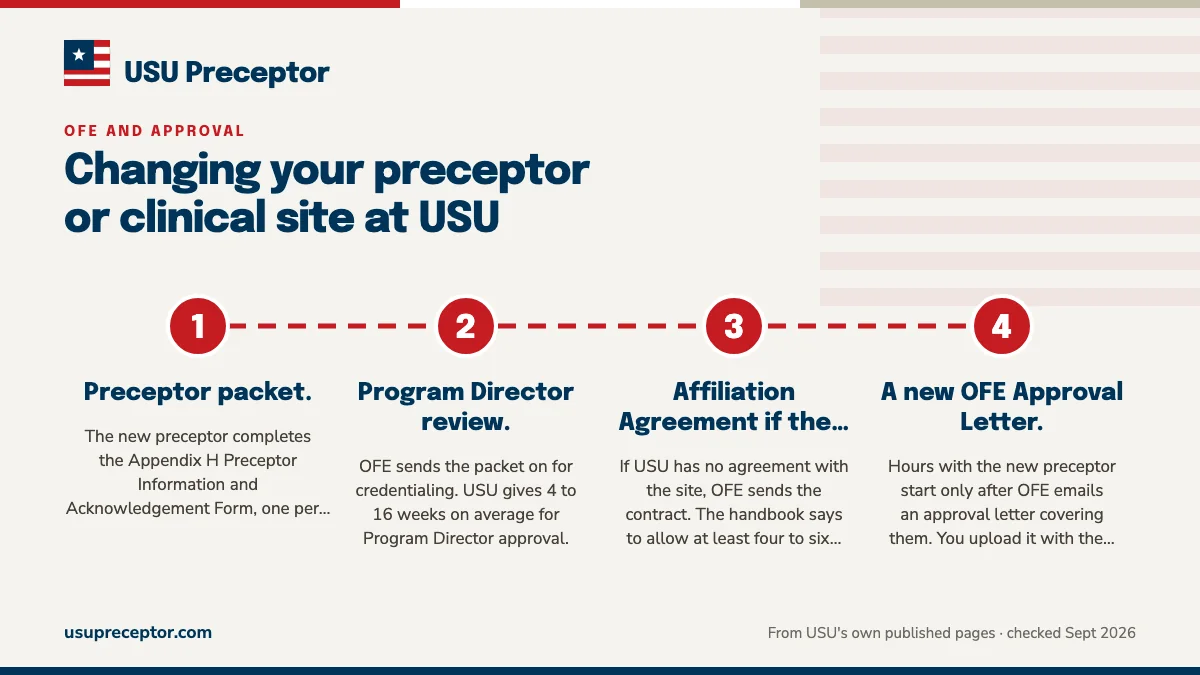
A new preceptor isn't a paperwork shortcut. Each one goes through the same PAC route (Preceptor, Agreement, Compliance) as the first, and you can't log an hour with them until OFE says so.
- Preceptor packet. The new preceptor completes the Appendix H Preceptor Information and Acknowledgement Form, one per student, site and specialty. You email it to OFE with their license verification, CV or resume, and proof of board certification for APRNs.
- Program Director review. OFE sends the packet on for credentialing. USU gives 4 to 16 weeks on average for Program Director approval.
- Affiliation Agreement if the site is new. If USU has no agreement with the site, OFE sends the contract. The handbook says to allow at least four to six months, while the Appendix A flyer says agreements may take 16 weeks. Don't contact the site during this unless OFE asks.
- A new OFE Approval Letter. Hours with the new preceptor start only after OFE emails an approval letter covering them. You upload it with the preceptor acknowledgement form in week one of the course. See the OFE Approval Letter.
When a preceptor drops out
If a preceptor can't continue for reasons outside your control, the 2026-27 catalog says OFE will make every reasonable attempt to find an alternative. That's a commitment to try, not a promise of a new placement. If no alternative works, you may have to withdraw and retake the course at your own cost, and the hours for that course are lost.
Tell your CPC the same day, from your USU email, and say how many approved hours you've logged in Project Concert. USU says same-day or urgent placement requests can't be accommodated, so early notice is the only lever you have. If you already have a second approved preceptor, or leads of your own, name them.
The catalog's rules for any placement OFE provides are worth knowing here. You can decline one, but declining or not answering within 24 business hours means placing yourself for that rotation by the deadline, and accepting means completing all of its hours. Our preceptor dropped out page walks through the first week after a withdrawal.
Don't start at a new site or with a new preceptor before OFE's approval letter covers them. USU doesn't allow hours or site time before the letter.
What withdraw-and-retake means for your hours
Three USU rules make a mid-course gap costly in time. Clinical hours don't roll over from one course to the next. An FNP Incomplete needs at least 81 of the course's 135 hours done. And if clinical hours don't begin in a course's first week, the catalog says you may need to withdraw, reapply and retake it.
The FNP practicums also run in a chain. FNP594 lists FNP592 as a prerequisite, FNP596 needs FNP594, and FNP597 needs FNP596, so retaking one course pushes the rest back. The catalog's field experience policy says incomplete clinical hours are lost and repeated the following term.
If you're close to 81 hours when a preceptor leaves, ask your course faculty about an Incomplete before you assume a withdrawal. Our page on delayed graduation shows how one retake moves the rest of your plan.
Other programs and special cases
- RN-to-BSN:
NUR378andNUR499use the same agency leader for both courses, so switching leaders between them isn't the normal path. Ask your CPC before you approach a new agency. - Nurse Educator and Health Care Leadership:
MSN578andMSN587each require a 1:1 preceptor-to-student ratio. We found no separate change process for either, and the handbook states a 16-week paperwork deadline forMSN578. - DNP: a new Project Mentor needs Program Director approval, which the DNP handbook puts at 2 to 16 weeks. We found no separate mentor-change rule.
- FNP, adding rather than replacing: USU recommends no more than three preceptors per 8-week course. A second approved preceptor can soften the blow if one leaves, as long as you reach at least 135 hours with a nurse practitioner across the program.
- Moving: USU says it isn't responsible for a placement if you move after a term starts, so a site change caused by a move carries extra risk. See out-of-state clinicals.
What USU doesn't publish about changes
Several things students ask about aren't in USU's published handbooks or catalog. The FNP appendix list has no change-request form; the new preceptor's Appendix H is the paperwork USU names. USU doesn't define which reasons count as outside your control, and it doesn't say whether the 16-week rule bends when a preceptor leaves mid-course. Nor does it say how long OFE keeps looking for an alternative before withdrawal becomes the answer.
It also doesn't say how hours already logged with an approved preceptor are treated if you finish the same course with someone else. Ask your CPC and course faculty in writing and keep the reply. Their answer, and the current handbook on USU's catalog site, is what counts.
Why students choose us for a replacement
If you need a replacement, a placement advisor can search for a preceptor and site that fit the course you're in and help you assemble the Appendix H packet and site details OFE asks for. Because the Program Director's review and any new affiliation agreement take time, we move quickly on the search so the replacement reaches USU as early as possible, ready for the same approval every preceptor and site receives.
If a search still makes sense for you, tell us your course and state and we'll say plainly whether the timing looks workable.
Questions USU students ask
Can I switch preceptors in the middle of a USU clinical course?
USU's handbook requires preceptor and site changes to be approved at least 16 weeks before the course they apply to, and it doesn't describe a mid-course switch you can simply choose. If your preceptor can't continue, OFE tries to find an alternative. If you just want to leave, raise it with your CPC early and plan the change for a later course.
Will OFE find me a new preceptor if mine quits?
According to USU's catalog, OFE makes every reasonable attempt when a preceptor can't continue for reasons outside your control. It isn't a promise. If no alternative works out, you may need to withdraw and retake the course, and the hours for it are lost. Sending OFE your own leads quickly widens the options.
Do I need a new Appendix H form for a new preceptor?
Yes. USU wants a separate Preceptor Information and Acknowledgement Form for each student, site and specialty, so a new preceptor, or your current preceptor at a different site, means a new form. It goes to OFE with license verification, a CV and, for APRNs, board certification, and then to the Program Director for approval.
Can I have more than one preceptor in a USU FNP course?
Yes, within limits. USU recommends no more than three preceptors per 8-week FNP course. Each one needs their own Appendix H packet and Program Director approval before you log hours with them. Across the whole program, at least 135 of your clinical hours must be with a nurse practitioner preceptor.
Can I turn down a replacement placement OFE offers?
Yes. USU's catalog lets you decline a placement OFE provides. If you decline, or don't accept within 24 business hours, you must find your own placement for that rotation by the deadline. If you accept, you're expected to complete all of its hours, and walking away can lead to a Code of Conduct referral.
Related pages
Last checked 2026-09-23
We check these pages against USU's own catalog, handbooks and disclosures. USU's current handbook and your Clinical Placement Coordinator have the final word.
Six months out is USU's rule. We start now.
Tell us your USU program, your state and when your next practicum opens. We look for preceptors who meet USU's rules and help you build the packet the Office of Field Experience and Program Director review.
- Preceptors matched to the course: family practice, pediatrics, women's health, urgent care within USU's caps
- Appendix H, license, CV and board certification gathered the way OFE asks
- In person near you; telehealth only inside USU's 40-hour limit
Start your placement plan
A placement advisor replies with what a USU-ready preceptor and site look like for you.