The Appendix G Interest Form: getting your preceptor leads on record
The Preceptor and Clinical Placement Interest Form (Appendix G, usually just the Interest Form) is how you tell USU's Office of Field Experience who you'd like to precept you. It's a Google Form that needs your USU Google login, and it asks for at least three possible preceptors or sites for each setting. Submitting it starts the OFE's checks; it doesn't approve anyone.
Short of three leads per setting?
Tell us your USU course and state. A placement advisor replies with how we'd look for preceptors you can put on your Interest Form.
What the Interest Form is
In the FNP Clinical Handbook it's Appendix G, the Preceptor and Clinical Placement Interest Form, shortened to the Interest Form. It's a Google Form and only opens when you're signed in to your USU Google account. The catalog talks about submitting preceptors on either the Preceptor Form or the Interest Form, so you'll see both names in USU's policy language.
The RN-BSN, MSN Nurse Educator and Health Care Leadership handbook has its own version, the Preceptor & Clinical Practicum Placement Interest Form, also Appendix G. DNP students need to be careful here: in the DNP Practice Immersion Handbook, Appendix G is the Project Mentor Information and Acknowledgement Form, which does a different job.
Don't mix any of these up with the Preceptor Inquiry Form on USU's Preceptor Resources Hub. That one is for clinicians offering to precept, not for students listing leads.
Three leads per setting, not three in total
The FNP handbook says that at enrollment you should have preceptors and sites confirmed, or at least three potential preceptors and sites in each setting. Appendix G asks for at least three per specialty setting or course. For FNP students that adds up quickly, because the four clinical courses call for different settings.
| Course | Settings to list leads for |
|---|---|
FNP592 | Family practice, primary care or primary care internal medicine. Urgent care isn't accepted for this course. |
FNP594 | The same primary care settings, plus urgent care with a primary care focus (urgent care is capped at 135 hours across the program). |
FNP596 | Pediatrics, women's health and geriatrics, plus any optional specialty (40 hours maximum, combined). |
FNP597 | Primary health care across the lifespan. |
Every lead has to be someone USU would actually accept, which the preceptor requirements page sets out in full.
The timing: 6 months in the catalog, 16 weeks in the handbooks
USU's 2026-27 catalog (p. 106) wants at least three qualified preceptors, with valid contact information, submitted at least 6 months before each clinical course. The clinical handbooks draw a different line: every site, preceptor and health and safety approval on file with the OFE at least 16 weeks before the course. Both are current, and you're held to both.
Read them as two checkpoints. The Interest Form is how you meet the 6-month one, and the 16-week one is when approvals have to be finished. The gap between them is about ten weeks, while Program Director review averages 4–16 weeks and a new Affiliation Agreement is expected to take four to six months. A lead at a site USU has never worked with really belongs on your form well before the 6-month mark.
The FNP handbook goes further and expects leads at enrollment, and DNP students begin mentor identification in their second course. The full timeline is on the clinical deadlines page.
What the OFE does with your form
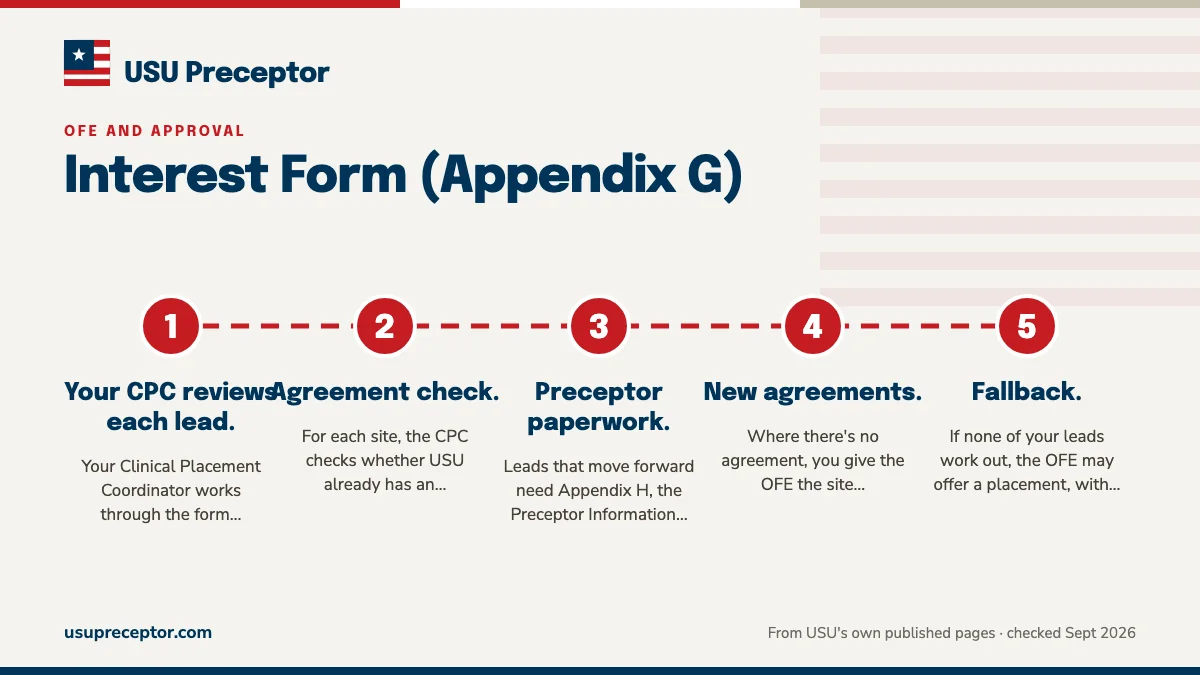
Submitting the form puts your leads in front of the OFE. From there, USU's handbook and catalog describe this sequence:
- Your CPC reviews each lead. Your Clinical Placement Coordinator works through the form setting by setting.
- Agreement check. For each site, the CPC checks whether USU already has an affiliation agreement or whether outreach is needed. An existing agreement can take months off your timeline.
- Preceptor paperwork. Leads that move forward need Appendix H, the Preceptor Information and Acknowledgement Form, which goes to the Program Director for approval.
- New agreements. Where there's no agreement, you give the OFE the site coordinator's details and the OFE sends the contract.
- Fallback. If none of your leads work out, the OFE may offer a placement, with priority for students whose documents were in on time. OFE placement support explains how those offers work.
What makes a lead worth listing
Three names that can't be approved are worth less than one that can. Before a lead goes on the form, check it against USU's basics:
- A board-certified NP or a licensed MD or DO employed at the site, or a CNM for women's health hours only. PAs aren't on USU's list.
- At least one year of experience, and an active, unencumbered license in the state where you'll do the clinical.
- Permission from their employer to precept, which they'll confirm on Appendix H.
- No family tie or reporting line: USU rules out a spouse, domestic partner, first-degree relative or your direct supervisor.
- A site in your state of residence where possible, since USU encourages clinicals there. Inpatient settings are never approved for FNP hours.
- Valid contact details for the preceptor and for whoever handles agreements at the site.
Why students choose us to fill the form
If you're struggling to reach three leads per setting, that's the gap we work on. We search for preceptors and sites that fit your USU course and state, check them against the rules above, and hand you the details to enter on the form yourself from your USU Google account.
The CPC's checks and the Program Director's decision apply to every name, and our screening means each lead you enter already fits USU's rules. If you're already inside the 6-month window, tell us the course and session and we'll say honestly what looks realistic. To start a lead search, use the form below.
Questions USU students ask
Where do I find the USU Interest Form?
It's Appendix G in your clinical handbook on USU's catalog site, usuniversity.smartcatalogiq.com, which links to the Google Form. Sign in to your USU Google account first or it won't open. If the link fails, or you're unsure which version applies to your program, ask your CPC for the current one.
Can I submit the Interest Form with fewer than three preceptors?
USU asks for at least three per setting, and its documents don't say what happens if you list fewer. If you're short, submit what you have and tell your CPC which settings are thin rather than waiting in silence. Fewer leads also leaves you less room if a preceptor says no or a site won't sign.
Does submitting the Interest Form mean my preceptor is approved?
No. The form only puts leads on record. Approval comes later: the preceptor completes Appendix H, the OFE sends it to the Program Director, and review averages 4–16 weeks. You also need a fully executed Affiliation Agreement and clear Complio records before the OFE issues your approval letter.
Do I fill in the Interest Form again for each clinical course?
USU doesn't spell this out. Appendix G asks for leads per specialty setting or course, and the catalog's 6-month rule applies to each clinical course, so expect to update the OFE whenever a new course needs a new setting or site. Ask your CPC whether they want a fresh submission or an email update.
What's the difference between the Interest Form and the Preceptor Inquiry Form?
The Interest Form (Appendix G) is for students listing potential preceptors and sites. The Preceptor Inquiry Form is a separate Google Form on USU's Preceptor Resources Hub for clinicians who want to precept USU students. A keen clinician can use it, but your own leads still belong on the Interest Form.
Related pages
Last checked 2026-09-23
We check these pages against USU's own catalog, handbooks and disclosures. USU's current handbook and your Clinical Placement Coordinator have the final word.
- USU FNP Clinical Handbook: Appendix G, Preceptor and Clinical Placement Interest Form
- USU FNP Clinical Handbook: Roles and Responsibilities
- USU 2026-2027 General Catalog (p. 106)
- USU FNP Clinical Handbook: Appendix I, FNP Site & Preceptor Guidance
- USU RN-BSN, MSN NE and HCL Practicum Handbook: Appendices
Six months out is USU's rule. We start now.
Tell us your USU program, your state and when your next practicum opens. We look for preceptors who meet USU's rules and help you build the packet the Office of Field Experience and Program Director review.
- Preceptors matched to the course: family practice, pediatrics, women's health, urgent care within USU's caps
- Appendix H, license, CV and board certification gathered the way OFE asks
- In person near you; telehealth only inside USU's 40-hour limit
Start your placement plan
A placement advisor replies with what a USU-ready preceptor and site look like for you.