Your USU Clinical Placement Coordinator: finding, booking, preparing
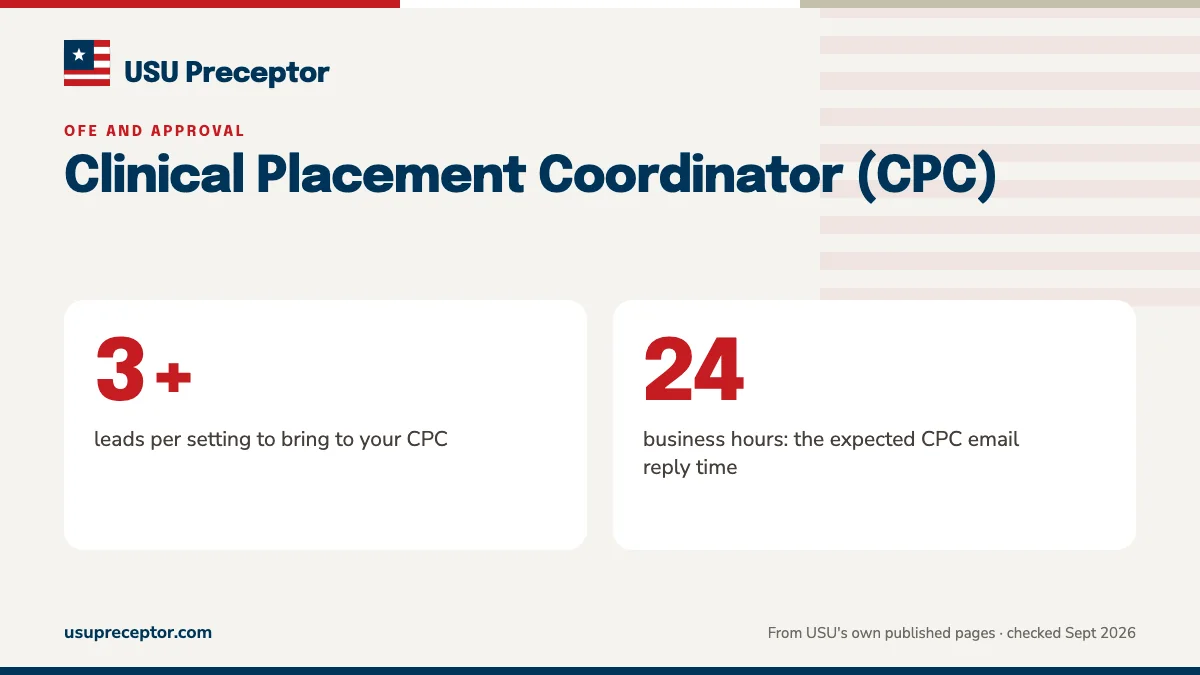
Each USU student has a dedicated Clinical Placement Coordinator (CPC) in the Office of Field Experience. You'll find yours in the Student Portal (MYPORTAL), reach them by USU email or a Calendly booking, and can expect email replies within 24 business hours. Your CPC checks your leads and moves your file along; they don't approve preceptors, and the search itself starts with you.
Walk into your CPC meeting with leads
Tell us your USU course and state. A placement advisor replies with how we'd build a lead list your CPC can work with.
Where to find your CPC
Log in to MYPORTAL at my.usuniversity.edu; the login page labels it the Student Portal. USU's OFE page says your CPC is listed there, and the Calendly link for booking them lives in the portal too. Your online classroom is a separate system, D2L Brightspace, where the Nursing Caring Corner holds clinical guides. The D2L and portal page maps where each thing sits.
If no CPC shows in the portal, email ofe@usuniversity.edu from your USU account and ask who's assigned to you. DNP students will see the role called the Practice Immersion Placement Coordinator (CPC) in their handbook; it's the same job under a longer name. The OFE contact sheet lists CPC I and CPC III titles, so you may see either title.
Booking, reply times and the USU email rule
You have two ways in: email or a Calendly appointment. Use email for quick questions and anything you want on record, and book a Calendly slot when you need to go through several leads or plan a whole term. Email replies are expected within 24 business hours, so a question sent on Friday afternoon may not be answered until Monday or Tuesday.
Always write from your USU-issued Google account. The FNP handbook says all CONHS communication has to come from your university address, and the Interest Form won't open without your USU Google login anyway. Keeping one email thread per clinical course lets your CPC see the history at a glance.
Plan around one hard limit. The handbook says same-day or urgent requests for sites and preceptors can't be accommodated, so however helpful your CPC is, they can't turn a lead into an approval this week.
What your CPC does, and what they can't
Your CPC's first job is your Interest Form. For each lead they check whether USU already has an agreement with that site or needs to start outreach, and they can talk through options from the OFE's database, which isn't published. Together with the OFE, they manage the legal review of new affiliation agreements between USU's lawyers and the site's.
Your CPC is also who you tell in writing, along with your clinical instructor, if an FNP clinical will be at your employer. Change requests go through them and need approval at least 16 weeks before the affected course. If your own leads fall through, an OFE-offered placement reaches you through this same channel.
What they can't do: approve a preceptor, which is the Program Director's decision; pass a Complio item, which Complio's reviewers handle; or waive any health and safety requirement, which the catalog says USU won't do.
What to bring to a CPC meeting
A Calendly slot goes much further if you arrive with this ready. Email it the day before so your CPC can look up agreements in advance.
- Your program, the clinical course number (for example
FNP592orMSN578) and the session it starts in. - Your state of residence and the address USU has on file. State rules, and USU's telehealth rule, follow that address.
- At least three leads for each setting, each with the preceptor's name, credentials, specialty, site address and valid contact details.
- The name and email of each site's coordinator or office manager, so the OFE can send an agreement if one is needed.
- Where each preceptor stands on Appendix H: not asked yet, sent, signed or submitted.
- Your Complio status, including anything that expires before or during the course.
- Any lead who is your employer, supervisor or relative, flagged up front.
- Your questions written down, each with the date you need an answer by.
Afterwards, send a short email summarizing what was agreed and who is doing what next. It gives you both a record, and it's the first thing to forward if a question comes up later.
When to talk to your CPC
Early, and on a schedule. The FNP handbook expects you to arrive at enrollment with preceptors and sites confirmed, or at least three possibilities in each setting. The catalog wants three qualified preceptors named 6 months before each clinical course, and the handbooks want every approval on file 16 weeks before it.
A workable rhythm is a planning conversation well before the 6-month mark for your first clinical course, a check-in once your Interest Form is in, another when Program Director decisions come back, and a last one before the 16-week line to confirm nothing is missing. FNP clinicals fall in year two in 8-week sessions, so the USU course calendar page helps you turn those rules into real dates. DNP students should open the conversation in the program's second course, when mentor identification begins.
When a lead falls through
Tell your CPC the same day, in writing. The catalog says the OFE will help if your preferred placements don't work out, and priority goes to students whose documents were submitted on time, so a prompt, complete file matters. If the OFE offers a placement, you have 24 business hours to accept. Declining or missing the window means you place yourself for that rotation, and accepting means completing all of its hours. The OFE placement support page sets out those rules.
A preceptor leaving for reasons outside your control is treated differently from you choosing to leave. In the first case the OFE makes every reasonable attempt to find an alternative; in the second, the handbook's Preceptor Fit rule says the new search is yours. Changing preceptors covers both cases.
Why students choose us before a CPC meeting
Most of what makes a CPC meeting productive is the lead list, and that's the part we help with. We search for preceptors and sites that fit your USU course and state, check them against USU's published preceptor rules, and help you gather the Appendix H details before you book the call. If a lead doesn't work out, we keep searching while you keep your CPC updated.
You still send everything from your USU account, your CPC still runs your file, and the Program Director still decides, now with a stronger lead list in front of them. If you want a lead list built around your course dates and the state USU has on file for you, use the form below.
Questions USU students ask
How do I find out who my Clinical Placement Coordinator is?
Log in to MYPORTAL, USU's Student Portal, where the OFE says your CPC is listed alongside the Calendly booking link. If no name appears, or you think it's out of date, email ofe@usuniversity.edu from your USU account with your full name, program and expected first clinical course, and ask who is assigned to you.
How quickly will my USU CPC reply to an email?
The OFE's stated expectation is a reply within 24 business hours. Weekends and holidays don't count toward that, so allow a longer gap around them. For anything with several moving parts, such as a set of new leads or a site change, book a Calendly appointment so it gets handled in one conversation.
Can I ask for a different CPC?
USU's handbooks and OFE page don't describe a process for switching coordinators. If communication has broken down, email ofe@usuniversity.edu, explain the problem factually, and ask how the office would like to handle it. Keep your own record of dates and replies either way; it matters if a deadline is at risk.
Will my CPC find a preceptor for me?
Not as a matter of course. The catalog makes you responsible for identifying preceptors and sites and asks you to partner with the OFE. Your CPC checks your leads, looks for existing agreements and may bring you an OFE-offered placement if your own options fail, but the search starts with you.
Is the DNP Practice Immersion Placement Coordinator the same as a CPC?
Yes, in function. The DNP Practice Immersion Handbook uses the longer title and still abbreviates it CPC. What changes is what you're placing: a Project Mentor and an immersion site for courses such as DNP707, with mentor approval taking 2–16 weeks and documents due 16 weeks before the immersion.
Related pages
Last checked 2026-09-23
We check these pages against USU's own catalog, handbooks and disclosures. USU's current handbook and your Clinical Placement Coordinator have the final word.
Six months out is USU's rule. We start now.
Tell us your USU program, your state and when your next practicum opens. We look for preceptors who meet USU's rules and help you build the packet the Office of Field Experience and Program Director review.
- Preceptors matched to the course: family practice, pediatrics, women's health, urgent care within USU's caps
- Appendix H, license, CV and board certification gathered the way OFE asks
- In person near you; telehealth only inside USU's 40-hour limit
Start your placement plan
A placement advisor replies with what a USU-ready preceptor and site look like for you.