Program Director approval of your USU preceptor
Every USU preceptor and DNP Project Mentor needs the Program Director's approval, and OFE sends the file for review only once you've returned the preceptor's documents. USU puts the wait at 4–16 weeks on average for FNP preceptors and 2–16 weeks for DNP mentors, so the packet has to go in long before the 16-week deadline.
Want a preceptor lined up before the review clock starts?
Share your course and state. A placement advisor will reply with what we can search for.
Who makes the decision
USU's FNP Clinical Handbook gives the Program Director final approval or denial of each preceptor, and the DNP handbook does the same for Project Mentors. The November 2025 FNP handbook lists an FNP Program Director, an FNP Clinical Assistant Program Director and an FNP Assistant Program Director. It doesn't say how review work is split among them.
The route runs through the Office of Field Experience. Your Clinical Placement Coordinator and OFE collect the documents and send them on, and questions about status go to your CPC rather than to the Program Director.
For RN-to-BSN, Nurse Educator and Health Care Leadership, the practicum handbook describes the preceptor or agency leader as "university approved" but doesn't name who signs off. Ask your CPC which office reviews your MSN578, MSN587 or NUR378 preceptor.
What goes to the Program Director
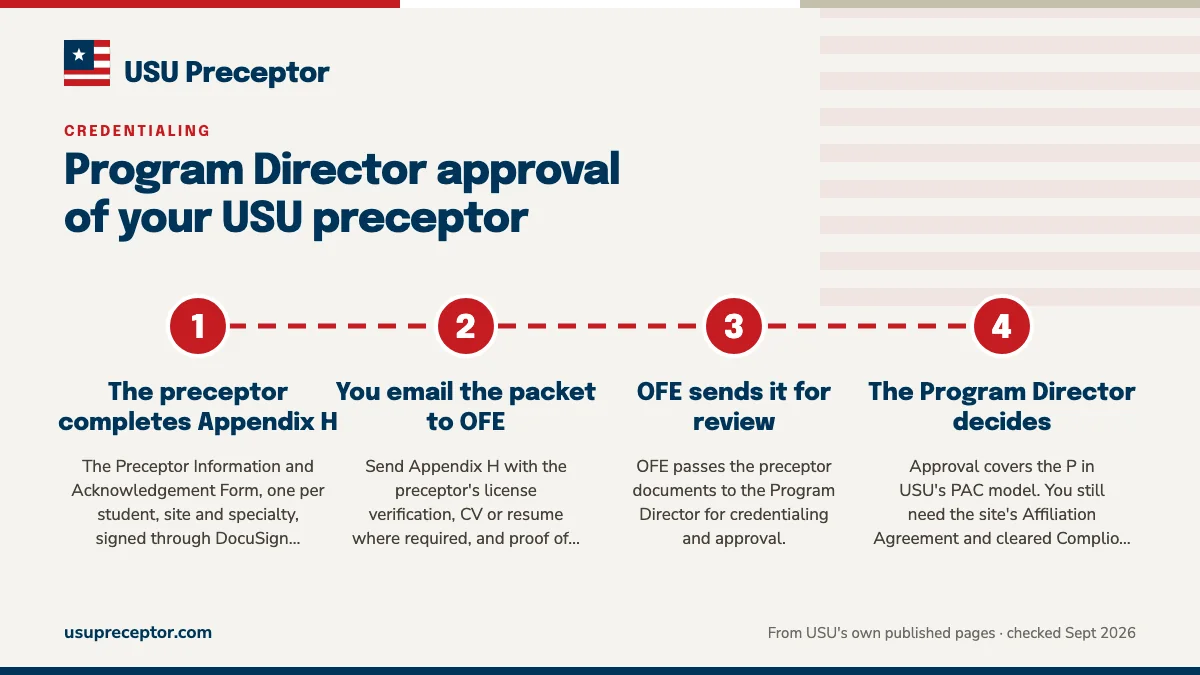
- The preceptor completes Appendix HThe Preceptor Information and Acknowledgement Form, one per student, site and specialty, signed through DocuSign. Exhibit A holds board certification for APRNs; Exhibit B covers employment history when the preceptor has been with their employer under three years.
- You email the packet to OFESend Appendix H with the preceptor's license verification, CV or resume where required, and proof of board certification for APRNs. Use your USU email; the handbook requires it for all college communication.
- OFE sends it for reviewOFE passes the preceptor documents to the Program Director for credentialing and approval.
- The Program Director decidesApproval covers the P in USU's PAC model. You still need the site's Affiliation Agreement and cleared Complio items before OFE emails your approval letter.
Check the file against the Appendix H guide before you send it. A missing exhibit or license verification can mean another round of emails before review starts.
How long approval takes
The FNP handbook says college approval of a preceptor or site takes "4-16 weeks on average." The DNP handbook gives 2–16 weeks for a Project Mentor. USU doesn't publish a turnaround for Nurse Educator, Health Care Leadership or RN-to-BSN reviews.
Set that against the rule that all site, preceptor and health and safety approvals must be on file 16 weeks before the clinical course. If a review runs the full 16 weeks, a packet sent 32 weeks before the course lands just in time. That is earlier than the catalog's 6-month mark for naming three qualified preceptors, which is why the best time to send a packet is the week a preceptor says yes.
USU doesn't say what moves a file toward the short or long end of the range. A complete packet for a preceptor who plainly meets the criteria is the part you control.
USU's handbook says same-day or urgent requests for sites and preceptors can't be accommodated, so plan for the full review time.
What the review checks
USU doesn't publish a list of denial reasons. The criteria in its handbooks are the test, and a preceptor who misses one is unlikely to be approved. For FNP students, check these before anything goes to OFE:
- Type: a board-certified NP or licensed MD or DO; a CNM only for women's health; never a chiropractor, acupuncturist or naturopath. PAs aren't on the list.
- Experience: at least one year at or above the level of licensure of your program, and active clinical practice.
- Credentials: national board certification appropriate for FNP education for NPs, and an active, unencumbered license in the clinical state.
- Employer: employed by the clinical facility, with permission to precept confirmed on Appendix H.
- Relationships: not your spouse, domestic partner, first-degree relative or direct supervisor.
- Setting: right for the course, for example no specialty practice or urgent care for
FNP592, and never inpatient. - Student load: no more than two students at once, counting other schools' NP students; one in New Jersey.
The full rules for every program are on USU preceptor requirements. If a preceptor is turned down, what to do after a denial walks through the fix.
Other decisions that sit with the Program Director
The role reaches beyond signing off preceptors. USU's handbooks send several exceptions and judgment calls to the Program Director:
- A relative or spouse as preceptor. The Clinical Hour Requirements page allows it with written Program Director permission, while the preceptor criteria list it as a ban.
- Optional specialty hours before
FNP597, which need Program Director approval (effective July 2024) and stay within the 40-hour cap. - Misdemeanors on your background check, which the Program Director reviews. Felonies are not accepted.
- Loss of OFE placement help. After a Code of Conduct violation, clinical probation or a jeopardized placement, the Program Director or OFE Director can require you to find your own placements.
None of these has a published turnaround. Ask early, in writing, and keep the reply in your USU email.
Re-review, renewals and new forms
Approval isn't permanent. USU says preceptors are subject to periodic re-review, and OFE asks preceptors to renew licenses that are about to expire. If your preceptor's license runs out during your course, expect OFE to ask for the renewal.
Appendix H is completed per student, per site and per specialty. A preceptor approved for your FNP592 hours at one clinic needs a new form if you see them at a second site or for a different specialty. USU doesn't say whether that new form goes through the full 4–16 week review, so plan as if it might and ask your CPC.
Changing preceptor or site needs approval at least 16 weeks before the course where the change applies. The changing preceptors page covers that path.
How we help before the review
We search for preceptors against USU's criteria for your course and state, then help you put together a complete file: Appendix H with its exhibits, license verification, CV and board certification. The Program Director decides, and a complete file the first time is the best way to keep that review moving.
If you want help, tell us your course and term.
Questions USU students ask
Does USU tell you why a preceptor was denied?
USU's handbooks don't describe a denial notice or what it contains. Ask your CPC by USU email which criterion wasn't met, because the fix depends on it: a missing document can be supplied, but a preceptor of the wrong type or with a relationship conflict can't be approved for that course. Keep your other leads active while you wait.
Can I start clinical hours as soon as my preceptor is approved?
No. Preceptor approval is one part of USU's PAC model. You also need a fully executed Affiliation Agreement with the site and a compliant Complio record, and then OFE emails your approval letter. You may not be on site or log hours until that letter arrives, even if the preceptor is ready for you.
Is approval faster if the preceptor has taught USU students before?
USU doesn't say. OFE keeps an internal database of approved sites and preceptors, but Appendix H is still required for each student, site and specialty, and preceptors face periodic re-review. Ask your CPC whether an existing preceptor's file shortens the process in your case, and don't build your dates around it.
Who approves a DNP Project Mentor?
The Program Director, as with FNP preceptors. The DNP handbook gives 2–16 weeks for the decision and wants site, mentor and health and safety approvals finalized 16 weeks before the immersion course. Mentor identification starts in the program's second course, and the mentor's details go on the DNP handbook's Appendix G, the Project Mentor Information and Acknowledgement Form.
Can I appeal a Program Director's decision on my preceptor?
USU's clinical handbooks don't describe an appeal route for a denied preceptor. Ask your CPC whether the file can be resubmitted, for example with a corrected or missing document, and check the current catalog on USU's catalog site for any wider student policies. Meanwhile, move your next qualified lead forward so the 16-week deadline doesn't slip.
Related pages
Last checked 2026-09-23
We check these pages against USU's own catalog, handbooks and disclosures. USU's current handbook and your Clinical Placement Coordinator have the final word.
- USU FNP Clinical Handbook: Selection Criteria for FNP Clinical Preceptors
- USU FNP Clinical Handbook: Clinical Placement
- USU Appendix H: Preceptor Information and Acknowledgement Form (Nov 2025)
- USU DNP Practice Immersion Handbook: Selection Criteria for Project Mentor
- USU FNP Clinical Handbook: Clinical Attendance and Participation
Six months out is USU's rule. We start now.
Tell us your USU program, your state and when your next practicum opens. We look for preceptors who meet USU's rules and help you build the packet the Office of Field Experience and Program Director review.
- Preceptors matched to the course: family practice, pediatrics, women's health, urgent care within USU's caps
- Appendix H, license, CV and board certification gathered the way OFE asks
- In person near you; telehealth only inside USU's 40-hour limit
Start your placement plan
A placement advisor replies with what a USU-ready preceptor and site look like for you.