North Dakota: USU's FNP clinicals run through the Board's recognition list
USU's admitting nursing programs are all open to North Dakota residents. North Dakota requires distance programs to be recognized by its Board of Nursing before APRN students train in the state, and USU's disclosure lists that approval. What's left for you is checking that it's current for your semester.
Get your placement plan
Tell us your USU track and where you live. A placement advisor replies with what a USU-ready preceptor and site look like for you.
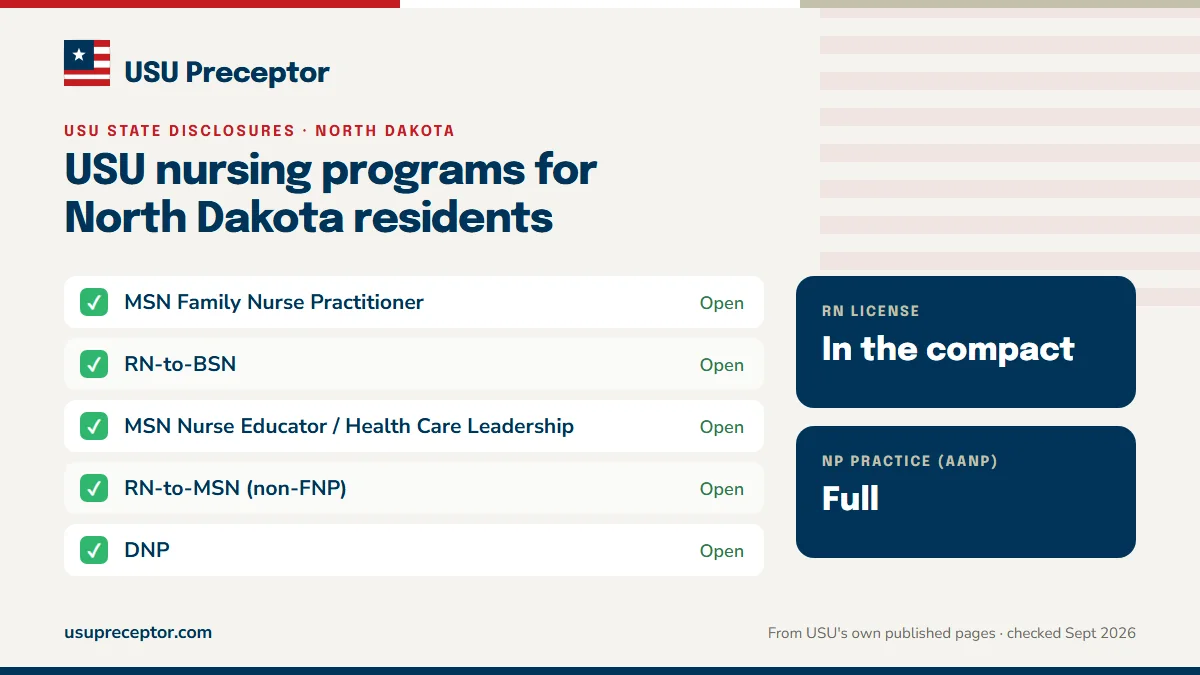
USU programs and hours for North Dakota residents
| Program | Open in North Dakota? | Hours |
|---|---|---|
| MSN Family Nurse Practitioner | Yes | 540 (FNP592 to FNP597) |
| MSN Nurse Educator | Yes | 100 |
| MSN Health Care Leadership | Yes | 100 |
| RN-to-BSN | Yes | 90 |
| DNP | Yes | 1,000 post-baccalaureate |
No USU exclusion list names North Dakota. The recognition rule below is the part that's particular to this state.
How North Dakota recognizes distance programs
Distance programs placing students in North Dakota facilities are recognized by the North Dakota Board of Nursing (NDBON). Because the Board's definition reaches any program that leads to LPN, RN or APRN licensure, NP programs such as USU's FNP fall within it. A program's request is due 60 days before planned student activity, and graduate programs pay an annual fee.
The statute works in two parts. Out-of-state programs need approval from the nursing board of the state where they're headquartered, under NDCC 43-12.1-17(1). Students practicing in a board-recognized program from another state are then exempt under NDCC 43-12.1-04(12), once the Board is notified in writing and provided clinical sites are available.
Where USU stands on the list
USU's Board of Nursing disclosure, updated May 19, 2026, lists North Dakota approval for APRN clinical placements and shows USU as recognized for 2024-2025. USU's separate state authorization disclosure shows a North Dakota date of March 26, 2026, which has passed. Research for this page didn't confirm USU's place on the Board's 2026-2027 list.
That gap is worth one email. Before you build an FNP rotation around a North Dakota clinic, ask your Clinical Placement Coordinator whether USU's recognition covers the semester your hours fall in.
Recognized once doesn't mean recognized now. Confirm USU's North Dakota status for your semester before you commit to a site.
What the Board receives about you each semester
Recognition isn't a one-time filing. A recognized program sends NDBON a roster every semester, ahead of any student activity, covering:
- Student names, with North Dakota or compact license information
- The facilities and courses involved
- Preceptor and faculty names, resumes and North Dakota or compact licenses
- Affiliation agreements, plus each facility's verification of clinical space
USU files this, not you, but it overlaps with what OFE already collects: your Appendix H preceptor form, the preceptor's CV and license, and the affiliation agreement. A preceptor swap close to a course start may need to reach the Board before you work with the new person, so tell your CPC as soon as a lead changes.
Full practice, from Fargo to Minot
AANP lists North Dakota as a full practice state, so NP-led practices belong on your list; USU wants at least 135 of your 540 hours with an NP. Census estimates for 2025 put about 202,000 North Dakotans in the Fargo metro, 140,000 in Bismarck, 76,000 in Minot and 75,000 in the Grand Forks metro.
In North Dakota, FNP students look at CHI St. Alexius Health in Bismarck; Trinity Health in Minot; Essentia Health in Fargo; Altru Health System in Grand Forks; and Sanford Health, which has medical centers in Fargo and Bismarck. They're examples, not a list of USU sites, and whichever you approach, the hours have to be outpatient.
Licensing: two compacts, one waiting
North Dakota implemented the Nurse Licensure Compact on January 19, 2018, and enacted the APRN Compact in 2021. Seven enactments are needed before the APRN Compact operates, and as of 2026 only five states have passed it: Delaware, North Dakota, South Dakota, Utah and Wyoming. Until it is, there's no multistate APRN license to plan around.
USU requires an active, unencumbered RN license in your state on file and in any state where you train. Fargo and Grand Forks both reach across the Minnesota line, and Minnesota isn't a compact state, so a clinic on that side would need a Minnesota license as well as USU's agreement to out-of-state hours. See RN license for clinicals.
Why North Dakota students choose us
A placement advisor searches North Dakota for preceptors who fit your USU course and gathers the details OFE needs, much of which also goes on the Board's roster. If a preceptor drops, we search again. USU approves every placement and deals with the Board. Ask about a North Dakota search.
Questions USU students ask
Do I need a North Dakota license for USU clinicals there?
USU requires an active, unencumbered RN license where you live and where you train. NDBON's roster asks for each student's North Dakota or compact license information, so a multistate license from another compact state is the kind it expects to see. For a North Dakota resident, that's normally the license North Dakota issued.
Does North Dakota's recognition rule apply to USU's RN-to-BSN?
In NDBON's description, distance recognition applies to programs that lead to LPN, RN or APRN licensure; RN-to-BSN programs aren't described as covered. USU's practicum handbook still asks for an active license in the state of your rotation, and the practicum is 90 community hours across NUR378 and NUR499. See the RN-to-BSN page.
What if USU isn't on North Dakota's current recognition list?
The statute's student exemption applies to board-recognized out-of-state programs, so recognition is what lets USU FNP students train in North Dakota. If your CPC can't confirm it for your semester, plan with them before committing to a site. USU's own process adds a backstop: no hours count before your OFE Approval Letter.
Can telehealth count toward my hours in North Dakota?
Up to 40 hours across the FNP, with approval. The patients must be in North Dakota, your state on file, and you must be licensed there. Your preceptor has to be physically with you, video is required and teleprecepting isn't approved. See virtual clinical options.
Related pages
Last checked 2026-09-23
We check these pages against USU's own catalog, handbooks and disclosures. USU's current handbook and your Clinical Placement Coordinator have the final word.
Six months out is USU's rule. We start now.
Tell us your USU program, your state and when your next practicum opens. We look for preceptors who meet USU's rules and help you build the packet the Office of Field Experience and Program Director review.
- Preceptors matched to the course: family practice, pediatrics, women's health, urgent care within USU's caps
- Appendix H, license, CV and board certification gathered the way OFE asks
- In person near you; telehealth only inside USU's 40-hour limit
Start your placement plan
A placement advisor replies with what a USU-ready preceptor and site look like for you.