USU's FNP in South Dakota: no program approval, one faculty expectation
Every admitting USU nursing program is open to South Dakota residents. Out-of-state programs aren't approved by the South Dakota Board of Nursing; placements rest on agreements the program makes with an in-state preceptor or agency. Even so, the Board wants the program to have a faculty member licensed for South Dakota.
Get your placement plan
Tell us your USU track and where you live. A placement advisor replies with what a USU-ready preceptor and site look like for you.
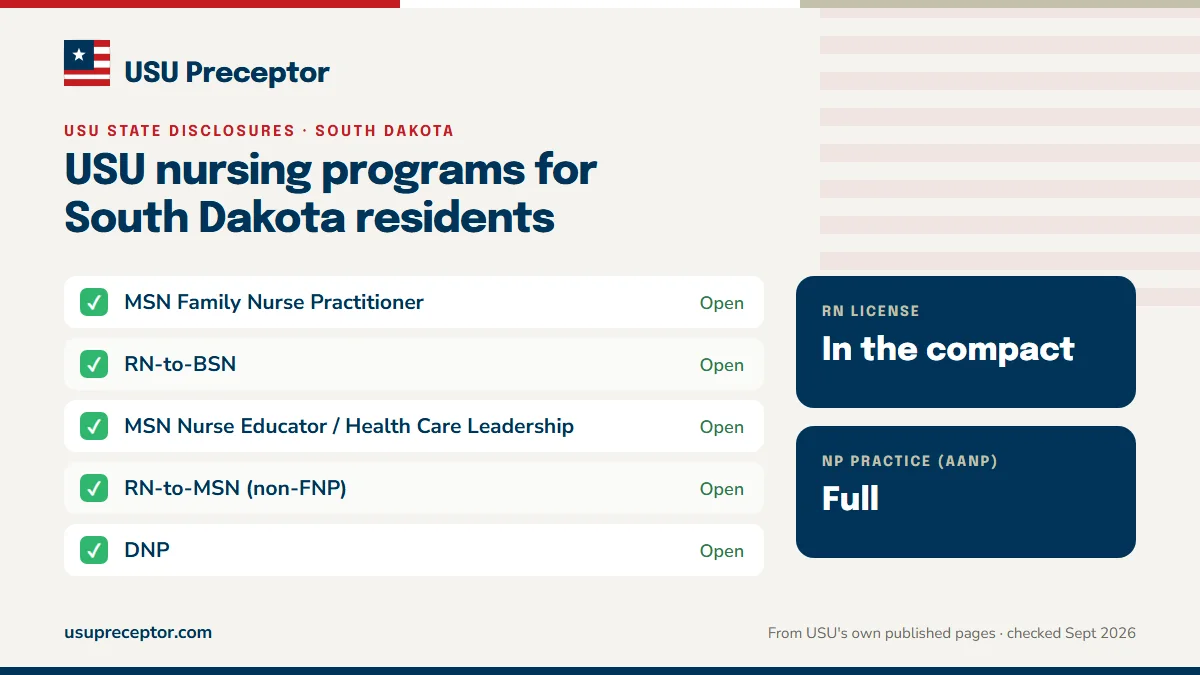
Can you take USU's programs from South Dakota?
| Program | Open to South Dakota residents? | Clinical hours |
|---|---|---|
| MSN Family Nurse Practitioner | Yes | 540, in four 135-hour courses |
| MSN Nurse Educator | Yes | 100 (MSN578) |
| MSN Health Care Leadership | Yes | 100 (MSN587) |
| RN-to-BSN | Yes | 90 (NUR378, NUR499) |
| DNP | Yes | 1,000 post-baccalaureate |
None of USU's admitting programs is closed to South Dakota residents. The Post-Master's FNP certificate is out of reach here as everywhere, because it's closed to new applicants.
What the South Dakota Board does and doesn't do
The Board's guidance for out-of-state nursing programs, revised in June 2020, says it does not approve out-of-state programs. For direct-care settings in South Dakota, the program reaches its own placement agreement with the preceptor or agency in the state. For you, the paperwork that matters is USU's: the affiliation agreement OFE sends to your site and the Appendix H form your preceptor signs.
The Board does expect one thing of the program: at least one faculty member licensed in South Dakota or holding a privilege to practice there, which for APRN students means an SD APRN license. ARSD 20:48:07:49 says the same for faculty teaching APRN students located in the state. That's for USU to arrange, and research didn't show how it does, so it's a fair question for your CPC before your first South Dakota course.
Preceptors: USU's rules and South Dakota's standard
ARSD 20:48:07:34 sets South Dakota's preceptor standard, and it is aimed at Board-approved programs. Under it, a preceptor should hold licensure matching or exceeding the level the student is training toward, and an APRN preceptor should practice in a role, focus or specialty comparable to the student's. USU's rules point the same way: a board-certified NP or a licensed MD or DO, a year of experience, an active South Dakota license and at least 135 of your 540 hours with an NP.
AANP lists South Dakota as full practice after an NP's first 1,040 hours, which are worked in written collaboration with a physician, certified NP or certified nurse midwife. If a newer NP is still working under such an agreement, their collaborating physician is another name to ask, since USU accepts licensed MDs and DOs. The Program Director approves each preceptor; preceptor requirements has the full list.
Sioux Falls, Rapid City, Aberdeen
Census estimates for 2025 put about 305,000 South Dakotans in the Sioux Falls metro, 157,000 in Rapid City and 42,000 in the Aberdeen micro area. FNP students in South Dakota tend to look at three systems, namely Avera Health, Monument Health and Sanford Health. That's where students search, not a list of sites with USU agreements.
USU's catalog expects you to travel anywhere in your state at your own expense, so a student in Aberdeen should keep both larger metros in view. Look for outpatient primary care: inpatient hours never count, and FNP592 must be family practice, primary care or primary care internal medicine.
Licensing: the RN compact now, the APRN Compact later
For South Dakota, Nurse Licensure Compact participation began January 19, 2018. It also enacted the APRN Compact, signed February 5, 2024, but that compact activates only once seven states enact it, and five have so far. For USU, your RN license is what counts: active and unencumbered in your state on file and wherever you train, with liability insurance in the same state.
The Sioux Falls metro reaches into Minnesota, which isn't a compact state. A clinic on that side would mean a Minnesota license and an out-of-state request whose hours USU can't promise another board will accept. See RN license for clinicals.
How a placement advisor helps
A placement advisor searches South Dakota for preceptors who fit your USU course and helps you prepare the preceptor packet and site details OFE and the Program Director review. Should a preceptor pull out, a new search starts. USU approves every preceptor, site and agreement. Request a South Dakota search.
Questions USU students ask
Does USU's FNP meet South Dakota's requirements for APRN licensure?
On hours, yes: the Board looks for a graduate APRN program that includes 500 or more clinical hours in the role and population focus; USU's FNP has 540. The Board also requires graduate courses in pathophysiology, health and physical assessment, and pharmacology. USU's disclosure says its MSN-FNP meets APRN educational requirements in the states where it's authorized, South Dakota included.
Do I have to register with the South Dakota Board before clinicals?
The Board's published guidance asks no registration or application of students in out-of-state programs; placement rests on agreements between the program and the preceptor or agency. Your steps run through USU instead: Program Director approval, the affiliation agreement, compliance items in Complio and the OFE Approval Letter before any hours.
Can a certified nurse midwife precept me in South Dakota?
For women's health hours only. USU accepts a board-certified CNM for that part of the FNP, alongside OB/GYN physicians, FNPs and WHNPs. South Dakota lets CNMs serve as collaborating partners for newer NPs, but USU's preceptor rules, not the state's practice rules, decide who can supervise your hours.
What if my Sioux Falls preceptor already has a student from another school?
USU allows at most two students per preceptor at the same time, and NP students from other schools count toward that limit. Any hours logged while that limit is exceeded won't be accepted. Ask any preceptor about their other students before you list them, and tell your CPC if the picture changes mid-course.
Related pages
Last checked 2026-09-23
We check these pages against USU's own catalog, handbooks and disclosures. USU's current handbook and your Clinical Placement Coordinator have the final word.
Six months out is USU's rule. We start now.
Tell us your USU program, your state and when your next practicum opens. We look for preceptors who meet USU's rules and help you build the packet the Office of Field Experience and Program Director review.
- Preceptors matched to the course: family practice, pediatrics, women's health, urgent care within USU's caps
- Appendix H, license, CV and board certification gathered the way OFE asks
- In person near you; telehealth only inside USU's 40-hour limit
Start your placement plan
A placement advisor replies with what a USU-ready preceptor and site look like for you.