USU's online FNP and nursing programs in Minnesota
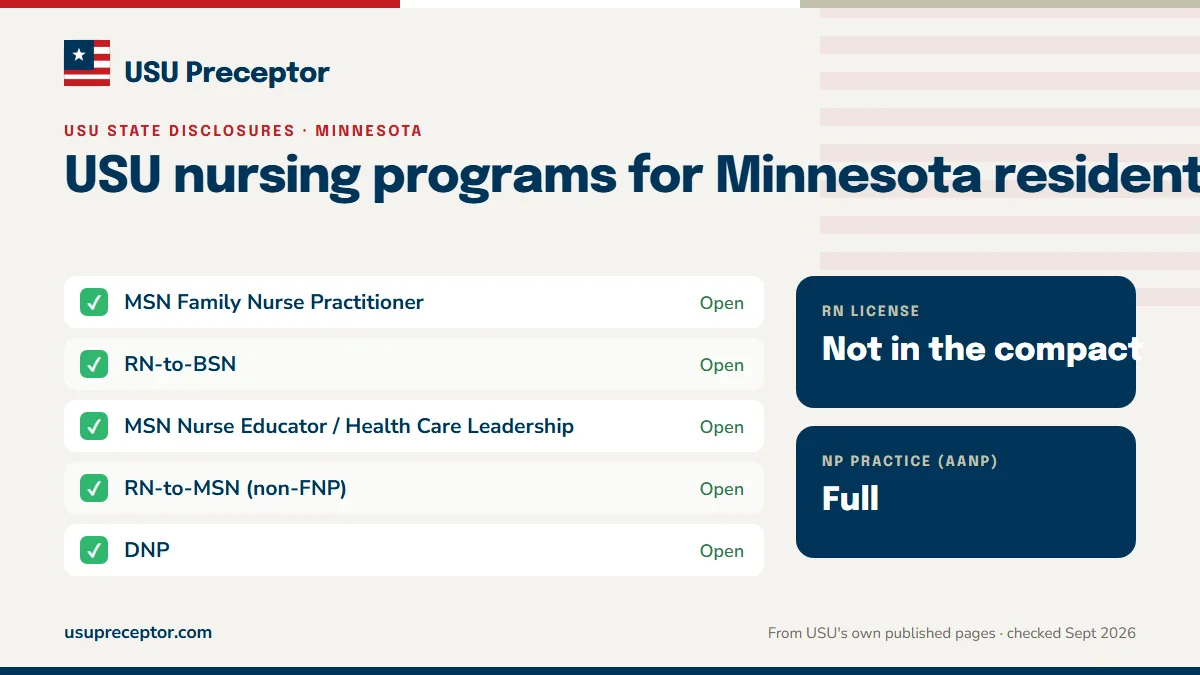
Minnesota residents are eligible for USU's FNP and every other nursing program USU is admitting. Programs from other states face no Minnesota board approval step, but some large sites set their own bar, and Minnesota has no part in the Nurse Licensure Compact.
Get your placement plan
Tell us your USU track and where you live. A placement advisor replies with what a USU-ready preceptor and site look like for you.
Can you enroll from Minnesota? Yes
None of USU's exclusion lists names Minnesota, and USU's disclosure lists no Minnesota clinical filing or approval. Every admitting program is open to you.
| USU program | Open in Minnesota | Clinical or practice hours |
|---|---|---|
| FNP (MSN) | Yes, open | 540 (four practicums of 135) |
| Nurse Educator (MSN) | Yes, open | 100 (MSN578) |
| Health Care Leadership (MSN) | Yes, open | 100 (MSN587) |
| RN-to-BSN | Yes, open | 90 across two community practicum courses |
| DNP | Yes, open | 1,000 post-baccalaureate practice hours |
USU's MSN admission asks for an unencumbered RN license where you live, which here means a Minnesota license. Keep its registration current as well: Minnesota's rule on supervising instructors and Mayo Clinic's site rules both refer to current registration, not just the license.
Full practice, after 2,080 hours
The AANP rates Minnesota as full practice, with a condition: an NP first builds up at least 2,080 hours of practice while collaborating, by agreement, with a physician or an APRN. After that, the NP can practice without one.
So your preceptor pool can include NPs who practice independently as well as those still inside a collaborative agreement. Whichever you find, USU's tests are the same: board certification for an NP (or an MD or DO instead), a year or more of experience, an active Minnesota license, and a cap of two students per preceptor. NPs have to supervise at least 135 of your hours. See preceptor requirements.
What Minnesota law says about out-of-state programs
Minnesota's board approves programs “conducted in Minnesota,” and no separate approval step for out-of-state programs turned up in our review of its rules. In the student exemption, Minn. R. 6305.0300 treats “nursing program approved by the board” as including any program in the U.S. or Canada that its own state or province has approved, provided the supervising instructor has a Minnesota RN license with current registration.
A second exemption, Minn. Stat. 148.271(6), covers RNs licensed in another state who are in Minnesota for a formal course of study such as a higher degree. USU's rule is stricter than that exemption. The FNP handbook wants an active, unencumbered license both in the state on your USU record and in every state that hosts your clinicals, so Minnesota clinicals mean a Minnesota license.
No compact bill is pending in Minnesota, which remains a non-member of the Nurse Licensure Compact. Your Minnesota license won't reach Wisconsin, a compact state, even though the Twin Cities and Duluth metros both cross into it. More on RN licenses for clinicals.
Sites can ask for more: the Mayo Clinic example
Mayo Clinic's NP clinical education program shows how a site can go beyond the statute. Mayo requires an affiliation agreement between itself and the student's program, and for academic experiences in Minnesota it asks for a background study by Minnesota's human services department, along with an unencumbered Minnesota nursing license whose registration is current. It also wants faculty of record licensed as an RN or APRN in the state where the experience happens.
Mayo is an example of site rules, not a site we can vouch for. At USU, affiliation agreements go out from OFE, with four to six months allowed for a new one, so hand any large-system lead to your CPC early. See affiliation agreements.
Twin Cities, Rochester, Duluth, St. Cloud
About 3.65 million Minnesotans live in the Minneapolis-St. Paul-Bloomington metro. Duluth (about 237,000 on the Minnesota side), Rochester (about 231,000) and St. Cloud (about 206,000) follow. Among the state's large systems are Mayo Clinic, M Health Fairview and HealthPartners, plus Allina Health and Essentia Health. Treat the list as a starting map, not a roster of USU partners, and ask your CPC what's already in place.
One state program doesn't help here. Minnesota's MERC program partly compensates Minnesota clinical training sites for accredited training, APRNs included, but it doesn't pay individual preceptors, and both the teaching program and the site must be in Minnesota. USU students, from an out-of-state program, don't generate MERC funds.
How we help Minnesota students
A placement advisor searches for Minnesota NPs and physicians who fit your USU course, checks their Minnesota licenses and registration, and helps you assemble the preceptor paperwork. The final word belongs to USU's Program Director and OFE, and the paperwork in front of them arrives complete. If a preceptor drops out, we start a new search. Tell us your course.
Questions USU students ask
Do I need a Minnesota RN license for USU clinicals in Minnesota?
Yes. Minnesota law exempts RNs licensed elsewhere who are in the state for a formal course of study, such as a higher degree, but that exemption doesn't change USU's own requirement: a license in good standing both where USU lists your address and wherever you see patients, with liability insurance in that same state.
Can I do my USU clinicals at Mayo Clinic?
Only if the pieces line up. For its NP clinical education program, Mayo requires a Minnesota DHS background study, a Minnesota license that has current registration, and an affiliation agreement with the student's program. USU's OFE handles agreements, and no placement at any system is promised. Ask your CPC whether an agreement exists before you invest time in it.
Does Minnesota pay preceptors who teach USU students?
No state program we found does. MERC, run by the Minnesota Department of Health, compensates Minnesota clinical training sites rather than individual preceptors, and its eligibility criteria require the accredited teaching program to be located in Minnesota. Because USU is an out-of-state program, its students don't generate MERC funds for a site.
Can I do clinicals on the Wisconsin side of the Twin Cities or Duluth metro?
You can request it, but Minnesota isn't in the compact, so your Minnesota license doesn't carry into Wisconsin; you'd need a Wisconsin license or privilege to practice there. USU also encourages keeping clinicals in your approved state of residence, which a Minnesota-side site does.
Related pages
Last checked 2026-09-23
We check these pages against USU's own catalog, handbooks and disclosures. USU's current handbook and your Clinical Placement Coordinator have the final word.
Six months out is USU's rule. We start now.
Tell us your USU program, your state and when your next practicum opens. We look for preceptors who meet USU's rules and help you build the packet the Office of Field Experience and Program Director review.
- Preceptors matched to the course: family practice, pediatrics, women's health, urgent care within USU's caps
- Appendix H, license, CV and board certification gathered the way OFE asks
- In person near you; telehealth only inside USU's 40-hour limit
Start your placement plan
A placement advisor replies with what a USU-ready preceptor and site look like for you.