Out-of-state clinicals and excluded states at USU
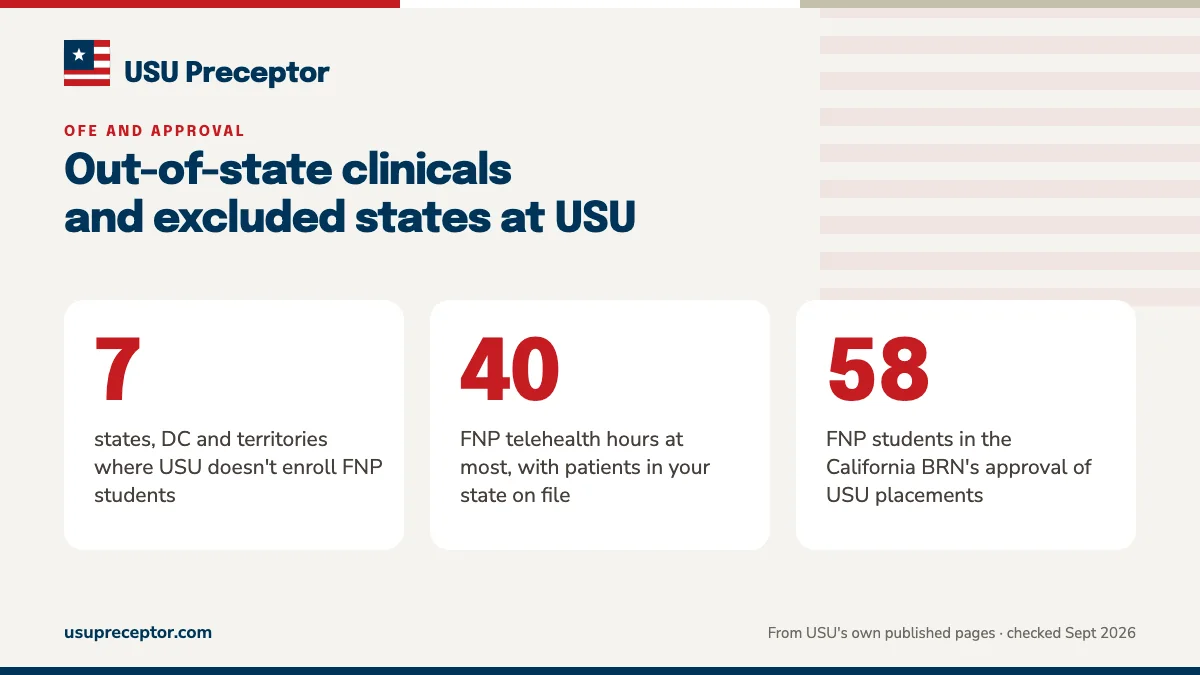
USU doesn't enroll students who live in states where it isn't authorized for their program, and for the FNP that rules out Kansas, Maryland, New Hampshire, New York, DC and two territories. Where you can enroll, USU wants your clinical hours in your home state, with an active nursing license in every state where you see patients. California adds its own rules under 16 CCR 1486.
Looking for a preceptor in your state?
Tell us where you live and your USU course.
Where USU won't enroll you, by program
USU's accreditation page links two lists: the Board of Nursing authorizations, updated May 19, 2026, and the state authorization disclosures, dated September 11, 2026. USU says it doesn't enroll students who live in states where it isn't authorized to offer their program. This table combines both lists.
| Program | Not offered to residents of | Note |
|---|---|---|
| MSN Family Nurse Practitioner | Kansas, Maryland, New Hampshire, New York, District of Columbia, American Samoa, Northern Mariana Islands | Open to Washington residents |
| MSN Nurse Educator, Health Care Leadership and the closed MSN tracks | Maryland, Washington, District of Columbia, American Samoa, Northern Mariana Islands | USU's two lists conflict on Washington |
| RN-to-BSN | Maryland, Washington, District of Columbia, American Samoa, Northern Mariana Islands | Both lists exclude Washington |
| RN-to-MSN (all specializations) | Idaho, Maryland, Oregon, Utah, Washington, District of Columbia, American Samoa, Northern Mariana Islands | No FNP specialization exists |
| DNP | Idaho, Maryland, New York, Oregon, Utah, Washington, District of Columbia, American Samoa, Northern Mariana Islands | Utah listed as ineligible per its board |
| Post-Master's FNP Certificate | Every state | Closed to new applicants since April 2024 |
American Samoa and the Northern Mariana Islands aren't authorized for distance education, and Maryland and DC require board of nursing approval USU hasn't obtained. For the FNP, USU says it doesn't meet Kansas's APRN clinical-hour rule (500 role-specialty hours if admitted on or before March 1, 2025, 750 after), New Hampshire's approval for out-of-state APRN programs hasn't been obtained, and New York requires prescription-law coursework USU doesn't offer.
Two conflicts to know. The Board of Nursing list says USU enrolls only the MSN FNP in Washington, while the state authorization list excludes RN-to-BSN there but not the other MSN tracks. Treat Washington as FNP-only until USU confirms otherwise. The PM-FNP closure date also differs: April 25, 2024 in the catalog, April 18, 2024 in the board list.
Your home state is where USU wants your hours
USU's Board of Nursing disclosure says it “encourages all students to complete their clinical hours in their approved state of residence.” You can ask to do hours in another state where USU is approved, but USU says it can't promise that state's licensing board will accept them. That matters most for FNP students, whose hours support an APRN license application.
Inside your state, expect to travel. The catalog says you must be willing to travel to any site in your state at your own expense, and travel time isn't an acceptable reason to turn down a placement. The FNP handbook describes that travel as within the state where you live or work.
Moving is the other risk. If you move to a state where your program isn't offered, you can't finish it. USU also says it isn't responsible for a clinical placement if you move after a term starts or, for out-of-state placements, within two terms before clinicals begin. Travel nurses must update their address to wherever they'll do clinicals. Our state pages cover the details state by state.
A license in every state where you see patients
The FNP handbook requires an active, unencumbered nursing license in your state on file and in any state where you do clinicals. It adds that your license and your liability insurance should both be active in the same state. The practicum handbook for RN-to-BSN, Nurse Educator and Health Care Leadership asks for an active license from the state where you expect to do your practicum.
Your preceptor needs a matching license too: FNP preceptors must hold an active, unencumbered license in the state where the clinical takes place. States can also go further than USU: the FNP handbook says state requirements on points like preceptor eligibility and ratios take precedence over university policy. USU's own ratio rule already carves out New Jersey, where placements must run 1:1 instead of the usual limit of two students per preceptor.
How multistate compact licenses fit these rules is covered on our RN license for clinicals page.
Telehealth follows your address on file
Telehealth doesn't get you around the state rule. Appendix I of the FNP handbook says telehealth patients must be located in the state of your address on file with USU, and you must be licensed there. The FNP allows at most 40 telehealth hours across the whole program, and only with approval.
Your preceptor must be physically with you, video is required and phone-only visits don't count. Teleprecepting, where you and your preceptor are in different places, isn't approved. The handbook asks you to declare telehealth on a Preceptor Nomination Form, which doesn't appear in the FNP appendix list, so ask your Clinical Placement Coordinator (CPC) which document it means. More on this under virtual clinical options.
States with extra clinical paperwork
USU's Board of Nursing list notes states where clinicals trigger extra filings, or where USU holds a specific approval. They're listed as USU's own filings and approvals. If your state appears here, ask your CPC whether it changes anything for your placement.
- Alabama: documentation required from out-of-state APRN programs doing clinicals.
- Delaware and Wyoming: filings for programs with clinical or preceptor components.
- North Dakota: approval for APRN clinical placements, listed as recognized for 2024-2025.
- Louisiana: approval on file for MSN FNP graduate clinical experiences.
- Tennessee, Arizona and Wisconsin: FNP approval, or approved out-of-state school status, on file.
- Washington: approved for practice experiences for Washington residents in the MSN FNP.
- Idaho: 11 or more students at one site at the same time triggers a physical-presence rule.
The September 2026 state authorization list also shows several state approval dates that have already passed, with SARA listed for most of those states. If yours is one of them, ask your CPC whether anything has changed.
California: an out-of-state program under 16 CCR 1486
USU's disclosure says it isn't accepting students into any in-state California track; its programs are registered with California's BPPE as out-of-state programs, valid until May 20, 2030. The California Board of Registered Nursing (BRN) lists USU's FNP on its Out-of-State NP Programs page at the Sandy Springs, Georgia address. USU notes the BRN doesn't approve RN-to-BSN or non-FNP MSN programs.
A BRN letter dated February 7, 2025 confirms the Board's August 2024 approval of California clinical placements for USU's FNP, for 58 students. Under 16 CCR 1486, those placements come with conditions:
- You need an active, valid California RN license to take part in clinicals in California.
- Your preceptor needs a valid, active California license, must be oriented to the program, and must be evaluated by program faculty at least every two years.
- The agency, preceptor and program sign a written agreement setting out the preceptor's role.
- The BRN can withdraw authorization for California placements at any time.
Two points are unclear. The BRN's NP program list still shows USU at its old San Diego address, and USU hasn't said whether the 58-student figure limits California seats. Some California health systems add their own gate: UC San Diego Health says it's considering new out-of-state NP affiliations only for its employees and specialty areas of need. See our California page.
Why students choose our home-state search
Because USU wants your hours at home, a placement advisor searches in your state of residence first and checks that each preceptor is licensed where the clinic sits; in California, that you both hold California licenses. State filings are USU's, and OFE and the Program Director approve every site and preceptor, so our effort goes into a preceptor who fits both your course and your state. If a search in your state would help, start here.
Questions USU students ask
Can I do USU clinicals in a different state from where I live?
You can ask, as long as USU is approved in that state, but USU encourages hours in your state of residence and says it can't promise another state's board will accept out-of-state hours. You'd also need an active nursing license in that state. Raise it with your Clinical Placement Coordinator well before the 16-week deadline.
Can I take USU's FNP if I live in New York or Kansas?
No. USU's Board of Nursing list excludes both for the FNP. New York requires coursework on state and federal prescription law that USU doesn't offer, and USU says its FNP doesn't meet Kansas's APRN clinical-hour rule. New York residents can still enroll in USU's RN-to-BSN and non-FNP MSN tracks, though not the DNP.
Do I need a California RN license for clinicals in California?
Yes. Under 16 CCR 1486(d), students in a non-California NP program need an active, valid California RN license to take part in clinicals there, and USU's own rule requires a license in every state where you do clinicals. Your California preceptor also needs a California license and faculty evaluation at least every two years.
What happens if I move to another state during USU's program?
If your program isn't offered in the new state, you can't finish it at USU. If it is offered, USU says it isn't responsible for placing you after a move once a term has started, or within two terms before clinicals for out-of-state placements. Update your address with USU and talk to your CPC before you move.
Can my telehealth patients be in a different state?
No. USU's Appendix I requires telehealth patients to be in the state of your address on file, and you must be licensed there. FNP telehealth is capped at 40 hours for the whole program, your preceptor must be physically with you, and teleprecepting from separate locations isn't approved.
Related pages
Last checked 2026-09-23
We check these pages against USU's own catalog, handbooks and disclosures. USU's current handbook and your Clinical Placement Coordinator have the final word.
Six months out is USU's rule. We start now.
Tell us your USU program, your state and when your next practicum opens. We look for preceptors who meet USU's rules and help you build the packet the Office of Field Experience and Program Director review.
- Preceptors matched to the course: family practice, pediatrics, women's health, urgent care within USU's caps
- Appendix H, license, CV and board certification gathered the way OFE asks
- In person near you; telehealth only inside USU's 40-hour limit
Start your placement plan
A placement advisor replies with what a USU-ready preceptor and site look like for you.