Your RN license and USU clinicals: which states you need
USU's license rule covers two places, the state on file with USU and each state where you log clinical hours, and in both your RN license must be active and unencumbered. A multistate compact license can extend to other compact states, though not to the states outside the compact, and California applies its own rule to students in NP programs based elsewhere.
Need a preceptor in the state where you're licensed?
Tell us your state, USU course and start date. A placement advisor will reply by email.
USU's license rules, program by program
USU states its license rules in three places: the catalog's admission requirements, the FNP Clinical Handbook, and the RN-BSN, Nurse Educator and Health Care Leadership handbook. The Appendix A checklist also lists an active, unencumbered nursing license as a compliance item, so OFE checks it alongside your immunizations and insurance.
| Program or stage | License rule USU states |
|---|---|
| MSN admission (all tracks) | Valid, unrestricted, unencumbered RN license in the state where you reside |
| FNP clinicals | Active, unencumbered license in your state on file and in any state where you do clinicals; license and liability insurance active in the same state |
| RN-BSN, Nurse Educator and Health Care Leadership practicums | Active nursing license from the state where you expect to do your clinical rotation |
| RN-BSN admission | Valid, unrestricted, unencumbered RN license, or an NCLEX-RN date before the end of the first term |
| DNP admission | Valid, unrestricted, unencumbered RN and/or APRN license |
Your state on file comes first
USU builds clinicals around where you live. Its Board of Nursing disclosure says USU encourages every student to complete clinical hours in their approved state of residence. You may ask to do hours in another state where USU is approved, but USU says it can't promise that state's licensing board will accept them. Our out-of-state clinicals page covers USU's excluded states by program.
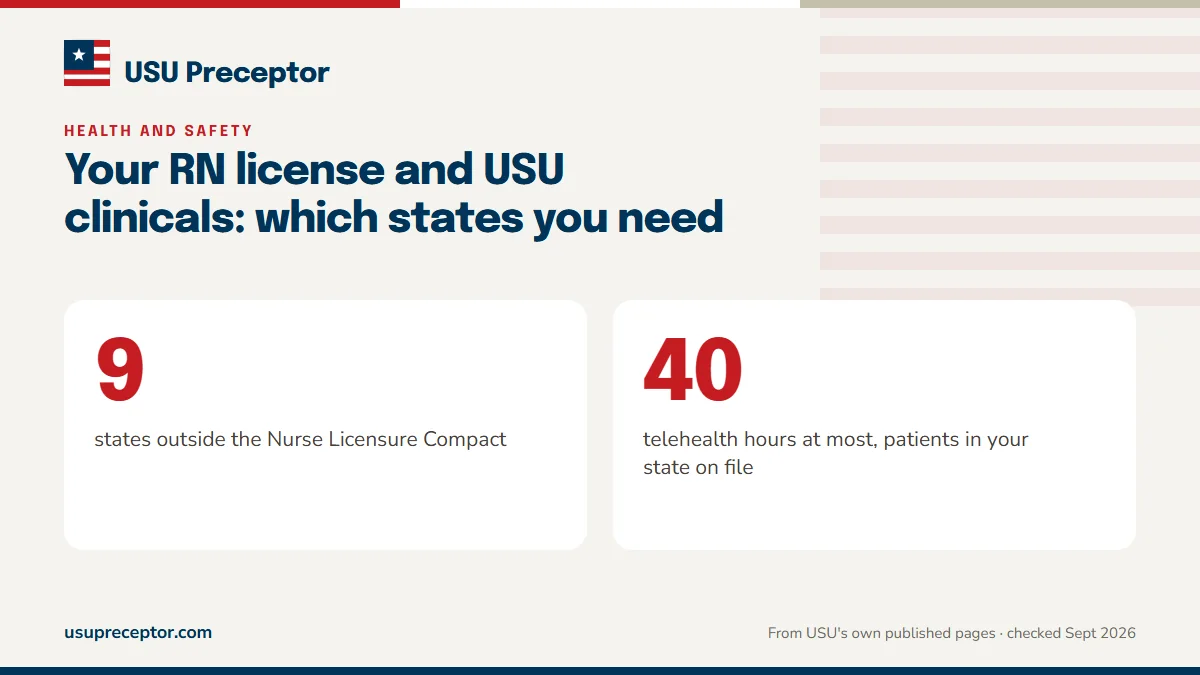
Your state on file also governs telehealth. For FNP telehealth hours, patients must be in the state of your address on file with USU, and you must be licensed there. Telehealth is capped at 40 hours for the whole program, as our virtual clinical options page explains.
Two more rules point toward a single licensing state. The catalog says you must be willing to travel anywhere in your state for clinicals, at your own expense. The FNP handbook adds that states may impose their own requirements, which take precedence over USU policy.
Compact (multistate) licenses
The Nurse Licensure Compact lets a nurse hold one multistate license in their primary state of residence and practice in the other compact states, as the Ohio Board of Nursing describes it. According to the compact's official map, it is in effect in 40 of the 50 states.
Nine states remain outside: Alaska, California, Hawaii and Illinois, plus Michigan, Minnesota, Nevada, New York and Oregon. Massachusetts passed compact legislation, but its board says it isn't in effect yet and is targeting implementation for May 2027. In all ten, holding another state's multistate license confers no practice privilege.
Some boards spell out what students need. Georgia says residents enrolled in an out-of-state program who do clinical hours there must hold either a Georgia license or another compact state's multistate license. Arizona says APRN students from out-of-state programs need an unencumbered Arizona or multistate RN license. North Carolina tells graduate students who hold neither an NC nor a multistate license to check the requirements with its board.
USU's student license rules talk about a license in each clinical state and don't address compact privileges directly. If you plan to rely on a multistate license for clinicals outside your home state, confirm with your CPC that USU will accept it for that placement.
A compact license doesn't reach California, New York or the other non-compact states. Check the clinical state before you count on it.
California's own rule
California has not joined the compact, and its Board of Registered Nursing (BRN) has a rule written specifically for students whom out-of-state NP programs place in the state. Under 16 CCR 1486, those students must hold an active, valid California RN license. The BRN lists USU's FNP on its out-of-state NP programs page, at USU's Sandy Springs, Georgia address.
The picture isn't fully tidy. The BRN's list of California NP programs still shows USU at its San Diego address, while USU says its in-state California track isn't accepting students. The BRN's rules for California-based programs, in section 1484, were amended effective October 1, 2025, so that either a California RN license or one held in the preceptorship's state is accepted. The sources we checked don't say which section governs a USU student admitted now, so plan on a California RN license for California hours and confirm with OFE.
USU's catalog also notes that California NP certification requires an active California RN license, whichever route your clinical hours take.
If you live in California, our California page covers what this means for USU's FNP.
Your insurance and your preceptor's license follow the same state
USU's FNP handbook says your nursing license and your liability insurance should both be active within the same state. Your student malpractice policy, the one that must state NP Student, needs to line up with the state where you're licensed and doing clinicals. The details are on our student malpractice insurance page.
Your preceptor is held to a parallel rule. An FNP preceptor needs an active, unencumbered license issued by the state hosting the clinical, and in California the BRN requires preceptors for out-of-state programs to hold a valid, active California license. More is on our preceptor requirements page.
Moving, travel nursing and keeping your license clean
A move can end a program. USU's catalog says a student who moves to a state where their program isn't offered can't complete it. The FNP handbook adds that USU isn't responsible for securing a placement for a student who moves after a term starts, and for out-of-state placements that also covers a move within two terms before clinicals begin.
Travel nurses must update their address with USU to wherever they'll do clinicals, and the license and liability insurance for that state need to be in place.
Keep your license active and unencumbered for the whole program. If anything changes, such as an expiry, a discipline matter or a move, tell your CPC straight away rather than waiting for it to surface in a compliance review.
Why students choose our in-state search
We search for preceptors and sites in the state where you're licensed and on file with USU, which is where USU encourages you to do your hours, and always in a state where USU offers your program. Licensing questions go to your board of nursing, which has the final word on your license.
USU approves every preceptor, site and agreement. Tell us your state and course, and a placement advisor will get back to you.
Questions USU students ask
Must my RN license cover the state where I do USU clinicals?
Yes. USU's FNP handbook requires an active, unencumbered nursing license in your state on file and in any state where you do clinicals. The RN-BSN, Nurse Educator and Health Care Leadership handbook asks for an active license from the state where you expect to do your practicum. USU encourages clinicals in your state of residence, which keeps it to one license.
Can I use my compact license for USU clinicals in another state?
Holding a multistate license issued by your home compact state allows practice in the other compact states, and boards such as Georgia's and Arizona's accept it for students doing clinicals there. It doesn't reach the nine non-compact states, or Massachusetts before its compact takes effect. USU's rules don't address compact licenses directly, so confirm with your CPC first.
Which RN license do I need for USU clinical hours in California?
Under 16 CCR 1486, students of out-of-state NP programs placed in California must hold an active, valid California RN license, and the BRN lists USU's FNP as an out-of-state program. Because California has no compact membership, a multistate license issued elsewhere doesn't count there. Confirm current requirements with OFE before you plan California hours.
What license do I need for USU telehealth hours?
For FNP telehealth hours, USU requires the patient to be in the state of your address on file with USU, and you must be licensed in that state. Telehealth is capped at 40 hours for the whole program and needs approval, and your preceptor must be physically with you. Teleprecepting, with you and the preceptor in different places, isn't approved.
What happens to my USU clinicals if I move to another state?
It depends on the state. If your program isn't offered where you move, USU's catalog says you can't complete it. USU also says it isn't responsible for securing a placement after a move once a term has started, or, for out-of-state placements, a move within two terms of clinicals. Talk to OFE before you move.
Related pages
Last checked 2026-09-23
We check these pages against USU's own catalog, handbooks and disclosures. USU's current handbook and your Clinical Placement Coordinator have the final word.
Six months out is USU's rule. We start now.
Tell us your USU program, your state and when your next practicum opens. We look for preceptors who meet USU's rules and help you build the packet the Office of Field Experience and Program Director review.
- Preceptors matched to the course: family practice, pediatrics, women's health, urgent care within USU's caps
- Appendix H, license, CV and board certification gathered the way OFE asks
- In person near you; telehealth only inside USU's 40-hour limit
Start your placement plan
A placement advisor replies with what a USU-ready preceptor and site look like for you.