Doing USU clinicals at your own workplace
USU lets FNP students use their employer as a clinical site on three conditions: you disclose it in writing to your Clinical Placement Coordinator (CPC) and clinical instructor, your clinical hours are separate from your job, and you aren't paid during them. Nurse Educator students can't count hours from their own work role, while DNP students face no employer restriction and may be paid.
Workplace won't work as a site?
Tell us your USU course and where you work, and we'll look at options near you.
The short version, by program
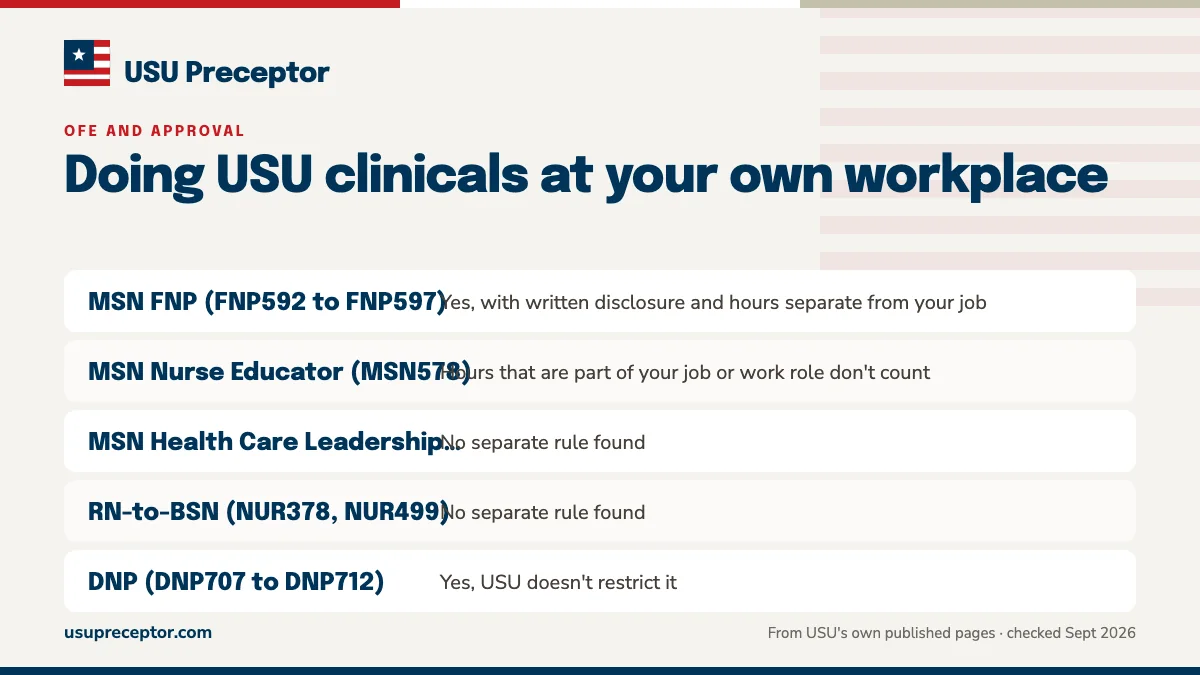
The answer depends on your program. USU's handbooks set different employer rules for FNP, Nurse Educator and DNP students and say less about the other tracks. This table sums up what USU publishes.
| Program | Employer as a site? | Paid during hours? | Your supervisor as preceptor? |
|---|---|---|---|
MSN FNP (FNP592 to FNP597) | Yes, with written disclosure and hours separate from your job | No | No |
MSN Nurse Educator (MSN578) | Hours that are part of your job or work role don't count | Not stated | No |
MSN Health Care Leadership (MSN587) | No separate rule found | Not stated | Not stated |
RN-to-BSN (NUR378, NUR499) | No separate rule found | Not stated | Not stated |
DNP (DNP707 to DNP712) | Yes, USU doesn't restrict it | May be paid by the site | Only if no other doctorally prepared mentor is available |
“Not stated” means USU's current handbooks and catalog don't address the point, not that it's allowed. Ask your CPC before you build a plan around it.
FNP: disclose, separate, unpaid
The FNP Clinical Handbook's Clinical Hour Requirements page allows clinicals at your place of employment. You must disclose the arrangement in writing to your CPC and your clinical instructor. USU doesn't name a form for this, so an email from your USU address that names the site, the preceptor and your job there makes a clear record.
Your clinical hours must be separate from your normal job duties, and the site or preceptor may not pay you during them. In practice, clinical time happens outside your paid shifts, in the student role, alongside your preceptor. The catalog says most FNP clinical hours run Monday to Friday, 8:00am to 5:00pm, so check that your work schedule leaves room for about 17 clinical hours a week.
A paid shift is never also a clinical hour. If you're on the clock for your employer, that time doesn't belong in your Project Concert log.
Who can precept you at work
Under the FNP preceptor selection criteria, your preceptor can't be your direct supervisor, spouse, domestic partner or first-degree relative. USU's pages disagree on one point: the Clinical Hour Requirements page says the relative or spouse restriction can be waived with written Program Director permission, while the selection criteria state it as a flat ban. A 2024 preceptor onboarding document also rules out friends and any other conflict of interest.
Otherwise the usual rules apply. The preceptor must be a board-certified NP, or a licensed MD or DO, employed by the clinical facility, with at least one year of experience at or above your licensure level. They need their employer's permission to precept, which they confirm on Appendix H. A colleague down the hall still goes through Program Director approval.
Watch the ratio at a busy employer. USU allows at most two students per FNP preceptor, one in New Jersey, and NP students from other schools count. Hours logged while the ratio is exceeded don't count.
Your workplace still has to be a valid FNP site
Working somewhere doesn't make it a suitable clinical setting. The FNP handbook says an inpatient hospital setting is never appropriate for FNP students, including for specialty rotations, so hours on a hospital unit won't count however well you know the staff.
FNP592 must be in family practice, primary care or primary care internal medicine, and urgent care isn't accepted for it. Urgent care hours are capped at 135 across the program, and Appendix I lists other settings USU won't use, such as emergency departments and telehealth-only services. If your employer runs an outpatient primary care practice, that practice may fit even though the hospital itself won't. Our hour log rules page sets out every cap.
The paperwork is the same as for any other site
Being an employee doesn't exempt the site from USU's approval route, and it doesn't make you the go-between.
- An Affiliation Agreement is still required. USU must have one with the site before you start, and OFE sends the contract to the site coordinator you name. See affiliation agreements.
- Stay out of the contract. The handbook says students shouldn't contact the site during the agreement process unless OFE asks, and it makes no exception for students who work there.
- Expect site rules on top. A site may add its own requirements, such as a different background check, fingerprints or its own training.
- Insure yourself. Your FNP malpractice policy must be in your own name as an NP student, not your employer's or an LLC's. Details are on the malpractice insurance page.
- Wait for the letter. You still need the OFE Approval Letter before any clinical hours, even at a site where you already have a badge.
Nurse Educator, Health Care Leadership and RN-to-BSN
For the MSN578 teaching residency, the practicum handbook says you may not complete hours that are part of your current employment position or work-related roles. So teaching you already do as part of your job can't be counted, and the preceptor can't be your direct supervisor or a relative. The residency runs at a 1:1 ratio, and the handbook recommends academic settings such as ADN and prelicensure BSN programs.
For the MSN587 Health Care Leadership residency and the RN-to-BSN practicum, USU's current handbook sets no separate employer rule. The HCL preceptor must be a nurse leader employed in a healthcare leadership role, and the RN-to-BSN agency must serve vulnerable community populations and be open to the public. Ask your CPC before you assume your workplace qualifies.
DNP: your employer can be your immersion site
The DNP Practice Immersion Handbook is the most permissive. USU doesn't restrict DNP students from using their current employer, and it doesn't stop them being paid by the site during the immersion. That suits the DNP model, where immersion hours tie to a project in a real setting such as a health system, hospital, public health agency or clinic.
The Project Mentor rules still apply. The mentor needs a doctorate, with a DNP strongly recommended, and can't be a relative. They can be your direct supervisor only if no other doctorally prepared mentor is available. Immersion hours still go into Project Concert within 48 hours, and they don't roll over from one course to the next. The DNP practice immersion page covers hours by course.
Why students choose us whether or not work can host
If your employer can't host your FNP hours, most often because it's a hospital, a placement advisor can look for an outpatient preceptor near you who fits the course. If your employer does fit, we can help you pull together the preceptor packet and site details OFE asks for. Either way, OFE and the Program Director give the final approval, and your file reaches them complete. Send us your course and setting to start.
Questions USU students ask
Can my manager be my preceptor at USU?
Not for FNP or Nurse Educator students. USU's criteria bar your direct supervisor from precepting you, along with spouses, domestic partners and first-degree relatives. DNP students are the exception: a direct supervisor can serve as Project Mentor, but only if no other doctorally prepared mentor is available. The Health Care Leadership rules we reviewed don't address it.
Can I do FNP clinicals at the hospital where I work?
Not on inpatient units. USU says inpatient hospital settings are never appropriate for FNP students, and those hours won't be counted. An outpatient primary care practice run by the same organization could qualify if it meets Appendix I's site rules for your course, has an affiliation agreement with USU, and you disclose the employment in writing.
Can I get paid while doing clinical hours at my job?
FNP students can't. The handbook says the site or preceptor may not pay you during clinical hours, and those hours must be separate from your normal duties. Nurse Educator hours that are part of your work role don't count at all. DNP students are different: USU doesn't restrict compensation from the site during the immersion.
Do I need an affiliation agreement if I already work at the site?
Yes. USU needs an agreement with every clinical site before you begin, and your employment doesn't replace it. OFE sends the contract to the site coordinator and manages the legal review with the site. The handbook says to allow at least four to six months for a new agreement, so ask your CPC early whether one already exists.
Does my employer's malpractice insurance cover my USU clinicals?
Not for USU's FNP requirement. FNP students must carry their own policy, in their own name, that describes them as a nurse practitioner student, and it must not list an employer or an LLC. The college also carries liability coverage on students in clinical programs, but that sits alongside your own policy rather than replacing it.
Related pages
Last checked 2026-09-23
We check these pages against USU's own catalog, handbooks and disclosures. USU's current handbook and your Clinical Placement Coordinator have the final word.
- USU FNP Clinical Handbook: Clinical Hour Requirements
- USU FNP Clinical Handbook: Selection Criteria for FNP Clinical Preceptors
- USU RN-BSN, MSN NE and HCL Practicum Handbook: Practicum Sites
- USU DNP Practice Immersion Handbook: Immersion Hours Requirements
- USU FNP Clinical Handbook: Affiliation Agreements
Six months out is USU's rule. We start now.
Tell us your USU program, your state and when your next practicum opens. We look for preceptors who meet USU's rules and help you build the packet the Office of Field Experience and Program Director review.
- Preceptors matched to the course: family practice, pediatrics, women's health, urgent care within USU's caps
- Appendix H, license, CV and board certification gathered the way OFE asks
- In person near you; telehealth only inside USU's 40-hour limit
Start your placement plan
A placement advisor replies with what a USU-ready preceptor and site look like for you.