Your preceptor or site wasn't approved at USU
USU doesn't publish a list of denial reasons, but its handbook criteria point to the likely cause: the wrong type of clinician, missing board certification, too little experience, a setting that doesn't fit the course, a personal or employer conflict, or a site or state problem. Find out which rule was missed, because some are fixed with a document and others only with a different preceptor or site.
Need a preceptor who fits USU's rules?
Tell us your course, state and what the review turned down. A placement advisor will reply with next steps.
First, find out which rule was missed
Ask your Clinical Placement Coordinator, by USU email, which criterion the preceptor or site didn't meet. USU's handbooks describe no denial notice or appeal route, so the question is yours to ask, and the answer decides your next move.
Then sort the answer. A fixable gap, such as a missing license verification or Exhibit B, can be corrected and sent again. A structural problem, such as a physician assistant for FNP hours or your own manager as preceptor, can't be fixed with paperwork; the only route is a different person or site.
Either way, the 16-week deadline keeps running and review takes 4 to 16 weeks on average, so move your next qualified lead forward the same week. If a new review can't finish in time, read need a preceptor fast. Program Director approval explains the review itself.
Reasons tied to the preceptor
These FNP criteria concern the clinician themselves, and each has a different fix.
| Likely reason | USU's rule | The fix |
|---|---|---|
| Physician assistant, chiropractor, acupuncturist or naturopath | FNP preceptors are board-certified NPs or licensed MDs or DOs; PAs aren't listed and the other three are ruled out | An NP, MD or DO, perhaps in the same practice |
| Nurse-midwife used outside women's health | A board-certified CNM may precept women's health hours only | Keep the CNM for women's health and find someone else for the rest |
| No current board certification | NP preceptors need national board certification suited to FNP education, shown on Exhibit A | Send proof if they hold it; otherwise choose another preceptor |
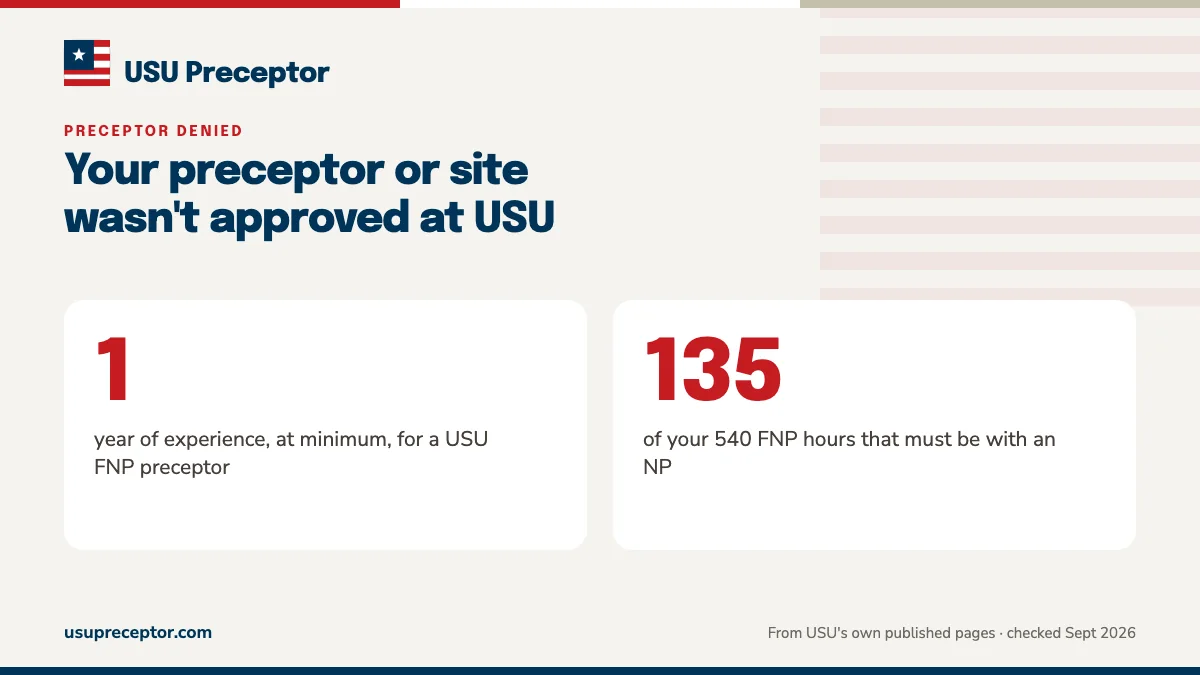
| Under a year of experience | At least a year at or above your program's level of licensure, in active practice | A more experienced clinician for this course |
| License problem | Active and unencumbered, in the state where the clinical takes place | Confirm the license state and status before sending again |
| Incomplete packet | Appendix H, license verification, CV and board certification; Exhibit B if under three years with the current employer | Supply the missing piece and ask your CPC how to resubmit |
Criteria for every program are on USU preceptor requirements.
Reasons tied to the setting or course
A qualified clinician can still be the wrong fit for a course. Appendix I, USU's FNP Site & Preceptor Guidance, sets out which settings suit each rotation.
- A specialty practice for
FNP592. The first rotation must be family practice, primary care or primary care internal medicine. Fix: save the specialist for later, inside the 40-hour specialty cap and, beforeFNP597, with Program Director approval. - Urgent care for
FNP592. Not allowed in the first rotation. Fix: use it inFNP594, where urgent care with a primary care focus is listed, up to 135 hours across the program. - Inpatient units and emergency departments. Inpatient hours are never approved for FNP students, and Appendix I lists EDs as inappropriate. Fix: an outpatient primary care practice.
- Other listed exclusions. Appendix I also rules out university health services and telehealth-only sites. Fix: an in-person practice that suits the course.
- A mismatched
FNP596rotation. Pediatrics calls for a pediatrician, or an FNP or PNP in a pediatrician's office; women's health for an OB/GYN, FNP, WHNP or CNM. Fix: match the preceptor to the rotation.
Relationship and employer conflicts
Your FNP preceptor can't be your spouse, domestic partner, first-degree relative or direct supervisor. On relatives, USU's pages disagree: the preceptor criteria read as a ban, while the hour-requirements page lets the Program Director waive it in writing. USU's 2024 onboarding guidance also rules out friends and other conflicts of interest. The usual fix is a colleague in the same practice who isn't related to you and doesn't manage you.
Employer problems take two forms. The preceptor must work for the clinical facility and confirm their employer's permission to precept on Appendix H, so a missing sign-off stalls the file. If the site is your own workplace, USU requires written disclosure to your CPC and clinical instructor, hours separate from your job and no pay during them. Nurse Educator hours that are part of your job don't count. See clinicals at your employer.
DNP students have more room. They may use their employer and be paid, and a Project Mentor may be their direct supervisor if no other doctorally prepared mentor is available.
When the site or the state is the problem
Sometimes the preceptor is fine and the site isn't. If a site won't sign USU's Affiliation Agreement, OFE can't issue your approval letter for it. The fix is a site that already has a USU agreement, or another site entirely; the affiliation agreement page explains how contracts move.
Student load can sink a file too. USU caps each FNP preceptor at two students, one in New Jersey, and NP students from other schools fill those seats too.
State rules can override USU's. The FNP handbook says states may add requirements, on preceptor eligibility or ratios for example, that take precedence over university policy. In California, 16 CCR 1486 requires preceptors with a California license and students with a California RN license. Alabama, Delaware and Wyoming require extra filings for clinicals there. See out-of-state clinicals.
Why students choose us after a denial
A placement advisor searches for preceptors and sites that fit your course and USU's rules. Before a name goes forward, we check clinician type, certification, experience, license state, setting, relationships, employer permission and student load. In person near you is the main route, with virtual hours only inside USU's telehealth rule. We help you assemble a complete packet, and you submit it.
When a denial was about the setting, we search for one that suits the course. The Program Director gives the final approval, and the next candidate reaches that review having already passed every check on USU's list. If a denial has left you short, use the form below or the chat.
Questions USU students ask
Can my preceptor be resubmitted once they're board certified?
USU requires NP preceptors to hold current national board certification suited to FNP education. Once they hold it, that criterion is met, and your CPC can tell you how to resubmit with the certificate on Exhibit A of Appendix H. Review runs again, so plan for 4 to 16 weeks and keep another lead moving.
If a preceptor is turned down for one course, can they precept a later one?
Sometimes. A setting mismatch is course-specific: an urgent care clinician who can't take FNP592 hours may fit FNP594, within the 135-hour urgent care cap. A problem with the person, such as clinician type, certification or a relationship, carries over. Appendix H is per student, site and specialty, so a new course may need a new form.
Can a preceptor be refused because the clinic hosts other schools' students?
The count matters, not the clinic. A USU FNP preceptor can take at most two students at once, or one in New Jersey, and other programs' NP students count. Hours logged while the ratio is exceeded don't count. Ask each preceptor how many students they'll have during your eight weeks, not just today.
How long does review take after I send a corrected packet?
USU doesn't publish a separate time for resubmissions. The FNP handbook's 4 to 16 weeks on average for Program Director approval is the safest assumption unless your CPC says otherwise, so keep a second qualified lead moving while the correction is reviewed.
Can a DNP Project Mentor be refused for not having a doctorate?
Yes. USU requires Project Mentors to hold a doctoral degree, with a DNP strongly recommended and an MD, DO or PhD accepted. A candidate with an EdD plus a healthcare master's may also be put forward. A mentor without a doctorate doesn't meet the rule, so look for another doctorally prepared mentor.
Related pages
Last checked 2026-09-23
We check these pages against USU's own catalog, handbooks and disclosures. USU's current handbook and your Clinical Placement Coordinator have the final word.
- USU FNP Clinical Handbook: Selection Criteria for FNP Clinical Preceptors
- USU FNP Clinical Handbook: Appendix I FNP Site & Preceptor Guidance
- USU Appendix H Preceptor Information and Acknowledgement Form (Nov 2025)
- USU FNP Clinical Handbook: Clinical Hour Requirements
- USU FNP Clinical Handbook: Clinical Placement
Six months out is USU's rule. We start now.
Tell us your USU program, your state and when your next practicum opens. We look for preceptors who meet USU's rules and help you build the packet the Office of Field Experience and Program Director review.
- Preceptors matched to the course: family practice, pediatrics, women's health, urgent care within USU's caps
- Appendix H, license, CV and board certification gathered the way OFE asks
- In person near you; telehealth only inside USU's 40-hour limit
Start your placement plan
A placement advisor replies with what a USU-ready preceptor and site look like for you.