USU's FNP from California: an out-of-state program with California rules
USU isn't taking students into its in-state California track, so Californians enroll under USU's out-of-state registration. The California Board of Registered Nursing (BRN) lists USU's FNP as an out-of-state NP program, and under 16 CCR 1486 that means Board approval for California placements and a California license for both you and your preceptor.
Looking for a California preceptor?
Tell us your region and your USU course.
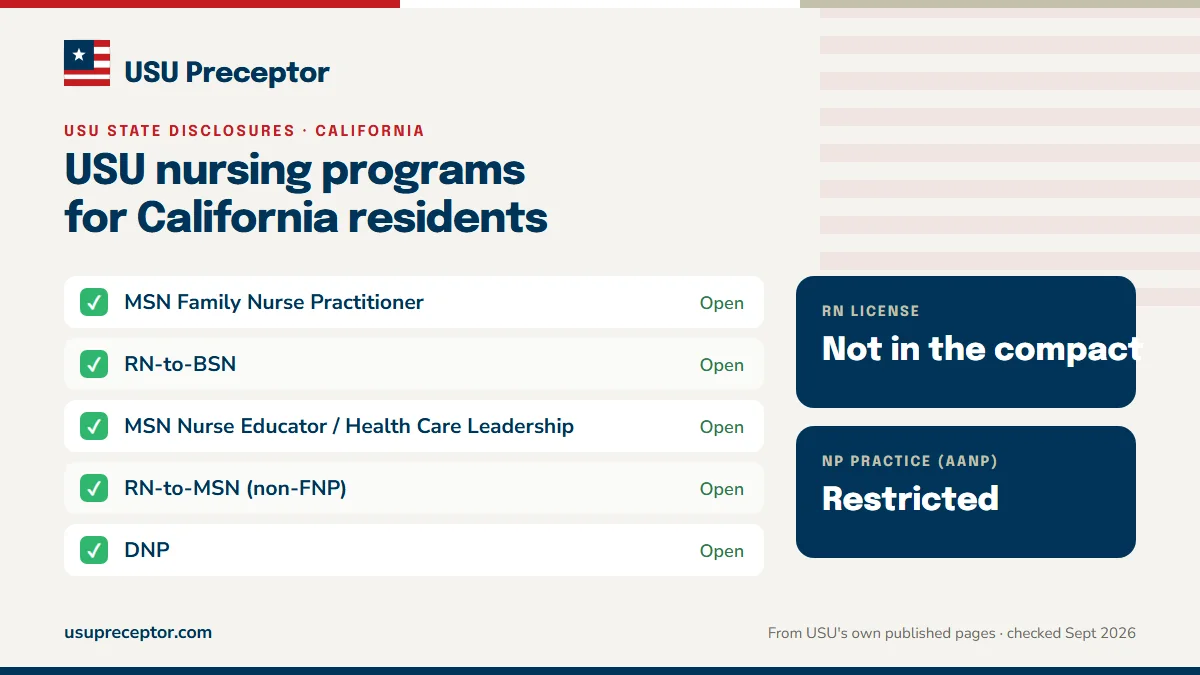
What Californians can take at USU
Californians can still enroll in USU's nursing programs, just not through a California-based track. USU's state authorization disclosure says it is “currently not accepting students” into any in-state California program; its programs are registered with California's Bureau for Private Postsecondary Education (BPPE) as out-of-state programs, a registration that runs to May 20, 2030.
| Program | Open to California residents? | Clinical hours |
|---|---|---|
| MSN Family Nurse Practitioner | Yes, as a BRN-listed out-of-state NP program | 540: FNP592, FNP594, FNP596, FNP597 |
| MSN Nurse Educator | Yes (the BRN doesn't approve non-FNP MSN tracks) | 100 in MSN578 |
| MSN Health Care Leadership | Yes | 100 in MSN587 |
| RN-to-BSN | Yes (no BRN program approval applies) | 90 in NUR378 and NUR499 |
| DNP | Yes; USU says it isn't currently CCNE-accredited | 1,000 post-baccalaureate |
| Post-Master's FNP Certificate | No; closed to new applicants since April 2024 | Not applicable |
USU notes that the BRN approves NP programs only, so the California rules below weigh most on FNP students. Every program still needs an RN license active where your practicum happens, which here means a California license. The general rules are on our out-of-state clinicals page.
What 16 CCR 1486 asks of you, your preceptor and USU
Section 1486 of Title 16 governs NP programs with no physical location in California that want to place students here. The BRN approved USU's FNP under it at its August 21-22, 2024 meeting, for 58 students, and confirmed the decision in a letter dated February 7, 2025. The Board's Out-of-State NP Programs page lists USU's Family track at the Sandy Springs, Georgia address.
Conditions that come with a California placement
- You: an active, valid California RN license to take part in clinical experiences in California (1486(d)).
- Your preceptor: a valid, active California license, orientation to USU's program and curriculum, and an evaluation by program faculty at least every two years.
- Paperwork: a written agency-preceptor-program agreement setting out the preceptor's role, plus a BRN NP Program Preceptor form (Form #3) the school keeps for each California preceptor.
- Curriculum: content on California NP law, including Business and Professions Code sections 2835.7 and 2836.1 on furnishing.
- The Board's reserve power: the BRN may withdraw a program's authorization for California placements at any time.
Under USU's model you still identify preceptor leads, and OFE and the Program Director approve them. Section 1486 makes the program answerable for preceptors who meet Board requirements, so expect close checks on a California preceptor's license. USU hasn't said whether the 58-student figure caps California seats; ask your Clinical Placement Coordinator if it could affect your term.
Where section 1484 comes in
Section 1484 is the BRN's rulebook for California-based NP programs, those “physically located in California” under section 1480. It sets a floor of 500 hours of supervised direct patient care under certified nurse practitioner preceptors and makes the program arrange clinical instruction. An amendment effective October 1, 2025 added license rules: preceptors in California need a California license, preceptors elsewhere need one where the preceptorship happens, and students need a California RN license or one from the state where they're precepted.
The BRN's list of California NP programs still shows United States University at its San Diego address, now an administrative site since USU moved its main campus to Georgia in 2025. USU's catalog also maps California NP certification to two routes: Method One for students with a California enrollment agreement, Method Two for those who signed in Texas or Georgia. Which route fits a Californian admitted today isn't spelled out, so confirm it with USU. Either way, certification requires an active California RN license.
Health systems add their own gate
BRN approval lets a program place students in California; it doesn't oblige any hospital or clinic to sign. UC San Diego Health says an out-of-state NP program must be BRN-approved before it will consider an affiliation agreement. It's currently weighing new affiliations only for its own employees and specialty areas of need, students may not submit agreement requests, and a fully executed agreement may take about 6 to 12 months.
Kaiser Permanente Southern California lists a current school affiliation contract as a student prerequisite. At USU, OFE sends affiliation agreements and the handbook allows four to six months for a new one, so a site that needs a fresh contract has to be named early (see affiliation agreements). California's 2024 clinical placement law, AB 1577, won't help here: it covers prelicensure programs, not NP programs.
Regions and the kinds of sites FNP students look at
The names below are examples of site types by region, taken from public listings, not places that have agreed to take USU students.
- San Diego: Sharp HealthCare and Scripps Health; federally qualified health centers (FQHCs) such as Family Health Centers of San Diego and San Ysidro Health.
- Los Angeles: Cedars-Sinai, UCLA Health and the LA County Department of Health Services; FQHCs such as AltaMed and Venice Family Clinic.
- Inland Empire: Loma Linda University Health and Riverside University Health System; FQHCs such as SAC Health.
- Bay Area: Stanford Health Care and UCSF Health; FQHCs such as La Clínica de La Raza and Asian Health Services.
- Sacramento: UC Davis Health and Sutter Health; FQHCs such as WellSpace Health.
- Central Valley: Community Health System in Fresno and Kaweah Health; FQHCs such as Clinica Sierra Vista and Golden Valley Health Centers.
Outpatient primary care is the target because inpatient hours never count at USU, and your first rotation, FNP592, must be family practice, primary care or primary care internal medicine. HRSA's 2025 data show 170 health center awardees reporting in California.
Licensing: California stands outside the compact
California isn't a Nurse Licensure Compact state, and the compact's map shows no pending legislation to join. A multistate license from Arizona, Texas or anywhere else gives you no privilege to practice here, so a California RN license is the baseline for both section 1486 and USU's rule that your license be active wherever you see patients. Telehealth doesn't change that: USU requires telehealth patients to be in your state on file.
California is restricted practice in AANP's classification, meaning NPs keep a standardized protocol agreement for select settings and procedures, subject to exemptions the BRN describes. USU accepts board-certified NPs and MD or DO physicians as FNP preceptors, and at least 135 of your hours must be with an NP. See preceptor requirements and RN licenses for clinicals.
Why California students choose us
We search your part of California for NP or physician preceptors in the settings your USU course needs, and check at the start that each holds an active California license. We help you assemble what USU reviews, from Appendix H and proof of licensure to the preceptor's CV and certification and the site information OFE uses for the agreement, and we search again if a preceptor drops. Every approval stays with USU. Tell us your region and course.
Questions USU students ask
Can I enroll in USU's FNP if I live in California?
Yes, but not through a California-based track. USU says its in-state California track isn't accepting students, so you enroll under its out-of-state registration. The BRN lists USU's FNP as an approved out-of-state NP program under 16 CCR 1486, which brings Board conditions on your license, your preceptor and each site agreement.
Can my California preceptor be licensed in another state?
Not for clinicals in California. Section 1486 requires preceptors for out-of-state NP programs to hold a valid, active California license, be oriented to the program and be evaluated by faculty at least every two years. USU's own rule also requires a license in the state where the clinical takes place.
Does UC San Diego Health take out-of-state NP students?
It considers affiliations with out-of-state NP programs only after BRN approval, and for now only for its own employees and specialty areas of need. Students can't submit agreement requests, and it quotes about 6 to 12 months for a fully executed agreement, so it isn't a quick option.
Does the 58-student approval limit how many Californians USU places?
USU hasn't said. The BRN's 2024 approval and its out-of-state list both show 58 FNP students for USU, but no USU source says whether that works as a cap on California seats. Ask your Clinical Placement Coordinator before you commit to a California site.
Can I do my USU hours in Nevada or Oregon instead?
It's possible to request, but USU steers students toward their home state and warns that a licensing board may not accept hours earned outside your home state. Neither Nevada nor Oregon is a compact state, so you'd also need a separate RN license there. Raise it with your CPC first.
Related pages
Last checked 2026-09-23
We check these pages against USU's own catalog, handbooks and disclosures. USU's current handbook and your Clinical Placement Coordinator have the final word.
Six months out is USU's rule. We start now.
Tell us your USU program, your state and when your next practicum opens. We look for preceptors who meet USU's rules and help you build the packet the Office of Field Experience and Program Director review.
- Preceptors matched to the course: family practice, pediatrics, women's health, urgent care within USU's caps
- Appendix H, license, CV and board certification gathered the way OFE asks
- In person near you; telehealth only inside USU's 40-hour limit
Start your placement plan
A placement advisor replies with what a USU-ready preceptor and site look like for you.