USU nursing from Oregon: the FNP is open, the DNP isn't
Oregon residents can enroll in USU's FNP, RN-to-BSN, Nurse Educator and Health Care Leadership programs. USU's board list rules out its DNP and every RN-to-MSN specialization for Oregon. For FNP clinicals, the Oregon State Board of Nursing asks nothing of out-of-state NP programs, but you'll need an Oregon RN license.
Need an Oregon preceptor?
Tell us your area and your USU course.
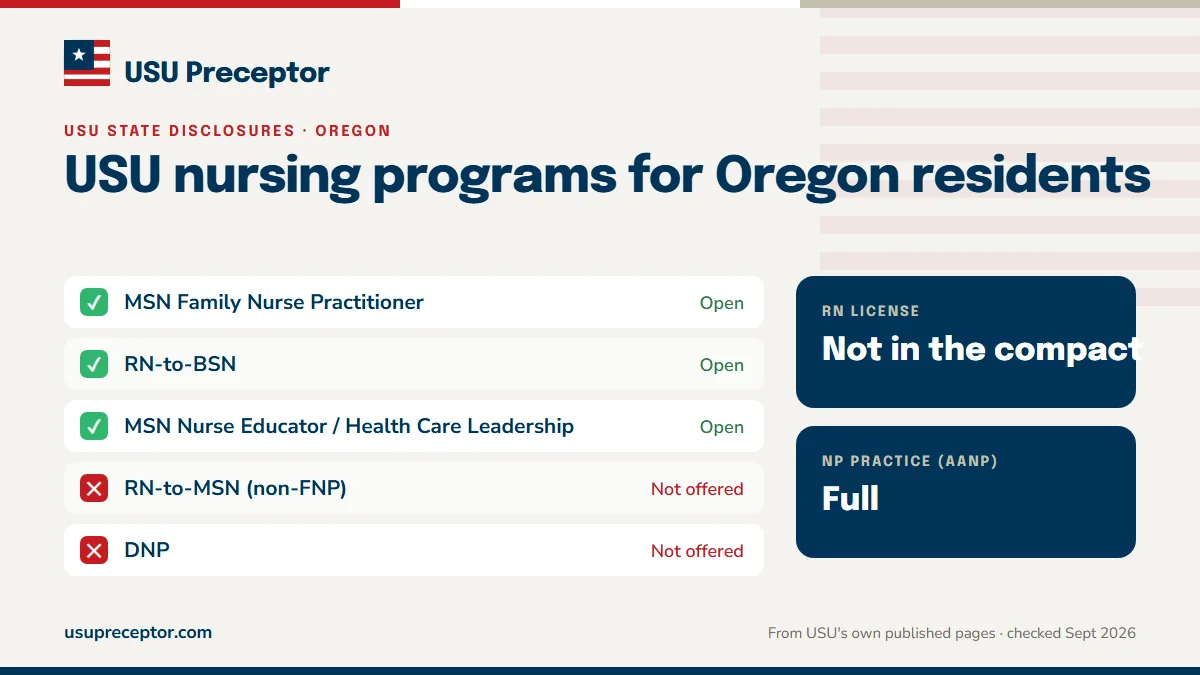
What's open to Oregon residents and what isn't
| Program | Open to Oregon residents? | Clinical hours |
|---|---|---|
| MSN Family Nurse Practitioner | Yes | 540 across FNP592, FNP594, FNP596, FNP597 |
| MSN Nurse Educator | Yes | 100 in MSN578 |
| MSN Health Care Leadership | Yes | 100 in MSN587 |
| RN-to-BSN | Yes | 90 in NUR378 and NUR499 |
| RN-to-MSN (all specializations) | No | Not applicable |
| DNP | No | Not applicable (1,000 post-baccalaureate elsewhere) |
| Post-Master's FNP Certificate | No, closed in all states | Not applicable |
Both exclusions come from USU's Board of Nursing list, which names Oregon alongside Idaho and Utah as states where USU enrolls every nursing program except RN-to-MSN, the DNP and the closed Post-Master's certificate. USU's state authorization list agrees. The RN-to-MSN matters less than it sounds: it appears only in USU's disclosures, with no page in the current catalog, and it has no FNP specialization.
If you were planning on USU's DNP
An Oregon nurse with a master's degree can't enroll in USU's DNP while living here. The exclusion also bites if you move: USU's catalog is blunt that moving to a state where your program isn't offered ends your ability to finish it, so a DNP student relocating to Oregon mid-program couldn't complete the degree at USU. Talk to USU before any move, not after.
The FNP carries no such problem, but moving still carries risk. USU also won't take responsibility for your placement if you relocate after a term begins, or, for out-of-state placements, within the two terms before clinicals. Details are on the DNP program page and the out-of-state clinicals page.
The Oregon State Board of Nursing leaves NP placements alone
Oregon asks out-of-state pre-licensure PN and RN programs to notify the Board before learning activities start, one form per track, resubmitted every year, under OAR chapter 851, division 21. According to the Board, no notice is needed from advanced practice programs or from programs that don't lead to licensure, for example RN-to-BSN, non-APRN MSN or DNP programs. Its APRN FAQ answers “No” to whether out-of-state APRN programs need Board approval to place students in Oregon.
That's a change from the past. Oregon used to require prior Board authorization before NP students in non-Oregon graduate programs could do practicums here, under a rule in OAR chapter 851, division 50, but that rule was repealed effective July 1, 2021. Faculty teaching in Oregon are still expected by the Board to have an active Oregon license, and before enrolling Oregonians, an institution has to satisfy NC-SARA or Oregon Higher Education Coordinating Commission requirements. USU participates in NC-SARA through its home state, Georgia.
Licensing outside the compact
Oregon has stayed out of the Nurse Licensure Compact, with no legislation pending. A multistate license from another state doesn't carry into Oregon, so an Oregon RN license is what satisfies USU's rule that your license be active in your state on file and wherever you do clinicals. Your student liability policy should be active in Oregon too. More detail is on our RN license page.
AANP rates Oregon as full practice. USU still sets the preceptor bar: national certification for NPs or an MD or DO license, a year's experience, 135 hours minimum with an NP, and two students per preceptor at most.
Portland, Salem, Eugene and Bend
The Oregon side of the Portland-Vancouver-Hillsboro metro holds about 2 million Oregonians; the next largest metros are Salem, Eugene-Springfield and Bend. FNP students approach the primary care clinics of systems such as Samaritan Health Services, Kaiser Permanente Northwest, Legacy Health, Oregon Health & Science University (OHSU) and Providence Oregon; none is a confirmed USU clinical site.
The Portland metro spills into Vancouver, Washington, but a clinic there is out of state. USU points students to their home state, and its Washington board approval, as USU describes it, covers practice experiences for Washington residents in the FNP. Staying on the Oregon side is the simpler path.
Why Oregon students choose us
We search your part of Oregon for outpatient preceptors with Oregon licenses who fit your USU course, get the approval packet in order, and go back to searching if a preceptor falls through. The approval decisions are USU's. Tell us your course and area.
Questions USU students ask
Can I take USU's DNP if I live in Oregon?
No. USU's Board of Nursing list excludes Oregon, along with Idaho and Utah, from the DNP and from every RN-to-MSN specialization, and its state authorization list agrees. Oregon residents can still take USU's MSN FNP, Nurse Educator and Health Care Leadership tracks and the RN-to-BSN.
Does Oregon need to approve USU before my FNP clinicals?
No. The Oregon State Board of Nursing says out-of-state APRN programs don't need its approval to place students in Oregon, and advanced practice programs don't have to notify it either. The old prior-authorization rule for NP students from non-Oregon programs was repealed in July 2021. USU's own approvals still apply.
Can I do clinicals in Vancouver, Washington, if I live in Portland?
You can ask, but it's out of state for USU, which wants hours in your home state and cautions that a licensing board may not accept hours done outside it. Its Washington approval, as USU describes it, covers Washington residents in the FNP. You'd also need a license valid in Washington.
Can I use a multistate license for USU clinicals in Oregon?
No. Oregon isn't a compact state, so a multistate license from elsewhere gives no privilege to practice here. You need an Oregon RN license, active and unencumbered, for clinicals in Oregon, and USU expects your liability insurance to be active in the same state.
Related pages
Last checked 2026-09-23
We check these pages against USU's own catalog, handbooks and disclosures. USU's current handbook and your Clinical Placement Coordinator have the final word.
Six months out is USU's rule. We start now.
Tell us your USU program, your state and when your next practicum opens. We look for preceptors who meet USU's rules and help you build the packet the Office of Field Experience and Program Director review.
- Preceptors matched to the course: family practice, pediatrics, women's health, urgent care within USU's caps
- Appendix H, license, CV and board certification gathered the way OFE asks
- In person near you; telehealth only inside USU's 40-hour limit
Start your placement plan
A placement advisor replies with what a USU-ready preceptor and site look like for you.