Your preceptor dropped out: what to do at USU
Tell your Clinical Placement Coordinator the same day, in writing, with the hours you've logged and your preceptor's last day. If the preceptor left for reasons outside your control, USU's catalog says OFE makes every reasonable attempt to find an alternative, but if none works you may have to withdraw and retake the course, so start on replacement leads straight away.
Lost your preceptor?
Tell us your course, the hours you've logged and your state. A placement advisor will reply with next steps.
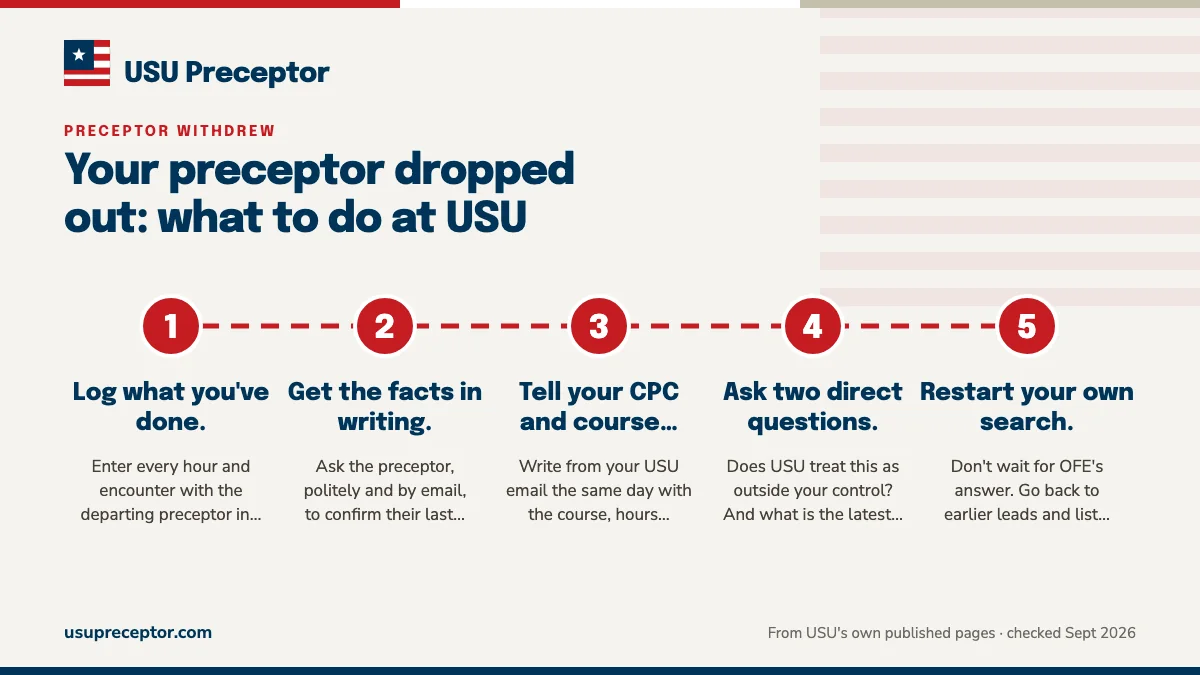
The first 24 hours
What you do on the first day shapes every option that follows.
- Log what you've done.Enter every hour and encounter with the departing preceptor in Project Concert now. The 48-hour rule still applies, and late entries don't count.
- Get the facts in writing.Ask the preceptor, politely and by email, to confirm their last day and whether they can finish any evaluation that's due. A short, factual record helps show the change wasn't your choice.
- Tell your CPC and course faculty.Write from your USU email the same day with the course, hours logged, last day and reason, and name any backup preceptor or leads. Your Clinical Placement Coordinator is listed in the Student Portal.
- Ask two direct questions.Does USU treat this as outside your control? And what is the latest date a replacement could start and still let you finish this course?
- Restart your own search.Don't wait for OFE's answer. Go back to earlier leads and list new ones in the same setting.
What OFE's “every reasonable attempt” means
The catalog's commitment applies when a preceptor can't continue for reasons outside your control. OFE then makes every reasonable attempt to find an alternative. That's a promise to try, not an assurance that something will turn up in time, and USU doesn't say how long OFE keeps looking.
Leaving by choice is treated differently. Under the FNP handbook's Preceptor Fit rule, a student who leaves for other reasons finds the new preceptor and site themselves. The changing preceptors page compares the two paths.
If OFE does find an alternative, the usual offer rules apply: 24 business hours to accept, travel anywhere in your state, and a commitment to finish every hour. Declining returns the search to you.
What's at stake: week one, lost hours and retakes
How much a withdrawal costs depends on when it happens. These rows combine rules from USU's catalog and FNP handbook; your course faculty can tell you how they apply to you.
| When the preceptor leaves | The USU rule that matters | What to ask for |
|---|---|---|
| Before the course starts | Hours must begin in the first week; changes need approval 16 weeks ahead | Whether an approved backup can cover week one, or whether a later session is wiser |
| In the first week | Missing the week-one start may mean withdrawal, reapplication and a retake | An urgent conversation with faculty and your CPC about this session |
| Mid-course, under 81 hours | An FNP Incomplete needs at least 81 hours; incomplete hours are lost and repeated the following term | Whether a replacement could realistically start in time |
| Mid-course, 81 hours or more | An Incomplete becomes possible | Whether faculty will grant one while a replacement is approved |
The catalog says a withdraw-and-retake is at your own cost, and hours never roll over between courses. Each FNP practicum is also a prerequisite for the next, so one retake shifts the rest. Delayed graduation covers that knock-on effect, and behind on clinical hours covers catching up once you're placed again.
Every replacement clears the full approval route
A replacement isn't a quick swap of names. The new preceptor completes their own Appendix H for you, that site and that specialty, with license verification, a CV and board certification for APRNs. The Program Director reviews it, which USU puts at 4 to 16 weeks on average. A new site also needs an Affiliation Agreement, and OFE's approval letter must cover the new placement before you see a patient.
The handbook requires changes to be approved 16 weeks before the affected course, but it doesn't say how that applies mid-course, so ask your CPC rather than assuming. The replacement must also suit the course: family or primary care for FNP592, for example, and never an inpatient unit. See Program Director approval for what the review checks.
However kind the offer, a colleague of your old preceptor can't simply take over. Until the new placement is approved and OFE's letter covers it, those hours won't count.
How to replace a preceptor faster
Nothing removes USU's approval steps, but some choices shorten the path to them.
- Stay at the same site if you can. If the site's agreement with USU stays in place, a colleague there avoids the contract step, though they still need their own approval.
- Favor sites that already work with USU. Your CPC can check whether a new site already has an agreement.
- Send complete packets. A packet missing its license verification, or Exhibit B for a preceptor with under three years at their employer, goes back and forth before review starts.
- Keep a second approved preceptor. USU recommends no more than three preceptors in an 8-week FNP course, so a backup approved in advance is allowed and softens the next drop.
- Check student load. Ask a new preceptor how many NP students they'll have during your course, since hours over the 1:2 ratio (1:1 in New Jersey) don't count.
Keep every message about the drop calm and factual. After a jeopardized placement, USU's handbook allows the Program Director or OFE Director to leave all future placement-finding to the student.
Why students choose us after a preceptor drops
When a preceptor drops, a placement advisor starts a fresh search for someone who suits your course and meets USU's preceptor criteria, usually in person close to home; virtual hours come into it only within USU's telehealth cap. We help you assemble the Appendix H packet and site details for OFE. You submit, USU approves, and hours start only after the letter. We can also look for a backup in the same setting, so one more drop doesn't leave you starting from zero.
OFE and the Program Director decide on the replacement, and USU's rules govern hours already lost, so we put everything into finding a strong candidate quickly. Tell us your course, hours logged and state through the form below or the chat.
Questions USU students ask
Do the hours I completed before my preceptor left still count?
Hours you logged in Project Concert within 48 hours, with an approved preceptor and after your approval letter, are part of your record. USU doesn't publish how they're treated if you finish the same course with someone else, so ask your course faculty in writing. Hours never carry over into a different course.
Can a colleague at the same clinic take over from my preceptor?
Possibly, but not straight away. The colleague needs their own Appendix H, license verification, CV and, for APRNs, board certification, then Program Director approval and an approval letter that covers them. If the site's agreement with USU stays in place, you may avoid a new contract. Check with your CPC first.
Does leaving a preceptor I don't get along with count as outside my control?
USU doesn't define outside your control. Its Preceptor Fit rule says students who leave for other reasons find the new preceptor and site themselves, with the change approved 16 weeks before the course it affects. Describe the situation to your CPC in writing and ask which rule applies before you say anything to the preceptor.
Who pays if I have to retake the course?
You do. The catalog says that if OFE can't find an alternative after a preceptor withdraws, you may need to withdraw and retake the course at your own cost. With 81 or more hours done in an FNP course, raise the option of an Incomplete with faculty first, and ask your CPC about timing before you withdraw.
What if OFE's replacement site is a long drive away?
Distance won't get you out of it. The catalog expects you to go anywhere in your state, paying your own travel, and rejects travel time as grounds for refusal. Saying no is allowed, but the rotation then becomes yours to fill by the deadline, and a yes commits you to finishing it.
Related pages
Last checked 2026-09-23
We check these pages against USU's own catalog, handbooks and disclosures. USU's current handbook and your Clinical Placement Coordinator have the final word.
Six months out is USU's rule. We start now.
Tell us your USU program, your state and when your next practicum opens. We look for preceptors who meet USU's rules and help you build the packet the Office of Field Experience and Program Director review.
- Preceptors matched to the course: family practice, pediatrics, women's health, urgent care within USU's caps
- Appendix H, license, CV and board certification gathered the way OFE asks
- In person near you; telehealth only inside USU's 40-hour limit
Start your placement plan
A placement advisor replies with what a USU-ready preceptor and site look like for you.