Taking USU's FNP from South Carolina
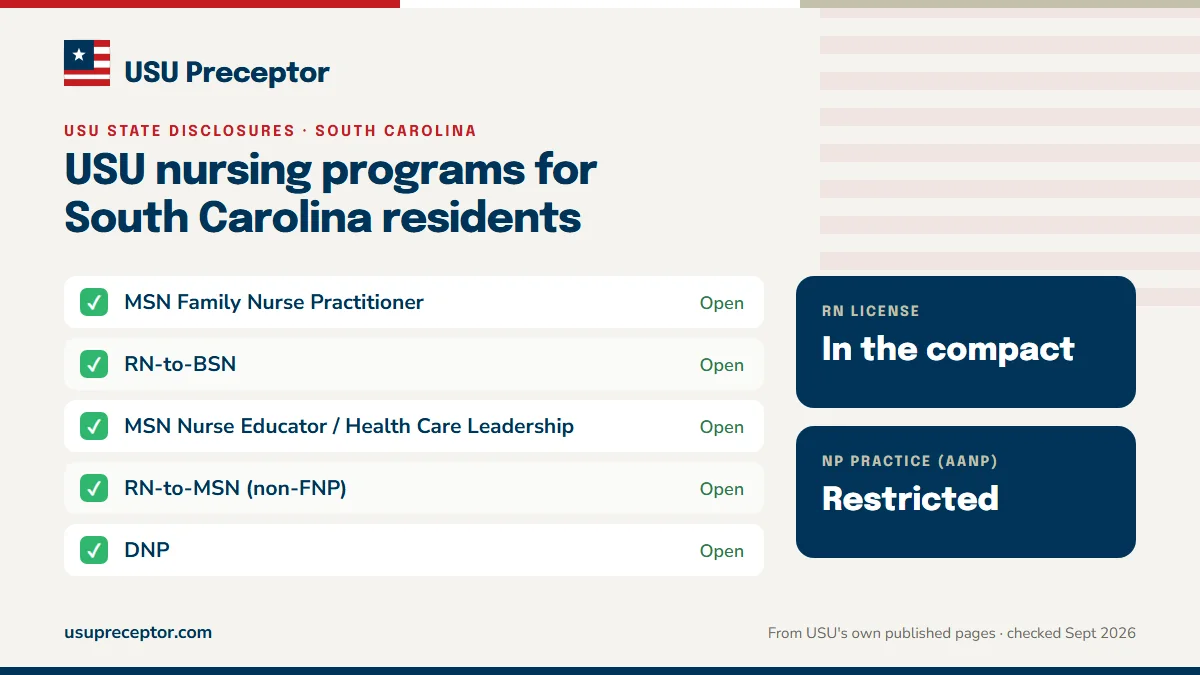
South Carolina residents can enroll in all of USU's admitting nursing programs, including the FNP. South Carolina's rule approving out-of-state programs targets pre-licensure clinicals, and its preceptor tax credit targets South Carolina schools, so neither does much for a USU student. What matters more is restricted NP practice and a search spread across Greenville, Charleston and Columbia.
Looking for a South Carolina preceptor?
Give us your USU course, start date and nearest city.
Regulation 91-6, and why it isn't written for the FNP
South Carolina's rule for out-of-state programs is S.C. Code Regs. 91-6. A program based in another state that runs clinicals in South Carolina to prepare students for initial licensure needs Board of Nursing approval first. The program has to keep full approval in its home state, sign a written clinical affiliation agreement, follow South Carolina rules for precepted experiences, and supervise on site and on shift through a faculty member who holds a license from South Carolina or another compact state.
The regulation doesn't address RN-to-BSN or APRN programs, and USU's Board of Nursing list doesn't name South Carolina among the states needing extra clinical filings. The approvals that decide your placement are USU's: Program Director sign-off on each preceptor, an Affiliation Agreement with the site, and an OFE Approval Letter before any hours.
Programs open to South Carolina residents
| USU program | South Carolina residents | Hours to complete |
|---|---|---|
| MSN Family Nurse Practitioner | Open | 540, or 135 in each of FNP592, FNP594, FNP596 and FNP597 |
| MSN Nurse Educator | Open | 100 in the MSN578 teaching residency |
| MSN Health Care Leadership | Open | 100 in the MSN587 residency |
| RN-to-BSN | Open | 90 community hours |
| DNP | Open | 1,000 post-baccalaureate, up to 500 transferable |
The four FNP practicums each call for a different kind of preceptor; our FNP preceptor page sorts out which is which.
Practice agreements, prescribing limits and who precepts
AANP lists South Carolina as restricted. NPs need a practice agreement with a physician to perform delegated acts, and they face limits on how much of a controlled substance they can supply.
USU's rules sit on top. Your FNP preceptor can be a board-certified NP or a licensed MD or DO, licensed in South Carolina, with a year's experience and the employer's permission to precept. At least 135 hours must be with an NP, and a certified nurse-midwife counts only for women's health hours. Every condition USU sets is listed on our preceptor requirements page.
South Carolina's preceptor tax credit, and why it misses USU
Under S.C. Code 12-6-3800, uncompensated physician, APRN and PA preceptors can claim an income tax credit for each qualifying rotation, plus a deduction for additional rotations. They must precept at least two rotations a year and meet conditions on Medicaid participation or the type of clinic they work in. A 2024 act extended the credit through tax year 2029, though an older revenue ruling still shows the original 2026 repeal date.
The deciding condition is the school: rotations must be for students enrolled at a South Carolina public or independent institution, and USU's home state is Georgia. There's a second mismatch too, since a qualifying rotation runs at least 160 hours and each USU FNP practicum is 135. Your preceptor would get USU's own benefits instead, described on our page for preceptors.
Your license for South Carolina clinicals
The Nurse Licensure Compact took effect in South Carolina on January 19, 2018; the state has not enacted the APRN Compact. USU requires an active, unencumbered license in your state on file and wherever you do clinicals, and wants your liability insurance active in the same state. A South Carolina multistate license covers both at home; more is on our license page.
Greenville, Charleston, Columbia and the Charlotte edge
South Carolina has three metros of similar size: Greenville-Anderson-Greer at about 1 million people, and Charleston-North Charleston and Columbia at close to 900,000 each. About 450,000 more live in the South Carolina part of the Charlotte metro. Big systems include Lexington Health, Roper St. Francis Healthcare, McLeod Health, MUSC Health and Prisma Health. They show where students search, not where USU has sites lined up, and their outpatient practices matter more than their hospitals, since inpatient hours never count.
The larger share of the Charlotte metro sits in North Carolina, which makes a practice there out of state for you. USU prefers hours in your state of residence, so keep your list inside South Carolina and expect to drive: the catalog says you must travel to any site in your state at your own expense.
What a placement advisor does for you
We search your part of South Carolina for a preceptor and outpatient site that fit your USU course, help you put together the packet OFE and the Program Director review, and look again if a preceptor drops. USU approves every placement. Start with your course and city.
Questions USU students ask
Does South Carolina's Board of Nursing need to approve USU before my FNP clinicals?
Regulation 91-6 requires approval for out-of-state programs whose clinicals prepare students for initial licensure, and it doesn't address APRN programs. USU's list of states needing extra clinical filings doesn't include South Carolina. If a site asks you about state approval, pass the question to your Clinical Placement Coordinator rather than answering it yourself.
Can a PA precept my USU hours in South Carolina?
No. South Carolina's preceptor tax credit includes PAs, but USU doesn't list PAs as eligible FNP preceptors. Your preceptors must be board-certified NPs or licensed MDs or DOs, with at least 135 of your 540 hours under an NP. A certified nurse-midwife can precept women's health hours only.
Can I do FNP hours in Charlotte if I live in South Carolina?
Only by request, because Charlotte is in North Carolina. USU encourages hours in your approved state of residence and can't promise that a licensing board will accept hours logged elsewhere. North Carolina is a compact state, so your multistate license would work there, but ask your Clinical Placement Coordinator before you contact a Charlotte practice.
How early should a South Carolina student start looking for preceptors?
Early enough to meet USU's catalog rule: at least three qualified preceptors submitted 6 months before each clinical course, with approvals on file 16 weeks ahead under the handbooks. With the main metros spread from Greenville to Charleston, and travel anywhere in the state expected, start with practices near home. Our deadlines page lays out the timeline.
Related pages
Last checked 2026-09-23
We check these pages against USU's own catalog, handbooks and disclosures. USU's current handbook and your Clinical Placement Coordinator have the final word.
Six months out is USU's rule. We start now.
Tell us your USU program, your state and when your next practicum opens. We look for preceptors who meet USU's rules and help you build the packet the Office of Field Experience and Program Director review.
- Preceptors matched to the course: family practice, pediatrics, women's health, urgent care within USU's caps
- Appendix H, license, CV and board certification gathered the way OFE asks
- In person near you; telehealth only inside USU's 40-hour limit
Start your placement plan
A placement advisor replies with what a USU-ready preceptor and site look like for you.