USU nursing from Georgia, the university's home state since 2025
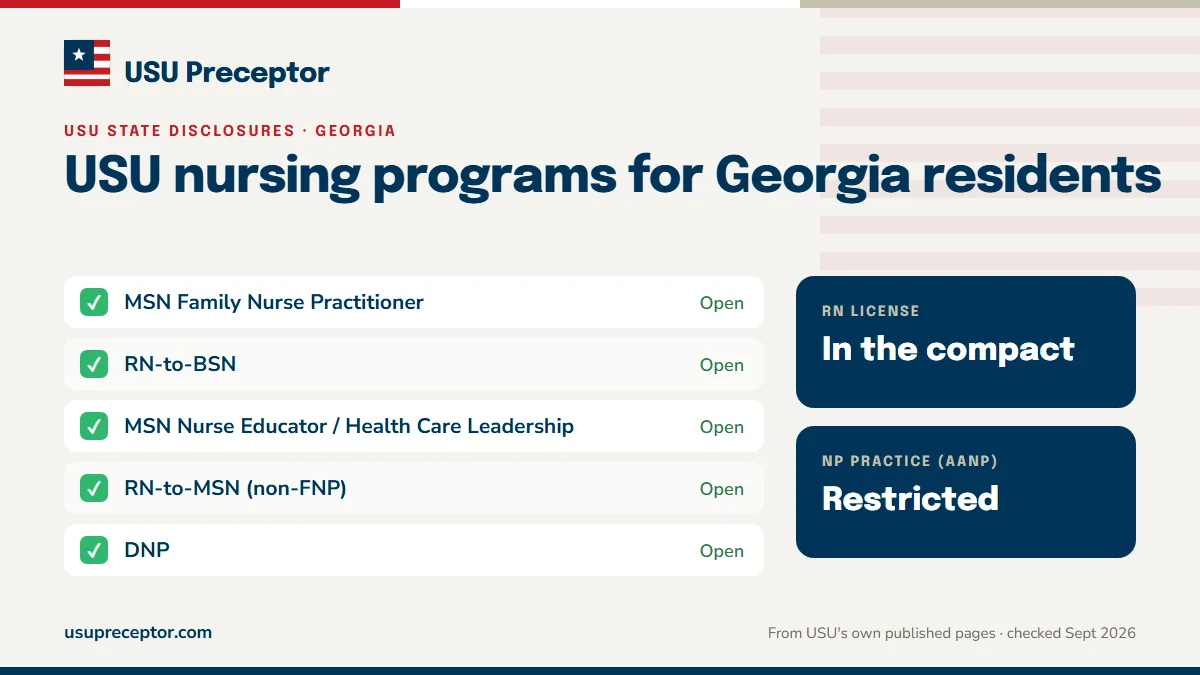
USU moved its main campus to Sandy Springs, Georgia in 2025, and every current USU nursing program is open to Georgia residents. The Georgia Board of Nursing doesn't approve post-licensure programs, so your clinical questions here are about licenses and preceptors, not program approval.
Need a Georgia preceptor?
Tell us your county and your USU course.
A Georgia university on paper, an online program in practice
The 2026-27 catalog lists USU's main campus at 859 Mt. Vernon Hwy NE in Sandy Springs, with San Diego now an administrative site. Georgia is also USU's home state for authorization purposes: USU takes part in NC-SARA through Georgia, which is how it enrolls students in other member states.
The move changed where USU is based, not how you get a preceptor. Georgia residents follow the same FNP handbook as everyone else. You list three or more qualified preceptors on the Interest Form half a year ahead of each clinical course, the Office of Field Experience (OFE) runs the agreement and compliance steps, and the Program Director approves each preceptor. The catalog also asks you to accept travel anywhere in Georgia, paid by you, and that radius can run from metro Atlanta to Savannah or Augusta.
Programs open to Georgia residents
| Program | Open to Georgia residents? | Clinical hours |
|---|---|---|
| MSN Family Nurse Practitioner | Yes | 540 in FNP592, FNP594, FNP596 and FNP597 |
| MSN Nurse Educator | Yes | 100 in MSN578 |
| MSN Health Care Leadership | Yes | 100 in MSN587 |
| RN-to-BSN | Yes | 90 in NUR378 and NUR499 |
| DNP | Yes | 1,000 post-baccalaureate, up to 500 transferable |
| Post-Master's FNP Certificate | No, closed to all new applicants | Not applicable |
Georgia appears on none of USU's exclusion lists. The only closed door is the Post-Master's FNP certificate, which stopped taking applications in April 2024 in every state. USU's disclosure also notes that its DNP isn't currently CCNE-accredited.
What the Georgia Board of Nursing requires
Housed in the Office of the Secretary of State, the Georgia Board of Nursing is explicit on its nursing education page that post-licensure programs, including APRN programs, are outside what it approves or regulates. No Board sign-off stands between USU and your RN-to-BSN, MSN or NP clinicals in Georgia. Pre-licensure is another matter: according to the Board, it currently approves no online or out-of-state programs for clinicals in Georgia.
Where the Board does set rules is licensing. If you live in Georgia, attend a program based elsewhere and do your clinical hours in the state, you need to be licensed in Georgia or hold a multistate license issued by a different compact state. The same license test applies to preceptors and faculty who teach or work in Georgia, whether in person or electronically. For post-licensure APRN programs, the Board adds that clinical instruction must be conducted by a nurse with APRN authorization in Georgia.
USU accepts MD and DO preceptors for FNP hours, but Georgia's Board says APRN clinical instruction must come from a nurse with Georgia APRN authorization. If your lead is a physician, ask your CPC how USU applies that before you send Appendix H.
Practice rules, preceptors and Georgia's tax credit
AANP rates Georgia a restricted practice state: NPs work under physician delegation or supervision, and their Schedule II prescribing is limited. Both roles appear on USU's list of eligible FNP preceptors, which names nationally certified NPs and licensed MDs and DOs, each with a year or more of experience, plus certified nurse-midwives for women's health hours only. USU requires a minimum of 135 hours with an NP preceptor and lets each preceptor take two students at most. Full criteria are on the preceptor requirements page.
Georgia also has a preceptor tax credit. Under the Preceptor Tax Incentive Program (PTIP), a licensed Georgia physician, APRN or PA who provides community-based clinical training without compensation earns a state tax credit for each 160-hour rotation, up to 10 rotations a year. Georgia AHEC says HB 144 revised and extended the program, with annual registration required from 2026, while the Department of Revenue page still shows the older terms.
The credit targets students enrolled in Georgia's medical, dental, NP or PA programs. Neither PTIP page says whether a USU rotation qualifies, and each USU FNP course runs 135 hours rather than 160, so a preceptor should check with Georgia AHEC before counting on it.
Atlanta and beyond: where Georgia FNP students look
The Atlanta-Sandy Springs-Roswell metro, home to about 6.5 million people and to USU's campus, holds the state's largest systems. Grady Health System, Northside Hospital, Emory Healthcare, Wellstar Health System and Piedmont Healthcare show where FNP students tend to look; they aren't a list of sites that accept USU students. Inpatient hours never count at USU, so the useful doors are these systems' primary care and outpatient practices; our hour-counting guide has the details.
Outside Atlanta, the main metros are Savannah, Augusta and Columbus. Two of them cross state lines: the Augusta metro reaches into South Carolina and Columbus into Alabama. A clinic across the river counts as out of state, and USU prefers that your hours stay in Georgia if Georgia is your home. Alabama also requires documentation from out-of-state APRN programs doing clinicals there, as our out-of-state clinicals page notes.
Your license for Georgia clinicals
Georgia has been a Nurse Licensure Compact state since January 19, 2018, and for clinicals the Board's rule accepts a Georgia license or, equally, a multistate license issued by a different compact state. USU's rule sits on top: your license must be active and unencumbered both in your state on file and in every state where you see patients, and your liability insurance must match that state.
The APRN Compact isn't in force anywhere yet. Georgia hasn't enacted it, only five states have, and it needs seven to operate. Telehealth hours, capped at 40 for the FNP, must involve patients located in Georgia if Georgia is your state on file. More on compact licenses is on our RN license page.
Why Georgia students choose us
A placement advisor searches Georgia, starting near your home, for outpatient preceptors who fit your USU course and meet both USU's criteria and the Board's license rules. We help you assemble the packet OFE and the Program Director review and keep searching if a preceptor withdraws. USU approves every placement. Start with the form.
Questions USU students ask
Does USU's move to Georgia make clinicals easier to find there?
Not directly. The move made Georgia USU's home state for authorization, but the placement process is the same for every USU student: you identify preceptors, OFE handles agreements and compliance, and the Program Director approves. No USU source we found describes Georgia-only clinical sites or a separate Georgia placement track.
Do I need Georgia Board approval for my USU clinicals?
No program approval is involved. The Georgia Board of Nursing doesn't approve or regulate post-licensure programs, NP programs included. What it does require is licensure for clinical hours in Georgia, meaning either a multistate license held through another compact state or a Georgia license, and preceptors and faculty teaching there face the same license rule.
Can my Georgia preceptor claim PTIP for a USU student?
That isn't confirmed. PTIP applies to community-based training given without compensation to students enrolled in Georgia's medical, dental, NP or PA programs, measured in 160-hour rotations; according to Georgia AHEC, HB 144 changed the program, and registration is annual from 2026. Your preceptor should ask Georgia AHEC whether a USU rotation qualifies.
Can I do clinicals in South Carolina or Alabama if I live near the border?
USU will hear the request, but it wants hours in your state of residence and cautions that a licensing board might not recognize hours earned outside it. You'd need a license valid in that state, and Alabama requires documentation from out-of-state APRN programs doing clinicals there. Raise it with your Clinical Placement Coordinator well before the 16-week deadline.
Related pages
Last checked 2026-09-23
We check these pages against USU's own catalog, handbooks and disclosures. USU's current handbook and your Clinical Placement Coordinator have the final word.
Six months out is USU's rule. We start now.
Tell us your USU program, your state and when your next practicum opens. We look for preceptors who meet USU's rules and help you build the packet the Office of Field Experience and Program Director review.
- Preceptors matched to the course: family practice, pediatrics, women's health, urgent care within USU's caps
- Appendix H, license, CV and board certification gathered the way OFE asks
- In person near you; telehealth only inside USU's 40-hour limit
Start your placement plan
A placement advisor replies with what a USU-ready preceptor and site look like for you.