USU's online FNP from North Carolina: who signs off, who precepts
Every admitting USU nursing program is open to North Carolina residents, the FNP included. The North Carolina Board of Nursing leaves post-licensure graduate programs, in state or out, outside its approval process, so USU's own approvals govern your placement. What shapes your search is North Carolina's restricted practice model and a Charlotte metro that spills into South Carolina.
Need a North Carolina preceptor for a USU course?
Tell us your course, your term and the nearest city.
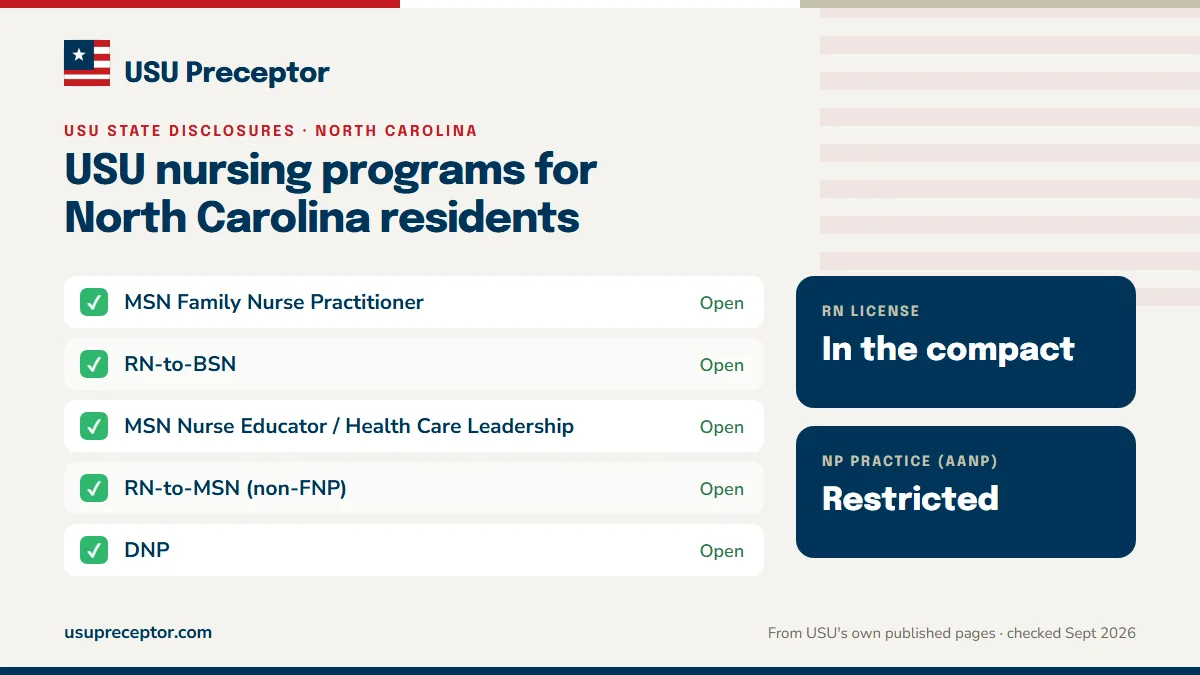
What a North Carolina address opens at USU
| Program | Open to NC residents? | Clinical hours |
|---|---|---|
| MSN Family Nurse Practitioner | Available | 540 hours: FNP592, FNP594, FNP596, FNP597 |
| MSN Nurse Educator | Available | 100 hours, MSN578 residency |
| MSN Health Care Leadership | Available | 100 hours, MSN587 residency |
| RN-to-BSN | Available | 90 community hours, NUR378 then NUR499 |
| DNP (post-master's) | Available | 1,000 post-baccalaureate |
| Post-Master's FNP Certificate | No, closed to new students in every state | Not applicable |
North Carolina doesn't appear on USU's list of states with extra clinical filings or approvals on file. How each practicum differs, and what it asks of a preceptor, is on our FNP preceptor page.
Where the NC Board of Nursing stands on programs like USU's
The North Carolina Board of Nursing (NCBON) states that it takes no approval position, for or against, on post-licensure graduate nursing programs, whether based in North Carolina or elsewhere, and it places RN-to-BSN, graduate and doctoral programs beyond its jurisdiction. Its out-of-state clinical rule, 21 NCAC 36 .0233, targets unlicensed pre-licensure students, whose clinical agency must request NCBON approval at least 30 days ahead.
One line in NCBON's education FAQ does reach graduate students: those without a North Carolina or multistate license should contact its Licensure Department for the requirements before clinicals in the state. The same FAQ notes that North Carolina joined SARA in June 2016 and that SARA-approved colleges' students may qualify for field placements in the state. USU participates in NC-SARA, with Georgia as its home state.
So the gates you'll meet are USU's: Program Director approval, an Affiliation Agreement with the site, and an OFE Approval Letter before your first hour, in the order shown on our placement process page.
A career-long physician agreement, and your preceptor pool
AANP rates North Carolina as restricted practice. For an NP's entire career an agreement with a physician is required, and a joint subcommittee drawn from the Medical Board and the Board of Nursing oversees NP licensure.
USU accepts a board-certified NP or a licensed MD or DO with at least a year of experience and the employer's permission to precept, but at least 135 of your 540 hours must be with an NP. PAs aren't on USU's list, and a preceptor can take no more than two students at once, other schools' NP students included. Our preceptor requirements page has the rest.
No North Carolina preceptor incentive is recorded in our research, so the benefits a preceptor sees are USU's own, listed on our page for preceptors.
Licensing: multistate since 2018, no APRN Compact
Because the Nurse Licensure Compact took effect in North Carolina on January 19, 2018, a multistate RN license issued there is also valid in the other compact states. It hasn't enacted the APRN Compact, which won't operate anywhere until seven states enact it; so far five have.
USU asks for an active, unencumbered license in your state on file and in any state where you do clinicals, with your liability insurance active in that same state. Compact questions are covered on our RN license page.
Charlotte, Raleigh, Greensboro, Winston-Salem
The biggest market is the Charlotte-Concord-Gastonia metro, about 2.9 million people, roughly 2.5 million of them on the North Carolina side. Raleigh-Cary follows at about 1.6 million, then Greensboro-High Point and Winston-Salem. Atrium Health (part of Advocate Health), UNC Health, Novant Health, Duke Health and ECU Health are among the large systems. These show where students tend to search, and none has a USU arrangement, and since inpatient hours never count, aim for their outpatient and primary care practices.
Charlotte's metro crosses into South Carolina. A practice a few miles over the line is another state as far as USU is concerned: hours there are by request only, and USU says it can't promise a licensing board will accept hours done outside your state of residence. The catalog expects you to travel anywhere in North Carolina at your own expense instead.
Why North Carolina students choose us
A placement advisor looks for an NP or physician preceptor and an outpatient site near you that fit your USU course, helps you assemble what the Office of Field Experience and your Program Director review, and searches again if a preceptor pulls out. USU approves every preceptor and site. Send us your course and city.
Questions USU students ask
Does the North Carolina Board of Nursing have to approve USU's FNP clinicals?
Not by its own account. By NCBON's statement, graduate programs for licensed nurses sit outside its approval process wherever they're based, and its out-of-state clinical rule targets unlicensed pre-licensure students. NCBON asks graduate students to reach its Licensure Department first if they hold no North Carolina or multistate license. USU's approvals still apply in full.
Can I count hours at a practice across the line in South Carolina?
Only if USU agrees. USU encourages every student to complete clinical hours in their approved state of residence, and it can't promise that hours done in another state will be accepted for licensure. South Carolina is a compact state, so your North Carolina multistate license would cover you there, but the call is USU's. Ask your Clinical Placement Coordinator before you approach the practice.
Can a physician be my only preceptor in North Carolina?
No. USU accepts licensed MDs and DOs, but at least 135 of your 540 FNP hours must be with a board-certified NP, and USU highly recommends spending most of your hours with FNP preceptors. Since each practicum is 135 hours, plan on an NP for at least one full course.
Will USU's FNP let me apply for NP licensure in North Carolina?
USU's state authorization disclosure says its MSN-FNP meets the educational requirements for APRN licensure in the states where it's authorized, and North Carolina is one of them. NP licensure there is handled jointly by the Medical Board and the Board of Nursing, so check its current requirements before you apply.
Related pages
Last checked 2026-09-23
We check these pages against USU's own catalog, handbooks and disclosures. USU's current handbook and your Clinical Placement Coordinator have the final word.
Six months out is USU's rule. We start now.
Tell us your USU program, your state and when your next practicum opens. We look for preceptors who meet USU's rules and help you build the packet the Office of Field Experience and Program Director review.
- Preceptors matched to the course: family practice, pediatrics, women's health, urgent care within USU's caps
- Appendix H, license, CV and board certification gathered the way OFE asks
- In person near you; telehealth only inside USU's 40-hour limit
Start your placement plan
A placement advisor replies with what a USU-ready preceptor and site look like for you.