Taking USU's nursing programs from Ohio
Ohio is open for all of USU's admitting nursing programs, including the 540-hour FNP. Ohio law has no board sign-off for out-of-state programs; it exempts their students directly, provided the supervision comes from the right person.
Get your placement plan
Tell us your USU track and where you live. A placement advisor replies with what a USU-ready preceptor and site look like for you.
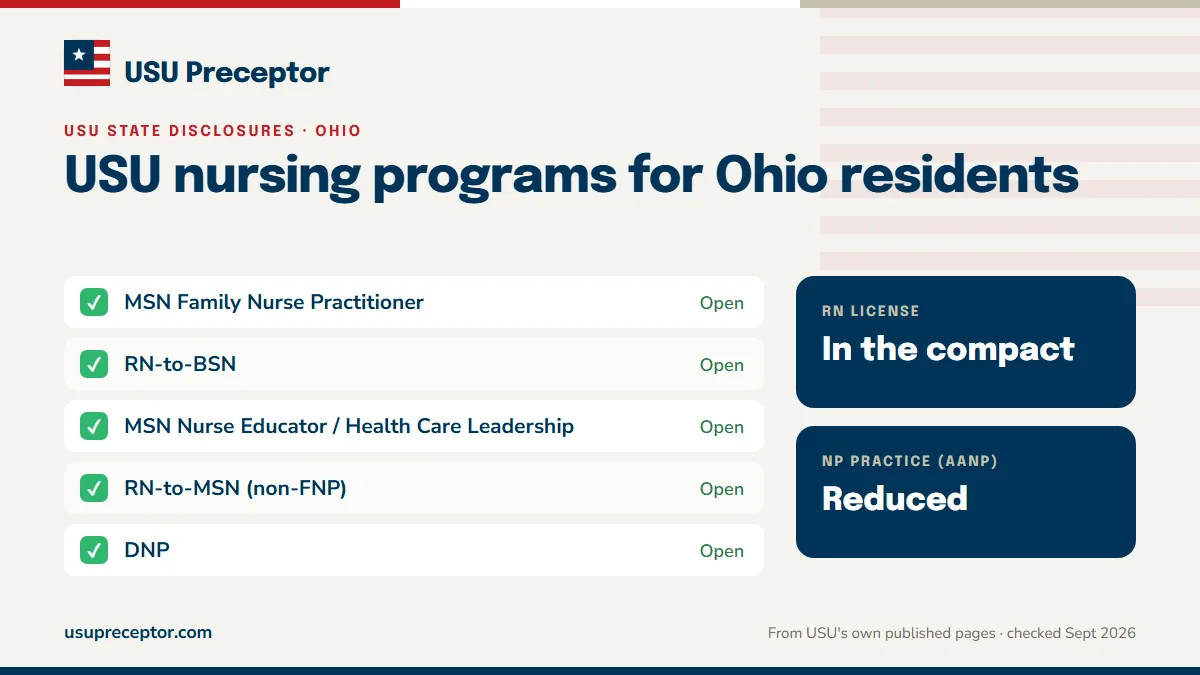
Ohio residents: every admitting USU program
Ohio isn't excluded from any USU nursing program that's taking students. Here's what each asks of you in clinical time.
| Program | Ohio | Clinical requirement |
|---|---|---|
| MSN Family Nurse Practitioner | Open | 540 hours in four 8-week courses of 135 (FNP592 to FNP597) |
| MSN Nurse Educator | Open | 100 hours in MSN578 |
| MSN Health Care Leadership | Open | 100 hours in MSN587 |
| RN-to-BSN | Open | 90 hours at a community agency |
| DNP | Open | 1,000 post-baccalaureate hours |
One line in USU's paperwork is worth checking. Its September 2026 State Authorization disclosure lists an Ohio approval with a “valid till” date of December 2025, which has passed. USU also participates in NC-SARA, and its May 2026 Board of Nursing list shows the FNP open to Ohio residents. The current lists are linked from USU's accreditation page.
Ohio's student exemption for out-of-state programs
Programs from other states face no board approval or notification step under the Ohio Revised Code. Instead, ORC 4723.32 exempts students. Division (A) applies to pre-licensure students whose program sits in another jurisdiction and holds approval from a member board of the National Council of State Boards of Nursing. Division (F) covers APRN students whose program qualifies them for an approved national certification exam, or leads to a qualifying master's or doctoral degree.
For FNP students the (F) exemption carries two conditions: you practice under the program's auspices, and you're supervised by an advanced practice registered nurse serving the program as a faculty member, teaching assistant or preceptor. Ohio isn't on USU's list of states with extra clinical filings, so USU's normal chain applies: the Program Director signs off on your preceptor, OFE contracts with the site, and your approval letter arrives before a single hour counts.
Standard care arrangements and choosing a preceptor
The AANP rates Ohio as reduced practice. All Ohio NPs must maintain a standard care arrangement, for their whole career, with a collaborating podiatrist or physician, and the practice setting limits Schedule II prescribing.
USU accepts board-certified NPs and licensed MDs or DOs as FNP preceptors, but Ohio's student exemption is worded around APRN supervision. If you're considering a physician for part of your hours, ask your CPC how USU applies the Ohio statute before you commit. An NP preceptor also covers USU's own floor of 135 hours with an NP. USU's full criteria are on preceptor requirements.
Licensing in a compact state
Ohio became a Nurse Licensure Compact member effective January 1, 2023. In the Ohio Board of Nursing's description, the compact gives you a single multistate license from your primary state of residence, and with it you can practice in the other compact states. How USU treats compact licenses is covered on RN licenses for clinicals.
Under USU's FNP handbook you need an active, unencumbered license wherever USU has you on file and wherever you see patients, plus liability insurance in that state, and USU would rather those hours stay in Ohio. Cincinnati is the obvious test: about 1.76 million of the metro's 2.31 million people live on the Ohio side, and a Kentucky-side clinic is out of state as far as USU is concerned, whatever your compact privileges. See out-of-state clinicals.
Columbus, Cleveland, Cincinnati, Dayton
Ohio's population is spread across several big metros rather than one. Columbus (about 2.24 million) has OhioHealth and The Ohio State University Wexner Medical Center. Cleveland (about 2.17 million) has Cleveland Clinic and University Hospitals. Cincinnati has Bon Secours Mercy Health (Mercy Health), and the Dayton-Kettering-Beavercreek metro adds about 827,000 people.
Treat this as a map of where FNP students search, not a list of USU sites. A brand-new affiliation agreement with a system can take OFE four to six months, so mention any system lead to your CPC early. Outpatient primary care is the target, since inpatient hours never count.
Why Ohio students choose us
We look for Ohio NPs, and physicians where your CPC confirms they fit, whose practice matches your USU course, then help you pull together the Appendix H form and license verification for USU's review. The decision on each preceptor and site is USU's. If a preceptor drops mid-course, we start searching again. Start with the form.
Questions USU students ask
Does Ohio require USU to register before I do clinicals there?
Not with the Board of Nursing, as far as the Revised Code goes. Under ORC 4723.32, programs from other states have no approval or notification step, and APRN students in qualifying programs are exempt when they practice under the program's auspices with APRN supervision. Institution-level authorization is a separate matter USU reports in its State Authorization disclosure.
Can an MD or DO be my USU preceptor in Ohio?
USU's handbook allows licensed MDs and DOs, but Ohio's student exemption refers to supervision by an APRN serving as faculty, teaching assistant or preceptor. Ask your Clinical Placement Coordinator how USU applies that in Ohio before you line up a physician. Whatever the answer, NPs must still account for 135 or more of your 540 hours.
I live near Cincinnati. Can I use a Northern Kentucky practice?
You can request it, but USU prefers clinicals in your approved state of residence, and it won't vouch for how a licensing board treats hours completed outside it. You'd also have to hold a license that's valid in Kentucky, plus liability insurance there. With about 1.76 million people on the Ohio side of the metro, that side is the place to start.
I just moved to Ohio. Which license do I use for USU clinicals?
The Ohio board describes a multistate license as one held in your primary state of residence, so if Ohio is now home, check with the board whether your license needs to move. USU, for its part, wants an active, unencumbered license covering both your address on file and every state where you do clinical hours. Update your address with USU as well; a move after a term begins leaves USU without responsibility for your placement.
Related pages
Last checked 2026-09-23
We check these pages against USU's own catalog, handbooks and disclosures. USU's current handbook and your Clinical Placement Coordinator have the final word.
Six months out is USU's rule. We start now.
Tell us your USU program, your state and when your next practicum opens. We look for preceptors who meet USU's rules and help you build the packet the Office of Field Experience and Program Director review.
- Preceptors matched to the course: family practice, pediatrics, women's health, urgent care within USU's caps
- Appendix H, license, CV and board certification gathered the way OFE asks
- In person near you; telehealth only inside USU's 40-hour limit
Start your placement plan
A placement advisor replies with what a USU-ready preceptor and site look like for you.