USU nursing from Indiana: what's open and how clinicals work
USU enrolls Indiana residents in its FNP and every other nursing program it's admitting. Indiana's board says it doesn't review RN-to-BSN or graduate programs, so the approvals that decide your clinical start are USU's own.
Get your placement plan
Tell us your USU track and where you live. A placement advisor replies with what a USU-ready preceptor and site look like for you.
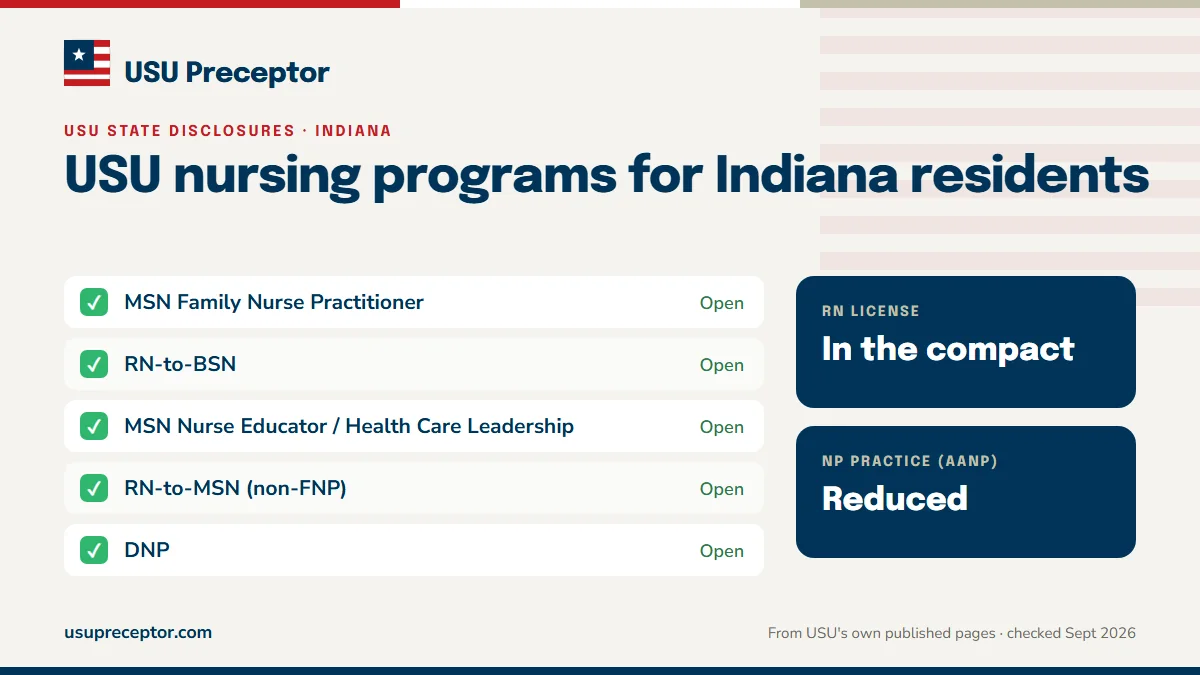
What USU offers Indiana residents
Indiana isn't on any of USU's exclusion lists for the programs it's admitting, so this table is short on caveats.
| USU program | Indiana residents | Hours you'll place |
|---|---|---|
| Family Nurse Practitioner (MSN) | Enrolled | 540 across four 135-hour practicums |
| Nurse Educator (MSN) | Enrolled | 100 in the MSN578 teaching residency |
| Health Care Leadership (MSN) | Enrolled | 100 in the MSN587 residency |
| RN-to-BSN | Enrolled | 90 community hours (NUR378, NUR499) |
| DNP | Enrolled | 1,000 post-baccalaureate; APRNs start with 500 credited |
| Post-Master's FNP certificate | Closed in every state | Not admitting |
No Indiana board step for out-of-state graduate programs
Accreditation of Indiana's own pre-licensure RN and LPN programs falls to the State Board of Nursing, which operates within the state's Professional Licensing Agency. RN-BSN programs and graduate nursing programs of any kind are, by the Board's own plain statement, outside its review and accreditation, and 848 IAC 1-2-4, its rule on eligible programs, reaches only pre-licensure RN and PN programs. Nor did we find any requirement that a graduate or RN-to-BSN program from another state get board approval before placing students in Indiana.
USU's disclosure doesn't flag Indiana for any extra clinical filing either. That leaves USU's own sequence: your preceptor leads, the Appendix H packet, Program Director approval, the affiliation agreement OFE sends to the site, and the OFE Approval Letter before any hours. The clinical placement process page walks through it.
Collaborative practice and your preceptor pool
Indiana appears as reduced practice in AANP's ratings, since a regulated physician collaboration agreement has to cover some element of each NP's practice. Any Indiana NP you approach will have that arrangement in place, and a physician can precept you as well, since USU accepts licensed MDs and DOs alongside board-certified NPs.
Match the preceptor to the course. Appendix I asks for a primary care, family practice or internal medicine practice with no specialty for FNP592, a pediatric office for pediatric hours, and OB/GYN or women's health clinicians, CNMs included, for women's health. A preceptor can take two students at most, and NP students from other schools count. Details are on preceptor requirements.
Your Indiana license and the state lines around it
Since July 1, 2020, when Indiana implemented the Nurse Licensure Compact, a multistate license issued by Indiana has carried practice privileges into the other compact states. USU's rules are narrower than the compact. It wants your clinical hours in your approved state of residence where possible, with your license and liability insurance active in whichever state you train.
The border metros are where this bites. About 729,000 Hoosiers live in the Chicago-Naperville-Elgin metro, and Illinois isn't in the compact, so an Illinois clinic would need an Illinois license on top of yours. Another 281,000 or so live in the Louisville metro, where a Kentucky practice is still a second state. Read RN licenses for clinicals before you chase a site across a state line.
Indianapolis, Fort Wayne and the systems students search
The Indianapolis-Carmel-Greenwood metro, about 2.2 million people, is the state's largest, and Fort Wayne adds about 466,000. Parkview Health, Franciscan Health, Ascension St. Vincent, Community Health Network and Indiana University Health are among Indiana's big systems. They're examples of where FNP students search; none is a promise of a USU agreement, and OFE doesn't publish which sites it already works with, so ask your CPC.
USU expects you to travel within Indiana for clinicals at your own cost, and a long drive isn't grounds to refuse a placement. Aim for outpatient practices: hospital and inpatient hours never count toward the FNP.
Why Indiana students choose us
A placement advisor looks for Indiana clinicians, NP or physician, whose setting matches what your next USU practicum calls for, checks their licenses and board certification, and helps you assemble the documents USU's reviewers ask for. Approval of each preceptor, site and agreement stays with USU. Should a preceptor pull out, the search resumes. Share your course and county.
Questions USU students ask
Does Indiana require USU to get approval before I do clinicals there?
Not that we found. By its own account, Indiana's board neither reviews nor accredits RN-BSN or graduate nursing programs of any kind; its program rules apply only to pre-licensure RN and PN programs. You still need every USU approval before your first hour: Program Director sign-off on your preceptor, an affiliation agreement with the site, and the OFE Approval Letter.
I live in Northwest Indiana. Can I do clinicals in Chicago?
You can ask, but Illinois sits outside the Nurse Licensure Compact, which means your Indiana multistate license carries no privilege there and you'd need an Illinois RN license as well. USU also can't promise that hours logged outside your state of residence will count with a licensing board. An Indiana-side practice avoids both problems.
Can my USU telehealth hours include patients in Kentucky or Ohio?
No. Under Appendix I of USU's FNP handbook, a telehealth patient has to be located in the state on your USU record, Indiana, and you need a license there. The FNP allows 40 telehealth hours at most, only with approval, and your preceptor sits beside you for each video visit rather than joining remotely. See virtual clinical options.
Is USU currently authorized to enroll Indiana students?
Indiana is open for every admitting nursing program on USU's Board of Nursing list, last updated May 19, 2026. Its September 2026 State Authorization disclosure, though, shows an Indiana entry marked valid until July 9, 2026, a date that has passed. USU also takes part in NC-SARA. Check the current lists linked from USU's accreditation page, or ask admissions, before relying on either.
Related pages
Last checked 2026-09-23
We check these pages against USU's own catalog, handbooks and disclosures. USU's current handbook and your Clinical Placement Coordinator have the final word.
Six months out is USU's rule. We start now.
Tell us your USU program, your state and when your next practicum opens. We look for preceptors who meet USU's rules and help you build the packet the Office of Field Experience and Program Director review.
- Preceptors matched to the course: family practice, pediatrics, women's health, urgent care within USU's caps
- Appendix H, license, CV and board certification gathered the way OFE asks
- In person near you; telehealth only inside USU's 40-hour limit
Start your placement plan
A placement advisor replies with what a USU-ready preceptor and site look like for you.