USU's FNP and nursing programs for Michigan residents
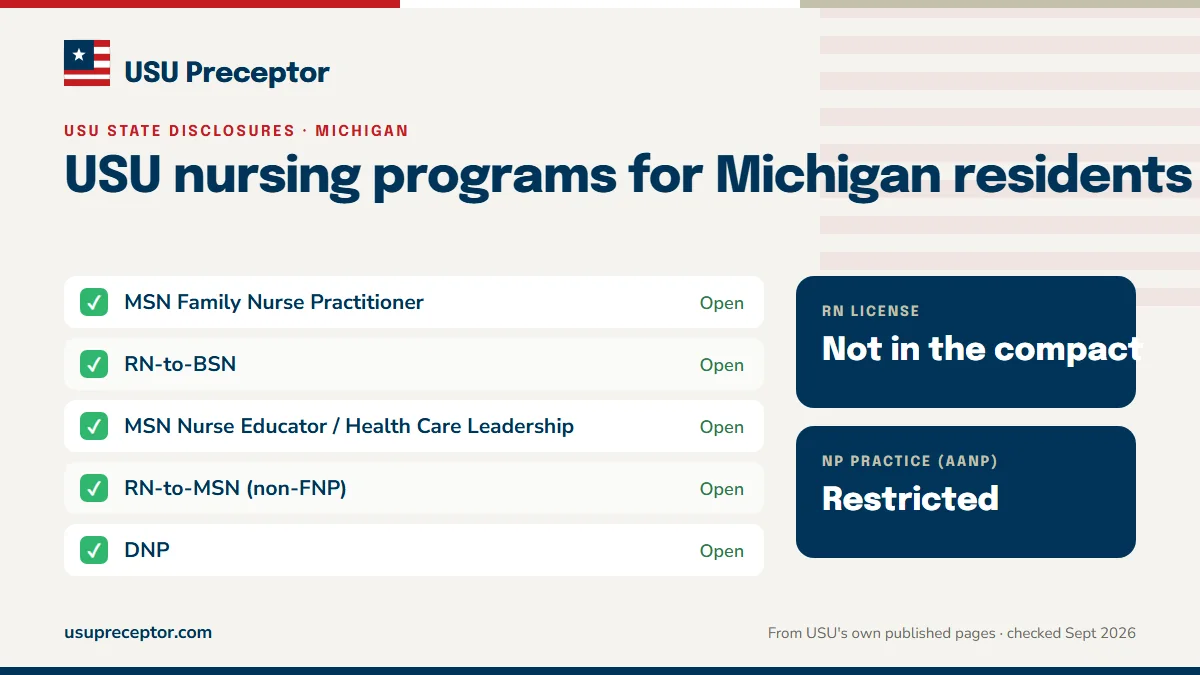
USU enrolls Michigan residents in its FNP and its other admitting nursing programs. Michigan is one of the states the AANP rates as restricted practice, and it isn't in the Nurse Licensure Compact, so plan your clinicals around a Michigan license and Michigan preceptors.
Get your placement plan
Tell us your USU track and where you live. A placement advisor replies with what a USU-ready preceptor and site look like for you.
Programs you can take from Michigan
Michigan appears on none of USU's exclusion lists, and it isn't one of the states where USU's disclosure records an extra clinical filing or approval.
| Program | Michigan residents? | Clinical hours |
|---|---|---|
| Family Nurse Practitioner, MSN | Eligible | 540 in four practicums, FNP592 through FNP597 |
| MSN Nurse Educator or Health Care Leadership | Eligible | 100 in MSN578 or MSN587 |
| RN-to-BSN | Eligible | 90 |
| DNP | Eligible | 1,000 post-baccalaureate (up to 500 transfer) |
| Post-Master's FNP certificate | Not open: USU stopped taking applications in every state | None |
USU admits MSN students on an unencumbered RN license from the state where they live. For a Michigan resident that's a Michigan license, since no multistate license from elsewhere is valid here.
Restricted practice, and checking a Michigan preceptor
The AANP classes Michigan as restricted practice because NPs need physician delegation to prescribe controlled substances. USU takes either side of that relationship as a preceptor, given a year or more of experience: an NP with national board certification, or a licensed physician (MD or DO). NP time can't drop below 135 of your 540 hours.
Michigan's own credentialing helps you vet an NP. The state grants NP specialty certification only to people who hold a current Michigan RN license plus national certification from a board-recognized body. USU asks for the same proof in its packet: license verification, and board certification in Exhibit A of the Appendix H form. A Michigan NP with specialty certification should be able to show both. More on preceptor requirements.
No Michigan sign-off found for out-of-state programs
Neither the Michigan Board of Nursing's rules nor its guidance, as far as we found, make programs from other states obtain approval or send notice before they place students in Michigan clinicals. The board's rules on program approval, starting at Mich. Admin. Code R 338.10301, address programs located within Michigan, and for licensure purposes the state recognizes programs from other states by their national nursing accreditation, not by board approval. That's the published position; the board wasn't asked directly.
What does apply is USU's own sequence. OFE handles the site contract, and USU's handbook says to allow four to six months when it's new. Nothing you log counts until your OFE Approval Letter is issued. The placement process page sets out the order.
Michigan's compact bill: pending, not law
Michigan isn't in the Nurse Licensure Compact. House Bill 4246 is pending, but until a compact law passes and takes effect, a Michigan RN license works only in Michigan and a multistate license from another state carries no practice right here. Moving in? To get a Michigan RN license you need a criminal background check, 2 hours of implicit bias training completed in the 5 years before issuance, and one-time training to recognize human trafficking victims.
The border cuts both ways. Ohio, Indiana and Wisconsin are compact states, but a single-state Michigan license doesn't reach them, and USU wants a license in every clinical state plus hours in your state of residence where possible. See RN licenses for clinicals.
Detroit, Grand Rapids, Lansing and Flint
The Detroit-Warren-Dearborn metro holds about 4.4 million people and Grand Rapids-Wyoming-Kentwood about 1.2 million, with Lansing-East Lansing (about 480,000) and Flint (about 401,000) behind them. McLaren Health Care, Trinity Health Michigan, Henry Ford Health, University of Michigan Health (Michigan Medicine) and Corewell Health are among Michigan's big systems. A familiar name isn't the same as a USU contract, so ask your CPC which Michigan sites already have an agreement before you approach a system.
USU's catalog expects you to travel anywhere in Michigan at your own expense. Stay with outpatient settings: USU never counts inpatient or hospital hours, and your first rotation, FNP592, has to be family or primary care, with primary care internal medicine also accepted.
What Michigan offers preceptors, and where we help
Michigan's health department has paid clinical preceptors before, through an MDHHS Office of Nursing Programs pilot with Michigan State University's College of Nursing, for preceptors of MSU's Family NP and Psychiatric-Mental Health NP students. MDHHS lists it as completed, and it covered only MSU students. No Michigan preceptor tax credit was found. That leaves USU's own preceptor benefits as the main thing to mention when you ask.
A placement advisor hunts for Michigan preceptors, NP or physician, suited to your current USU course, verifies their Michigan credentials, and helps you prepare the Appendix H form and supporting documents. OFE and the Program Director make every approval decision; if your preceptor backs out, the search restarts. Send us your course.
Questions USU students ask
Is Michigan in the Nurse Licensure Compact?
No. A compact bill, House Bill 4246, is pending, but Michigan isn't a member, so a multistate license from another state doesn't let you practice in Michigan and a Michigan license doesn't reach other states. For USU clinicals in Michigan you need an active, unencumbered Michigan RN license, with your liability insurance in the same state.
Is USU's authorization in Michigan current?
USU's May 2026 Board of Nursing list shows all of its admitting nursing programs open to Michigan residents. Its September 2026 State Authorization disclosure, however, still carries a Michigan line marked valid until December 2025. USU participates in NC-SARA. Check the current lists on USU's accreditation page, or ask admissions, if the date concerns you.
I live near the Ohio line. Can I do USU clinicals in Ohio?
You can request it, but your Michigan license is single-state, so you'd need a license valid in Ohio as well. USU steers students toward clinical hours at home and can't promise how a licensing board will treat hours earned across the line. Staying in Michigan keeps your license and insurance in one state.
Will the state pay my Michigan preceptor?
Not through any current program we found. The MDHHS preceptor incentive pilot is completed and applied only to preceptors of Michigan State University NP students, and Michigan has no enacted preceptor tax credit on record. What USU itself offers preceptors, such as its Honorary Clinical Faculty title and library access, is covered on precepting USU students.
Related pages
Last checked 2026-09-23
We check these pages against USU's own catalog, handbooks and disclosures. USU's current handbook and your Clinical Placement Coordinator have the final word.
Six months out is USU's rule. We start now.
Tell us your USU program, your state and when your next practicum opens. We look for preceptors who meet USU's rules and help you build the packet the Office of Field Experience and Program Director review.
- Preceptors matched to the course: family practice, pediatrics, women's health, urgent care within USU's caps
- Appendix H, license, CV and board certification gathered the way OFE asks
- In person near you; telehealth only inside USU's 40-hour limit
Start your placement plan
A placement advisor replies with what a USU-ready preceptor and site look like for you.