USU's FNP from Missouri: finding preceptors in a restricted practice state
A Missouri address doesn't close any admitting USU nursing program to you, the FNP included. Missouri's board has no published approval step for out-of-state programs, but its practice rules shape who precepts you, and its two biggest metros spill into states that complicate clinicals.
Get your placement plan
Tell us your USU track and where you live. A placement advisor replies with what a USU-ready preceptor and site look like for you.
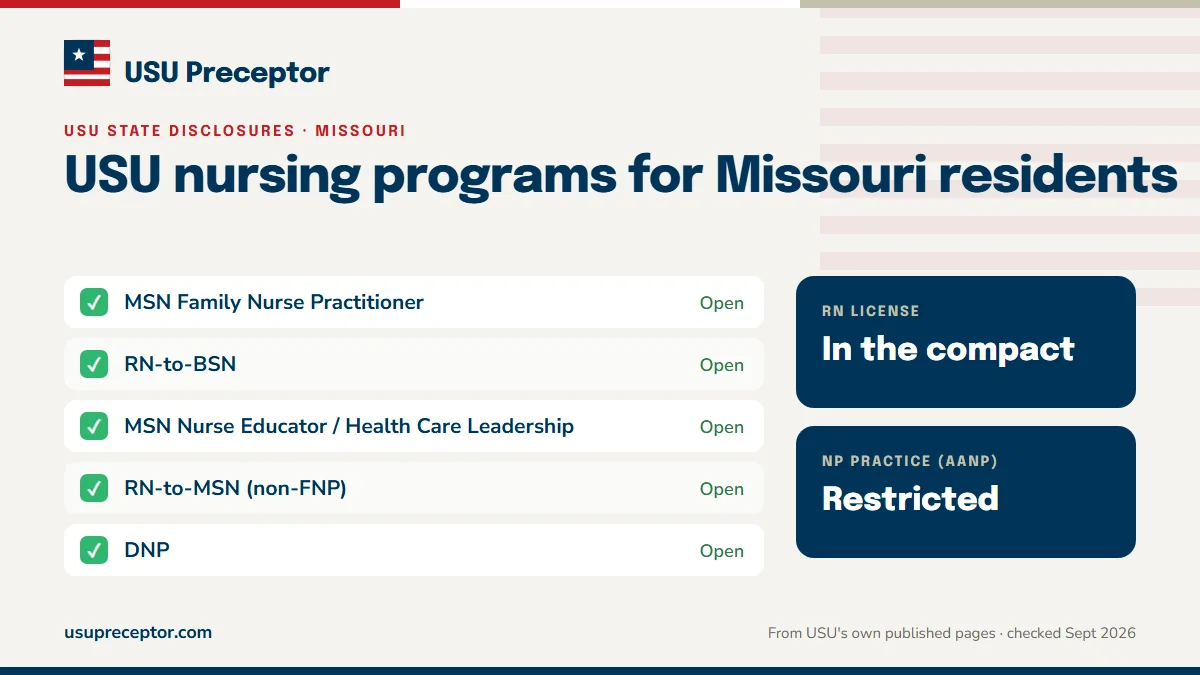
USU programs a Missouri address opens
| Program | Open to Missouri residents? | Clinical or practicum hours |
|---|---|---|
| MSN Family Nurse Practitioner | Yes | 540 across FNP592, FNP594, FNP596, FNP597 |
| MSN Nurse Educator | Yes | 100 in MSN578 |
| MSN Health Care Leadership | Yes | 100 in MSN587 |
| RN-to-BSN | Yes | 90 in NUR378 and NUR499 |
| DNP | Yes | 1,000 post-baccalaureate |
None of USU's exclusion lists names Missouri. USU encourages students to do clinical hours in their approved state of residence, so for a Missourian the search starts inside Missouri and, ideally, stays there.
Collaborative practice and your preceptor pool
AANP rates Missouri a restricted practice state. Missouri NPs keep a collaborative practice arrangement with a physician for their whole career, with limits on ratios, chart review and controlled substances. So the NPs you approach work alongside a collaborating physician, and either could precept you.
USU accepts a board-certified NP or a licensed MD or DO with at least a year of experience and an active license where the clinical happens. At least 135 of your 540 hours must be with an NP, so a practice where only the physician precepts can't carry the whole program. USU's limit of two students per preceptor counts NP students from other schools, so ask what a practice already hosts.
Missouri does have a preceptor tax credit, but it doesn't reach nursing. RSMo 135.690 offers its reward only for unpaid precepting of Missouri medical or PA students by physicians and physician assistants licensed in Missouri, which leaves out NPs, APRNs and nursing students.
Missouri's board and out-of-state programs: nothing published
We found no rule or guidance from the Missouri State Board of Nursing that makes programs from other states seek approval or give notice before placing students in Missouri. 20 CSR 2200-2, the Board's program rules, apply to the programs the Board approves. RSMo 335.081(6)(a) lets students in approved schools of nursing practice under supervision without a Missouri license, without saying how out-of-state programs are treated.
That exemption matters less to you than to a prelicensure student, because USU requires you to hold an active RN license where you live and train. The approvals between you and a Missouri clinic are USU's: Program Director approval of your preceptor, the affiliation agreement OFE sends to the site and the OFE Approval Letter.
St. Louis, Kansas City, Springfield, Columbia
The St. Louis metro holds about 2.14 million Missourians in 2025 Census estimates and the Kansas City metro 1.33 million, while Springfield has about 501,000 and Columbia about 219,000. Missouri FNP students look at systems such as MU Health Care, CoxHealth, SSM Health, Mercy and BJC HealthCare. Treat them as places to search, not as sites with a USU agreement.
Inside those systems, aim at primary care and family practice clinics: USU never counts inpatient hours, and FNP592 must be in family practice, primary care or primary care internal medicine.
Your license, and the clinic across the state line
Missouri's statutory adoption of the Nurse Licensure Compact, RSMo 335.360, took effect July 20, 2017, and implementation followed on January 19, 2018. It hasn't enacted the APRN Compact. USU requires your RN license to be active and unencumbered in your state on file and in any clinical state, with liability insurance active in the same state; the RN license page has the detail.
Both big metros cross state lines, and the compact helps less there than you'd think. Illinois isn't a compact member, so a Missouri multistate license gives no privilege to practice on the Illinois side of the St. Louis metro. Kansas is a compact state, but USU doesn't offer its FNP to Kansas residents because the program's hours fall short of Kansas's APRN minimum.
A Kansas City clinic on the Kansas side is a Kansas placement. Clear it with your CPC before you list it.
How we help Missouri students
A placement advisor looks for Missouri NPs and physicians who fit your USU course and have room under USU's student limit, then helps you pull together the Appendix H packet the Program Director reviews. If a preceptor withdraws, we look again. Approval stays with USU. Ask about a Missouri search.
Questions USU students ask
Can I do USU clinicals on the Illinois side of the St. Louis metro?
Only with extra hurdles. Illinois isn't in the Nurse Licensure Compact, so you'd need an Illinois RN license as well, since USU requires an active license in every state where you do clinicals. USU also prefers hours in your state of residence and can't promise Illinois's board would accept hours done there. See our Illinois page.
Can I do FNP clinicals at the Missouri health system where I work?
USU allows it if you disclose it in writing to your CPC and clinical instructor. The clinical hours must be separate from your normal job duties, and you can't be paid by the site or preceptor during them. Because USU never counts inpatient hours, a hospital employer only helps if it runs outpatient primary care clinics.
What license covers the RN-to-BSN practicum in Missouri?
USU's practicum handbook asks for an active nursing license from the state where you'll do the rotation. For a Missouri resident working at home, the license Missouri issued you covers that. The practicum itself is 90 community hours, split across NUR378 and NUR499, at a public-facing agency that serves vulnerable groups.
Is USU's DNP open to Missouri residents?
Yes. USU's DNP exclusions cover Idaho, Maryland, New York, Oregon, Utah, Washington and DC, plus two territories, not Missouri. Expect 1,000 post-baccalaureate practice hours (you can transfer up to 500) and a Project Mentor with a doctorate. USU's disclosure says the DNP isn't currently CCNE-accredited. More on the DNP page.
Related pages
Last checked 2026-09-23
We check these pages against USU's own catalog, handbooks and disclosures. USU's current handbook and your Clinical Placement Coordinator have the final word.
Six months out is USU's rule. We start now.
Tell us your USU program, your state and when your next practicum opens. We look for preceptors who meet USU's rules and help you build the packet the Office of Field Experience and Program Director review.
- Preceptors matched to the course: family practice, pediatrics, women's health, urgent care within USU's caps
- Appendix H, license, CV and board certification gathered the way OFE asks
- In person near you; telehealth only inside USU's 40-hour limit
Start your placement plan
A placement advisor replies with what a USU-ready preceptor and site look like for you.