Living in Kansas: USU's FNP is closed, its other nursing programs are open
USU does not enroll Kansas residents in its MSN Family Nurse Practitioner program, because its own disclosure says the FNP doesn't meet Kansas's clinical-hour minimum for APRN licensure. The RN-to-BSN, the Nurse Educator and Health Care Leadership MSNs and the DNP are still open to you.
In a USU program you can take from Kansas?
Tell us your course and where in Kansas you live.
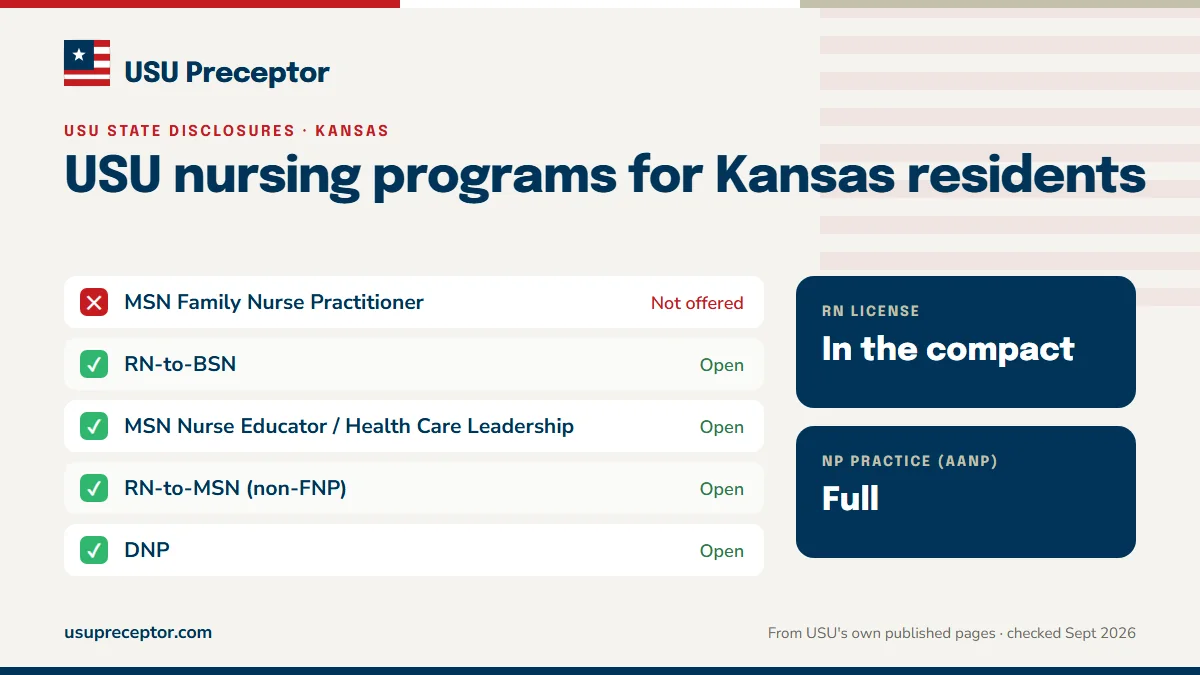
What USU lets you take with a Kansas address
| Program | Open to Kansas residents? | Clinical or practicum hours |
|---|---|---|
| MSN Family Nurse Practitioner | No | 540: FNP592, FNP594, FNP596, FNP597, 135 each |
| MSN Nurse Educator | Yes | 100 in MSN578 |
| MSN Health Care Leadership | Yes | 100 in MSN587 |
| RN-to-BSN | Yes | 90 in NUR378 and NUR499 |
| DNP (post-master's) | Yes | 1,000 post-baccalaureate, up to 500 transferred in |
Eligibility follows your home address. USU says it does not enroll students who live in states where it isn't authorized for their program, so living on the Kansas side of the Kansas City metro and hoping to do clinicals on the Missouri side doesn't reopen the FNP. The programs that are open each have their own practicum rules on the RN-to-BSN, Nurse Educator and DNP pages.
Why the FNP is closed: USU's reading of the Kansas hour rule
The reason is USU's, stated in its own documents. USU's State Authorization and Board of Nursing disclosures, both linked from its accreditation page, say the FNP does not currently meet Kansas's APRN licensure clinical-hour requirements. Their stated Kansas minimum is 500 role-specialty hours if admission came on or before March 1, 2025, rising to 750 for anyone admitted after that date.
Measured against USU's 540 hours, the 750 figure is the one that decides it: anyone starting now falls under it, and 540 is 210 hours short. On paper 540 clears the older 500 mark, yet USU still lists Kansas as closed for the FNP and doesn't explain how it counts role-specialty hours for earlier admits, so USU's list is the one to plan by. If you think the older rule should cover you, the people to ask are USU admissions and the Kansas State Board of Nursing (KSBN).
KSBN's guidance shows why the count carries so much weight. Online APRN programs based outside Kansas face no approval step before their students enroll. The review comes later, once a graduate seeks a Kansas APRN license: KSBN then checks the program for national accreditation, the clinical-hour minimum, at least 45 credit hours, and 3 credit hours apiece in pathophysiology, health assessment and advanced pharmacology.
Moving to Kansas partway through USU's FNP
USU's catalog says a student who moves to a state where their program isn't offered can't complete it, and the FNP handbook warns that a change of address can stop you progressing. USU's licensure disclosure adds that the FNP doesn't meet APRN educational requirements in states where it isn't authorized. A job offer in Wichita or Topeka during your second year is something to raise with your Clinical Placement Coordinator (CPC) before you sign a lease.
Finishing first and moving later is KSBN's call, not USU's: a Kansas license application on a USU degree gets measured against the checklist above.
The Kansas City metro runs across both states, with about 938,000 of its 2.27 million residents on the Kansas side. If you live in Missouri and study the FNP, USU only lets you request clinicals in other states where it is approved, and Kansas isn't one of them for this program. Our Missouri page covers your side of the line.
Kansas licensing, practice and employers
AANP rates Kansas a full-practice state for NPs. Kansas implemented the Nurse Licensure Compact on July 1, 2019 and has not enacted the APRN Compact. When APRN students train in Kansas clinical settings, KSBN says they practice on an RN license that Kansas recognizes, whether Kansas single-state or multistate, and their preceptor should be licensed as a Kansas APRN in the role being studied.
For the programs you can take, USU's practicum handbook asks for an active nursing license in the state where you'll do your practicum, so a Kansas or multistate license covers practicum hours at home. Our RN license page explains the compact details. Besides Kansas City, Kansas has metros in Wichita, Topeka and Manhattan; among its larger health systems are HCA's Wesley Healthcare in Wichita, Ascension Via Christi, Stormont Vail Health and The University of Kansas Health System.
Why Kansas students choose us
USU's FNP isn't open to Kansas residents, so our Kansas searches serve USU's other nursing programs. If you're in USU's Nurse Educator or Health Care Leadership MSN, the RN-to-BSN or the DNP, a placement advisor searches near you for a preceptor, mentor or community agency that fits your course, helps you prepare what USU's Office of Field Experience reviews, and searches again if someone drops out. USU gives the final approval on every site and preceptor. Tell us your course to start.
Questions USU students ask
Can I take USU's DNP while living in Kansas?
Yes. Kansas isn't on USU's excluded list for the DNP, which is a post-master's program requiring 1,000 post-baccalaureate practice hours, with up to 500 transferable from earlier graduate work. APRNs enter credited with 500 hours. You'll need a doctorally prepared Project Mentor, and USU's disclosure says the DNP is not currently CCNE-accredited.
What does USU's RN-to-BSN practicum look like for a Kansas student?
It's 90 hours split between NUR378 and NUR499, 45 each, with the same agency leader for both. The agency has to serve vulnerable community populations and be open to the public, and the leader submits a resume to USU's Office of Field Experience. You need an active nursing license in the state where you do the hours.
I was admitted to USU's FNP before March 2025. Can I move to Kansas and finish?
Don't plan on it. USU's disclosure lists Kansas as closed for the FNP without carving out earlier admits, and the catalog says a move to a state where your program isn't offered means you can't complete it. Put the question to your Clinical Placement Coordinator and USU in writing before you move, and check KSBN's requirements too.
Do Kansas preceptors need a Kansas APRN license?
According to KSBN, whoever precepts APRN students in Kansas should be a Kansas-licensed APRN in the role being studied, should be oriented, and should sign an agreement. It's a Kansas rule for APRN clinicals in general. For USU's FNP it doesn't come into play, because USU only considers out-of-state clinical requests in states where it's approved for the program.
Related pages
Last checked 2026-09-23
We check these pages against USU's own catalog, handbooks and disclosures. USU's current handbook and your Clinical Placement Coordinator have the final word.
Six months out is USU's rule. We start now.
Tell us your USU program, your state and when your next practicum opens. We look for preceptors who meet USU's rules and help you build the packet the Office of Field Experience and Program Director review.
- Preceptors matched to the course: family practice, pediatrics, women's health, urgent care within USU's caps
- Appendix H, license, CV and board certification gathered the way OFE asks
- In person near you; telehealth only inside USU's 40-hour limit
Start your placement plan
A placement advisor replies with what a USU-ready preceptor and site look like for you.