Hawaii and USU's FNP: a Hawaii license, a quiet board and a tax credit that stops short
Living in Hawaii doesn't rule out any admitting USU nursing program. Because Hawaii hasn't joined the Nurse Licensure Compact, your RN license has to be issued by Hawaii. Its Board has spoken on pre-licensure and post-licensure programs from elsewhere, but no Hawaii source found addresses graduate or APRN programs specifically.
Get your placement plan
Tell us your USU track and where you live. A placement advisor replies with what a USU-ready preceptor and site look like for you.
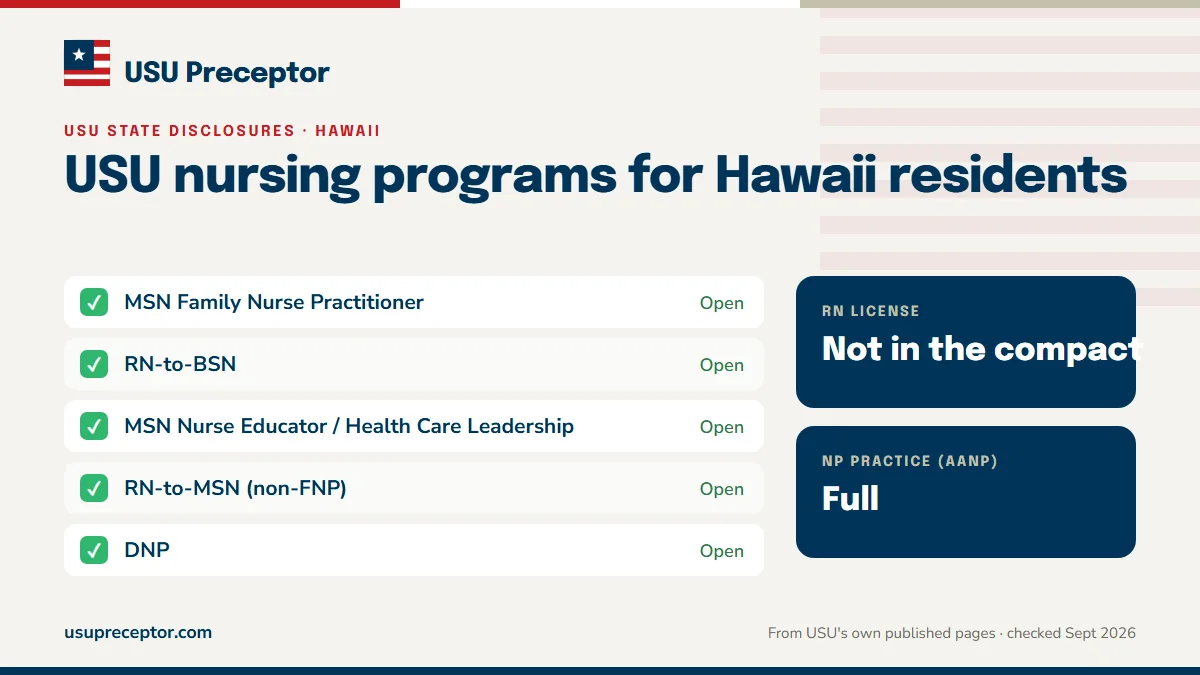
Your USU options as a Hawaii resident
| Program | Open to Hawaii residents? | Clinical hours |
|---|---|---|
| MSN Family Nurse Practitioner | Yes | 540 over FNP592, FNP594, FNP596, FNP597 |
| MSN Nurse Educator | Yes | 100 in MSN578 |
| MSN Health Care Leadership | Yes | 100 in MSN587 |
| RN-to-BSN | Yes | 90 in NUR378 and NUR499 |
| DNP | Yes | 1,000 post-baccalaureate |
Hawaii doesn't appear on USU's exclusion lists. As in every state, the Post-Master's FNP certificate is closed to new applicants.
What the Hawaii Board has said, and what it hasn't
The Board has taken positions on two kinds of out-of-state program. On the pre-licensure side, the student exemption in HRS 457-13(2) is limited to programs the Hawaii Board has accredited, and in 2016 the Board's Education Committee took the view that a pre-license BSN student could not be placed in Hawaii by a program from another state. For post-licensure programs without a Hawaii campus, such as RN-to-BSN, the Board's FAQ says it doesn't approve them, there's no application and they needn't notify it.
Graduate and APRN programs fall between those statements; research found no Hawaii source that addresses them specifically. You'll train as a licensed Hawaii RN, which USU requires anyway, but the Board's view of out-of-state NP clinicals is unconfirmed. Ask your Clinical Placement Coordinator how USU handles Hawaii FNP placements before you commit to a site.
For RN-to-BSN students, Hawaii's position is clear. For FNP students it isn't, so confirm with your CPC before hours are scheduled.
Hawaii's preceptor tax credit, and why it won't follow you
Act 43 of 2018 set up the state's Healthcare Preceptor Income Tax Credit, found today at HRS 235-110.25. The credit is nonrefundable and goes to physicians, APRNs and pharmacists who reside in Hawaii, keep a primary care practice there and supervise an unpaid, volunteer clinical rotation. The Department of Health certifies rotations, the statewide cap is 1,500 credits a year, and no sunset date is stated.
The catch is the student's program. For APRN students, the credit requires a program that is either Hawaii-accredited or physically based in Hawaii, with Hawaii residents forming a majority of its students. An online university headquartered in Georgia is unlikely to meet that test, so don't offer the credit as a reason to take you; a preceptor can check the program's FAQ.
Urban Honolulu, Kahului-Wailuku, Hilo-Kailua
AANP lists Hawaii as a full practice state, so NP-led practices can supply the 135 or more hours USU wants with an NP. Census estimates for 2025 put about 989,000 people in Urban Honolulu, 161,000 in Kahului-Wailuku and 210,000 in the Hilo-Kailua micro area.
In Hawaii, FNP students look at Hawaii Health Systems Corporation; Kaiser Permanente Hawaii; Hawaii Pacific Health, which operates under names including Wilcox, Straub, Pali Momi and Kapiolani; and The Queen's Health Systems. These are search starting points, not sites with USU agreements, and look past the hospitals: USU never counts inpatient hours, and FNP592 must be family practice, primary care or primary care internal medicine.
Licensing: a Hawaii license and nothing else
The compact's map shows Hawaii as a non-member with no bill pending to join. A multistate RN license from elsewhere carries no practice privilege there, so a license issued by Hawaii is the only kind that works. Hawaii hasn't enacted the APRN Compact either.
USU requires an active, unencumbered RN license in your home state and in every state where you train, with liability insurance active in the same state. See RN license for clinicals.
Why Hawaii students choose us
From Hawaii, a placement advisor looks for NPs and physicians whose practices suit your USU course, then helps you put together what OFE and the Program Director review. If a preceptor withdraws, we search again. USU approves every preceptor, site and agreement. Request a Hawaii search.
Questions USU students ask
Does the Hawaii Board need to hear about my RN-to-BSN practicum?
No. According to the Board's FAQ, post-licensure programs based elsewhere, online or at a distance, with no Hawaii campus fall outside its approval and needn't notify it; RN-to-BSN is one of its examples. USU still asks for an active license in the state of your 90-hour practicum, which in Hawaii means a Hawaii license. See the RN-to-BSN page.
Do USU faculty need a Hawaii license?
Under the Board's post-licensure FAQ, a Hawaii nurse license is required of program faculty only when they're physically in Hawaii teaching or precepting a student. That FAQ addresses programs like RN-to-BSN; no Hawaii source found speaks to APRN faculty. Your preceptor is a separate matter: USU requires an FNP preceptor to hold an active, unencumbered Hawaii license.
Can I count telehealth visits with patients on the mainland?
No. USU says telehealth patients must be in the state of your address on file, and you must be licensed there, so a Hawaii student's patients must be in Hawaii. USU caps telehealth at 40 hours across the FNP, your preceptor must be physically with you and video is required. See virtual clinical options.
Could I do my FNP hours in California instead?
USU steers students toward clinicals in their state of residence and says it can't promise that another state's board will count hours done outside it. California adds its own layer: under 16 CCR 1486, students of out-of-state NP programs need a California RN license, and their preceptors need California licenses too. See the California page.
Related pages
Last checked 2026-09-23
We check these pages against USU's own catalog, handbooks and disclosures. USU's current handbook and your Clinical Placement Coordinator have the final word.
Six months out is USU's rule. We start now.
Tell us your USU program, your state and when your next practicum opens. We look for preceptors who meet USU's rules and help you build the packet the Office of Field Experience and Program Director review.
- Preceptors matched to the course: family practice, pediatrics, women's health, urgent care within USU's caps
- Appendix H, license, CV and board certification gathered the way OFE asks
- In person near you; telehealth only inside USU's 40-hour limit
Start your placement plan
A placement advisor replies with what a USU-ready preceptor and site look like for you.