USU nursing programs for Florida residents
Florida is open for every current USU nursing program, including the 540-hour FNP. The Florida Board of Nursing's program approval law is aimed at pre-licensure schools, so your clinical checklist here is mostly USU's own, plus a Florida or multistate RN license.
Searching for a Florida preceptor?
Tell us your area and your USU course.
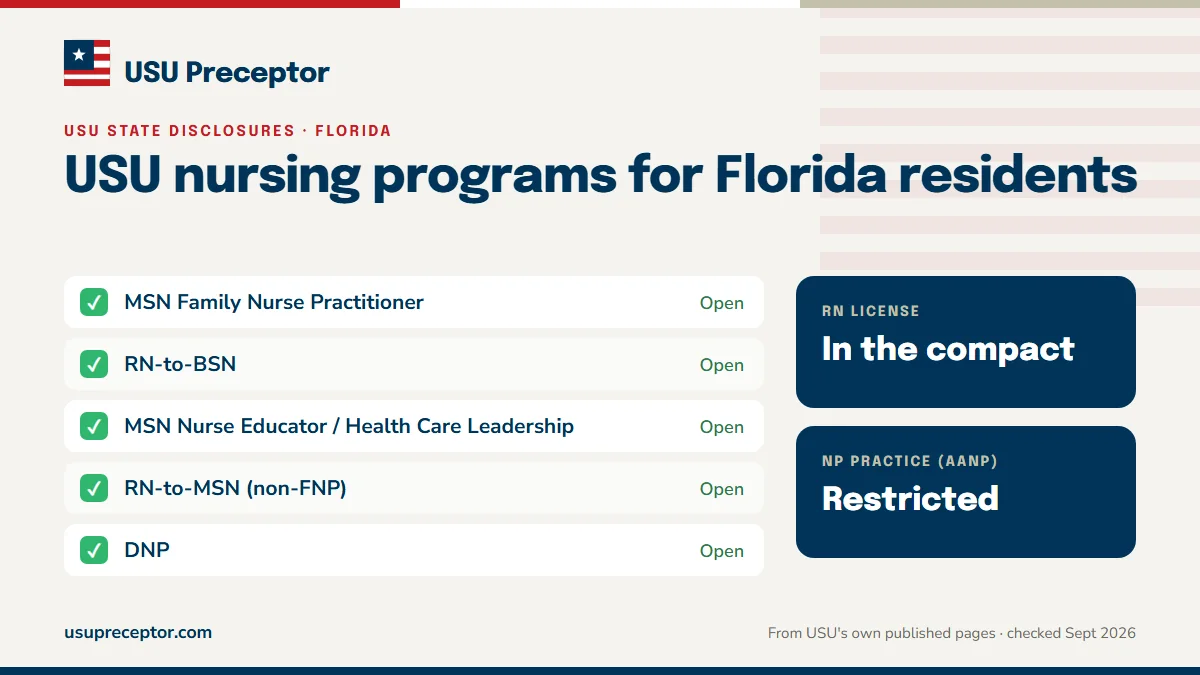
Your options from Florida
| Program | Open to Florida residents? | Clinical hours |
|---|---|---|
| MSN Family Nurse Practitioner | Yes | 540: 135 each in FNP592, FNP594, FNP596, FNP597 |
| MSN Nurse Educator | Yes | 100 in MSN578 |
| MSN Health Care Leadership | Yes | 100 in MSN587 |
| RN-to-BSN | Yes | 90 in NUR378 and NUR499 |
| DNP | Yes | 1,000 post-baccalaureate, up to 500 by transfer |
| Post-Master's FNP Certificate | No, not admitting anywhere | Not applicable |
Florida isn't on any of USU's exclusion lists, and it isn't among the states where USU's board list records extra clinical paperwork or a specific approval. FNP clinicals start in year two, and USU wants three preceptor leads six months before each course. The FNP preceptor guide walks through all four practicums.
Florida's board and out-of-state NP programs
Section 464.019 of the Florida Statutes, the state's law on program approval, is aimed at institutions seeking to offer a pre-licensure nursing program in Florida, and that is also how the Board of Nursing frames its approval role. We found nothing in Florida law obliging RN-to-BSN or APRN programs from other states to seek the Board's approval, or even send it notice, ahead of student placements in Florida.
That leaves USU's process as the gate. OFE sends the affiliation agreement to your site, the Program Director approves your preceptor, and you need the OFE Approval Letter before logging a single hour. Florida adds no layer on top, but a site's own legal review can still take months; see affiliation agreements.
Protocols, physicians and who precepts
Florida is a restricted-practice state on AANP's list; some Florida NPs are required to maintain a protocol agreement with a physician for their entire career, although exemptions can apply. For your search, that means both the NP and the collaborating physician in a Florida practice are possible preceptors under USU's rules, which allow either a certified NP or a licensed physician (MD or DO) who has practiced at least a year.
Two USU rules shape which Florida settings are worth approaching. Your first rotation, FNP592, has to happen in family practice, general primary care or primary care internal medicine, and never in urgent care. Across the whole program, urgent care can supply no more than 135 hours, and inpatient hours never count. An urgent care clinic can therefore supply one course's worth of hours at most.
TEACH funding: why it probably won't cover you
Qualified facilities can be reimbursed for each clinical hour they provide to APRN students in primary care through the TEACH Funding Program (Training, Education, and Clinicals in Health), which the Agency for Health Care Administration runs. Rural health clinics, federally qualified health centers, certain nonprofits in shortage areas, community mental health centers and certified community behavioral health clinics can all qualify. Preceptors must hold Florida licenses, payments depend on appropriation, and the law is set to repeal on July 1, 2034.
The catch is that TEACH reimburses only for students in accredited programs based in Florida. USU's main campus is in Sandy Springs, Georgia, so a Florida clinic shouldn't expect TEACH money for hosting you. The same site types remain good places to ask; they just won't be paid through this program for a USU rotation.
Miami to Jacksonville: where Florida FNP students look
Miami-Fort Lauderdale-West Palm Beach leads Florida's metros with roughly 6.4 million people, followed by Tampa-St. Petersburg-Clearwater at roughly 3.4 million, Orlando-Kissimmee-Sanford at roughly 3 million and Jacksonville at roughly 1.8 million; those are the four largest. FNP students approach outpatient practices run by systems such as UF Health, Baptist Health South Florida, BayCare Health System, HCA Florida Healthcare and AdventHealth. None is named here as a site that takes USU students.
USU expects you to travel anywhere in Florida if that's where a qualified preceptor is, at your own cost. If you live between these metros, decide early which one you'll drive to.
Florida licensing and the compact
Florida's compact membership took effect on January 19, 2018. A Florida multistate license, kept active and unencumbered, satisfies USU for clinicals at home, and USU wants your liability coverage issued for the same state. The APRN Compact isn't in effect; Florida hasn't enacted it. Our RN license page covers compact questions in more depth.
Why Florida students choose us
We search your part of Florida for primary care and outpatient preceptors who fit your USU course and USU's criteria, pull together the documents USU's reviewers need, and restart the search if a preceptor backs out. USU approves every preceptor and site. Tell us your city and course.
Questions USU students ask
Does the Florida Board of Nursing need to approve USU before I do clinicals in Florida?
No Florida rule found requires it. The approval law in Florida is about institutions that operate pre-licensure programs in the state, and no provision makes RN-to-BSN or APRN programs from other states seek approval or give the Board notice before they place students. USU's own approvals, from OFE and the Program Director, still come first.
Will my Florida clinic get TEACH funding for precepting me?
Probably not. TEACH reimburses qualified Florida facilities for APRN primary care students only when those students are in accredited programs based in Florida. USU's main campus is in Georgia. Payments are also subject to appropriation, and the law is set to repeal on July 1, 2034.
Can I use my Florida multistate license for USU clinicals?
Yes, for clinicals in Florida, provided it's active and unencumbered and your liability insurance is in the same state. Florida is a compact state, so the license also covers RN practice in other compact states, but USU encourages clinical hours in your state of residence.
Could I do clinicals in Georgia, where USU is based?
USU's campus location doesn't change its residence rule. USU wants clinical hours in your approved home state and notes that a licensing board may not credit hours earned outside it. Georgia's Board also sets its own license rules for clinicals there. Check with your CPC before making plans.
Related pages
Last checked 2026-09-23
We check these pages against USU's own catalog, handbooks and disclosures. USU's current handbook and your Clinical Placement Coordinator have the final word.
Six months out is USU's rule. We start now.
Tell us your USU program, your state and when your next practicum opens. We look for preceptors who meet USU's rules and help you build the packet the Office of Field Experience and Program Director review.
- Preceptors matched to the course: family practice, pediatrics, women's health, urgent care within USU's caps
- Appendix H, license, CV and board certification gathered the way OFE asks
- In person near you; telehealth only inside USU's 40-hour limit
Start your placement plan
A placement advisor replies with what a USU-ready preceptor and site look like for you.