USU student malpractice insurance: your own policy, plus the college's
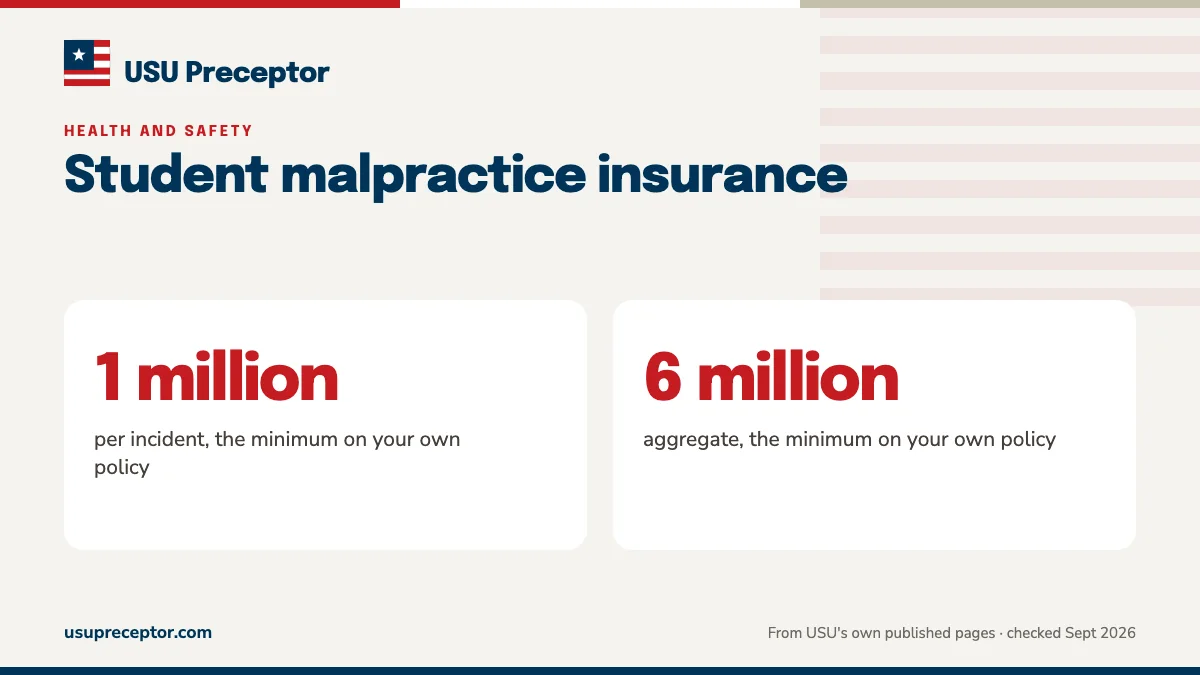
USU requires FNP students to carry their own professional liability policy of at least 1 million per incident / 6 million aggregate, in their own name, describing them as a Nurse Practitioner Student. The College of Nursing and Health Sciences also covers students, but that doesn't replace your policy. You'll need proof of personal health insurance as well.
Want a site in the same state as your license and policy?
Tell us your USU course, start date and state. A placement advisor will reply by email.
Two layers of coverage
USU's FNP Clinical Handbook describes two policies. The college's policy sits alongside yours; it doesn't stand in for it, and the Appendix A PAC checklist lists your own malpractice insurance as an item OFE must see. The difference that matters most is the aggregate: 6 million on the policy you buy, against 3 million on the college's.
| Policy | Who arranges it | Limits USU states | Wording |
|---|---|---|---|
| Your own student policy | You, in your own name | At least 1 million per incident / 6 million aggregate | Nurse Practitioner Student or Student Nurse Practitioner (Appendix A: NP Student) |
| CONHS Medical Professional Liability Insurance | USU's College of Nursing and Health Sciences, for all students in programs with clinical experiences | 1 million each occurrence / 3 million aggregate | Carried by the college |
What your own policy must show
- Limits of at least 1 million per incident / 6 million aggregate.
- Your status as a Nurse Practitioner Student or Student Nurse Practitioner. Appendix A shortens this to NP Student and says the policy must state it.
- You as the insured. The handbook says the policy must not list an employer or an LLC.
- The same state as your active nursing license. The handbook says your license and liability coverage should both be active and within the same state.
- Dates that cover your clinical courses. Like every compliance item, it must stay current, and Complio sends notices before it expires.
Before you buy, compare the insurer's declarations page against this list. A policy you already hold as a working RN, or one arranged through your job, is unlikely to describe you as an NP student, and the handbook rules out employer-listed coverage anyway.
You buy and pay for this policy yourself, separately from anything USU charges. The USU sources checked for this page don't state a premium.
An RN policy through your employer won't satisfy USU. The policy must be yours, in your name, and state NP Student.
The college's coverage, and why it isn't enough on its own
The FNP handbook says the College of Nursing and Health Sciences (CONHS) carries Medical Professional Liability Insurance on all students in programs that require clinical experiences, at 1 million each occurrence and 3 million aggregate. That is real coverage, and it applies to you automatically as a clinical student.
It doesn't satisfy the separate requirement for a policy you hold yourself. The handbook sets that requirement in addition to the college policy, with a higher aggregate, and OFE checks for your own policy along with the rest of your compliance items before your approval letter goes out.
On providers: USU's RN-BSN, Nurse Educator and Health Care Leadership handbook says OFE does not require a specific provider. The FNP rules we've read are about limits, wording, the named insured and the state, not a particular insurer.
Matching your policy to your license state
USU ties your coverage to your license. The FNP handbook says you need an active, unencumbered nursing license in your state on file and in any state where you do clinicals, and that your license and liability coverage should both be active within the same state. Our RN license for clinicals page covers the license side.
Check this whenever your clinical state changes. If you're considering clinicals outside your state of residence, ask your insurer to confirm the policy covers you in that state, and ask your CPC what USU needs before you commit. USU encourages students to complete clinical hours in their approved state of residence, and our out-of-state clinicals page explains why.
Travel nurses have an extra step. USU requires you to update your address to wherever you'll do clinicals, and your license and policy should line up with that state.
RN-BSN, Nurse Educator, Health Care Leadership and DNP
The RN-BSN, Nurse Educator and Health Care Leadership practicum handbook sets the same limits for students in those programs: your own policy at 1 million per incident / 6 million aggregate, plus the college's 1 million each occurrence / 3 million aggregate coverage.
The Nurse Practitioner Student wording comes from the FNP handbook, and RN-BSN, Nurse Educator and Health Care Leadership students aren't NP students. The USU pages we checked don't say what status those policies should show, so ask your CPC before you buy.
The DNP Practice Immersion Handbook has its own Appendix A, the PAC For Practice Immersion Health and Safety Checklist. The public pages we reviewed don't spell out DNP insurance limits, so check that checklist and confirm with your Practice Immersion Placement Coordinator.
Proof of health insurance
Separate from malpractice cover, USU requires proof of personal health insurance. Appendix A lists Proof of Health Insurance Coverage, and USU's admission requirements name current personal health insurance among the clinical documents students keep up to date.
The handbook adds one specific exclusion: "Military/government ID does not fulfill this requirement" (FNP Clinical Handbook). If your coverage comes through military or government service, submit proof of the coverage rather than an ID card, and ask your CPC if you're unsure which document counts.
Health insurance has to stay current through every clinical course, just like your malpractice policy. If it expires in your compliance record, you're on clinical pause and can't log hours, the same as with an expired vaccine record. More on that is on our Complio page.
How our search lines up with your policy
Your policy comes from the insurer you choose. Our part is the placement: we search for a preceptor and site in the state where you hold your license and plan to be covered, so your license, policy and clinical site line up the way USU's handbook expects.
USU approves every placement. Ask a placement advisor about your next clinical course.
Questions USU students ask
Can I use my employer's malpractice insurance for USU clinicals?
No. USU's FNP handbook says your student policy must not list an employer or an LLC. It has to be in your own name, carry at least 1 million per incident / 6 million aggregate, and state that you're a Nurse Practitioner Student or Student Nurse Practitioner. Appendix A shortens that wording to NP Student.
Doesn't USU already cover students for malpractice?
In part, yes. The College of Nursing and Health Sciences carries Medical Professional Liability Insurance on all students in programs with clinical experiences, at 1 million each occurrence and 3 million aggregate. The handbook still requires your own policy on top of it, and Appendix A lists your policy as a checklist item OFE must see.
Does USU require a specific malpractice insurance company?
USU's RN-BSN, Nurse Educator and Health Care Leadership handbook says OFE does not require a specific provider. The FNP handbook's rules, as we read them, cover limits, wording, the named insured and the state rather than a particular company. Whichever insurer you use, check the declarations page against USU's list before you pay.
What if I'm licensed in one state and doing clinicals in another?
USU's FNP handbook says you need an active, unencumbered license in your state on file and in any state where you do clinicals, and that your license and liability coverage should both be active within the same state. Talk to your insurer and your Clinical Placement Coordinator before committing to a site outside your home state.
Does a military ID count as proof of health insurance for USU?
No. USU's FNP handbook says a military or government ID does not fulfill the health insurance requirement. Submit proof of the coverage itself, and ask your Clinical Placement Coordinator if you're unsure which document USU will accept. Health insurance, like malpractice cover, must stay current through all of your clinical courses.
Related pages
Last checked 2026-09-23
We check these pages against USU's own catalog, handbooks and disclosures. USU's current handbook and your Clinical Placement Coordinator have the final word.
Six months out is USU's rule. We start now.
Tell us your USU program, your state and when your next practicum opens. We look for preceptors who meet USU's rules and help you build the packet the Office of Field Experience and Program Director review.
- Preceptors matched to the course: family practice, pediatrics, women's health, urgent care within USU's caps
- Appendix H, license, CV and board certification gathered the way OFE asks
- In person near you; telehealth only inside USU's 40-hour limit
Start your placement plan
A placement advisor replies with what a USU-ready preceptor and site look like for you.