USU clinical evaluations: who evaluates whom, and where
In USU's FNP clinicals, three evaluations run in three directions. You evaluate your preceptor (Appendix J), a faculty Clinical Site Supervisor evaluates your preceptor and site (Appendix K), and your preceptor or clinical faculty evaluates you (Appendix L). Project Concert is where USU schedules and reports every one of them.
Want a preceptor who knows what USU asks of them?
Tell us your USU course and start date. A placement advisor will reply by email.
Three evaluations, three directions
These are the evaluation appendices in the FNP Clinical Handbook (November 2025 version). USU says evaluations are scheduled and reported in Project Concert, so that's where you'll see them and complete your own.
| Appendix | Title | Completed by | Evaluates |
|---|---|---|---|
| J | Student Evaluation of Preceptor | You | Your preceptor |
| K | Preceptor and Site Evaluation by Site Supervisor | Your Clinical Site Supervisor (faculty) | Your preceptor and site |
| L | Preceptor/Clinical Faculty Evaluation of Student | Your preceptor or clinical faculty | You |
One naming quirk to know about: in some places the FNP handbook calls the FNP Site & Preceptor Guidance Appendix J, even though the appendix list shows it as Appendix I. If a handbook page sends you to Appendix J for site rules, it means that guidance, not the evaluation of your preceptor.
How evaluations run in Project Concert
Project Concert is USU's clinical tracking system. Your hours log, journal entry logs and clinical evaluations all sit there, at secure.projectnurse.com/usuniversity.
Your preceptor doesn't need a login. USU's preceptor onboarding document, dated 2024, says preceptors receive emailed links to complete their evaluations. Tell your preceptor to expect those emails, and ask them to check spam or clinic email filters if one doesn't arrive.
USU's public pages don't publish a fixed schedule for when each evaluation opens or closes. Project Concert and your clinical course in D2L show the due dates, so check both in the first week. While you're in Project Concert, confirm every encounter is logged: entries made more than 48 hours late don't count, as our clinical hour logs page explains.
The site supervisor visit behind Appendix K
Appendix K is completed by your Clinical Site Supervisor, a faculty member assigned to evaluate your site and preceptor. That person may or may not be your course's clinical faculty. They contact you through your usuniversity.edu email to arrange the visit.
USU's handbook is inconsistent about the format. The same process list says to set up a virtual visit unless an in-person visit is required, and also describes a "summative in-person clinical site-visit" (FNP Clinical Handbook). USU's 2024 onboarding document says visits may be virtual and/or on site. Ask your site supervisor which applies, and tell your preceptor so the clinic can plan for it.
After the visit, the supervisor records it in Project Concert within 24 hours as the Preceptor and Site Evaluation by Site Supervisor Evaluation. The handbook caps clinical faculty supervision at six students per faculty member. Our clinical site visits page covers the visit itself in more detail.
The College Practicum Evaluation Rubric
USU's FNP program page names a College Practicum Evaluation Rubric used in FNP592, FNP594 and FNP596. The public sources we checked don't reproduce the rubric or explain its scoring, so read it inside each course before your first clinical day rather than at the end.
The same page doesn't list FNP597 Clinical Residency and Practice Management for that rubric. If you're in FNP597, check the course in D2L for how your performance is evaluated there.
The catalog lists all four FNP practicum courses as credit/no credit (CR/NC), each carrying 135 clinical hours. Treat the rubric as the standard your faculty will use, and bring it to your preceptor early so you're both working toward the same expectations. The first of these courses is covered on our FNP592 practicum page.
DNP, RN-BSN, Nurse Educator and Health Care Leadership
The DNP Practice Immersion Handbook uses different letters for its evaluations, so don't carry the FNP appendix names across.
- Appendix H: DNP Mentor/Faculty Evaluation of Student
- Appendix I: DNP Student Evaluation of DNP Mentor/Site
- Appendix J: DNP Student Self-Evaluation
- Appendix K: Faculty Evaluation of DNP Mentor and Site
The DNP list adds a self-evaluation that the FNP list doesn't have, and the evaluation is of your Project Mentor rather than a preceptor. More on the DNP side is on our DNP practice immersion page.
The RN-BSN, Nurse Educator and Health Care Leadership practicum handbook's appendix list stops at Appendix H and names no evaluation forms. It does set check-ins at weeks 1, 4 and 8 for NUR378, NUR499 and MSN587, and MSN578 hours are reported weekly in Project Concert. Your course in D2L shows how evaluation works for your practicum.
Keeping your evaluations on track
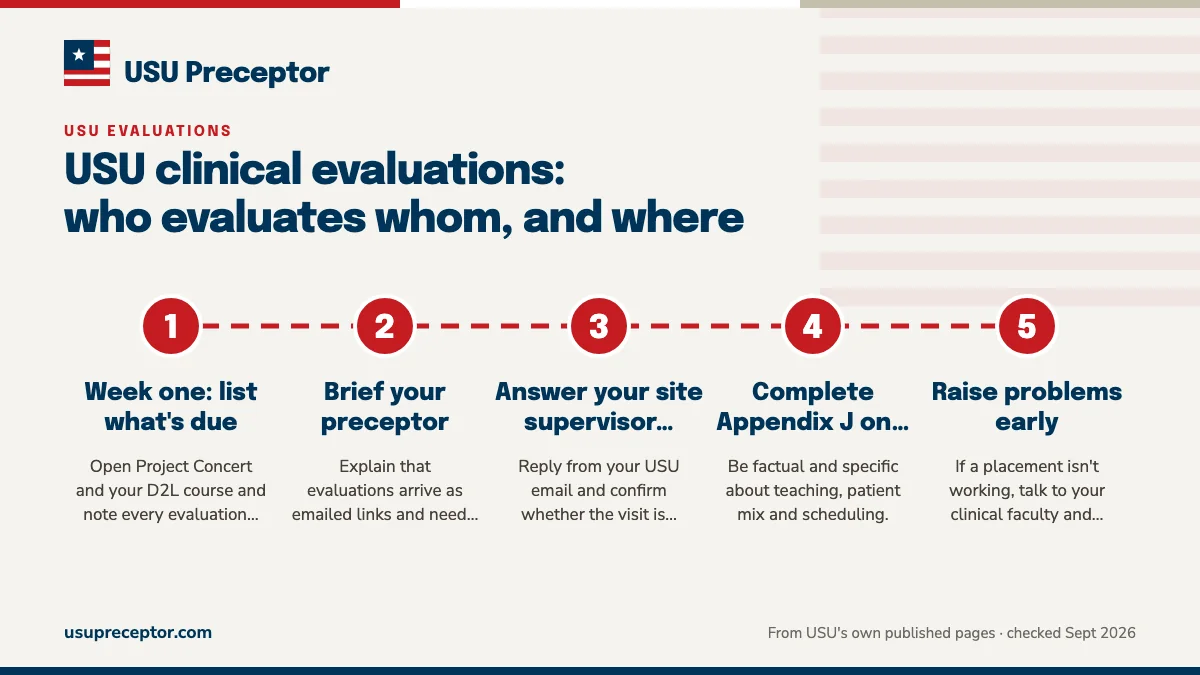
- Week one: list what's dueOpen Project Concert and your D2L course and note every evaluation and its date.
- Brief your preceptorExplain that evaluations arrive as emailed links and need no account.
- Answer your site supervisor quicklyReply from your USU email and confirm whether the visit is virtual or in person.
- Complete Appendix J on timeBe factual and specific about teaching, patient mix and scheduling.
- Raise problems earlyIf a placement isn't working, talk to your clinical faculty and CPC while there's still time to act. USU's rules on switching are on our changing preceptors page.
How we set up evaluations to run smoothly
Evaluations belong to you, your preceptor and USU faculty. Our help comes earlier: when we look for a preceptor for your USU course, we make sure they know USU will send evaluation links and that a faculty site supervisor will be in touch, so the clinic understands what it's agreeing to.
USU's Program Director approves every preceptor. Tell us about your course if you'd like a placement advisor to look at your options.
Questions USU students ask
Does my preceptor need a Project Concert account to evaluate me?
According to USU's 2024 preceptor onboarding document, no. Preceptors don't log in to Project Concert; they receive emailed links to complete their evaluations. Let your preceptor know to expect these and to check spam or clinic email filters, so an evaluation doesn't sit unopened near the end of the course.
Is the USU clinical site visit virtual or in person?
USU's FNP handbook says both. Its process list says the Clinical Site Supervisor sets up a virtual visit unless an in-person visit is required, and it also refers to a summative in-person visit. The 2024 preceptor onboarding document says visits may be virtual and/or on site. Your site supervisor will tell you which applies to your placement.
What is Appendix L in the USU FNP handbook?
Appendix L is the Preceptor/Clinical Faculty Evaluation of Student: the evaluation of your clinical performance, completed by your preceptor or clinical faculty. It's scheduled and reported in Project Concert, like Appendices J and K. Because FNP practicum courses are graded credit/no credit, read what it covers at the start of each course.
Do DNP students use Appendices J, K and L?
Not with the same meanings. The DNP handbook's evaluations are Appendix H (mentor/faculty evaluation of student), Appendix I (student evaluation of mentor and site), Appendix J (student self-evaluation) and Appendix K (faculty evaluation of mentor and site). When someone mentions an appendix letter, check which handbook they mean.
Who is my Clinical Site Supervisor?
A faculty member USU assigns to evaluate your site and preceptor. It may or may not be your course's clinical faculty. They contact you through your usuniversity.edu email to arrange the visit, then record it in Project Concert within 24 hours. If no one has been in touch as the course moves along, ask your clinical faculty.
Related pages
Last checked 2026-09-23
We check these pages against USU's own catalog, handbooks and disclosures. USU's current handbook and your Clinical Placement Coordinator have the final word.
Six months out is USU's rule. We start now.
Tell us your USU program, your state and when your next practicum opens. We look for preceptors who meet USU's rules and help you build the packet the Office of Field Experience and Program Director review.
- Preceptors matched to the course: family practice, pediatrics, women's health, urgent care within USU's caps
- Appendix H, license, CV and board certification gathered the way OFE asks
- In person near you; telehealth only inside USU's 40-hour limit
Start your placement plan
A placement advisor replies with what a USU-ready preceptor and site look like for you.