USU nursing for Tennessee residents: an approved FNP and an unsettled bill
Tennessee residents can enroll in all of USU's admitting nursing programs, and USU's Board of Nursing list records Tennessee's continued approval of the MSN-FNP. A 2026 bill would freeze new approvals for out-of-state programs, but no official source yet confirms that it became law. Tennessee also funds a preceptor incentive whose rules may reach a Georgia-based school like USU.
Need a Tennessee preceptor for your USU course?
Share your course, your start term and where in Tennessee you live.
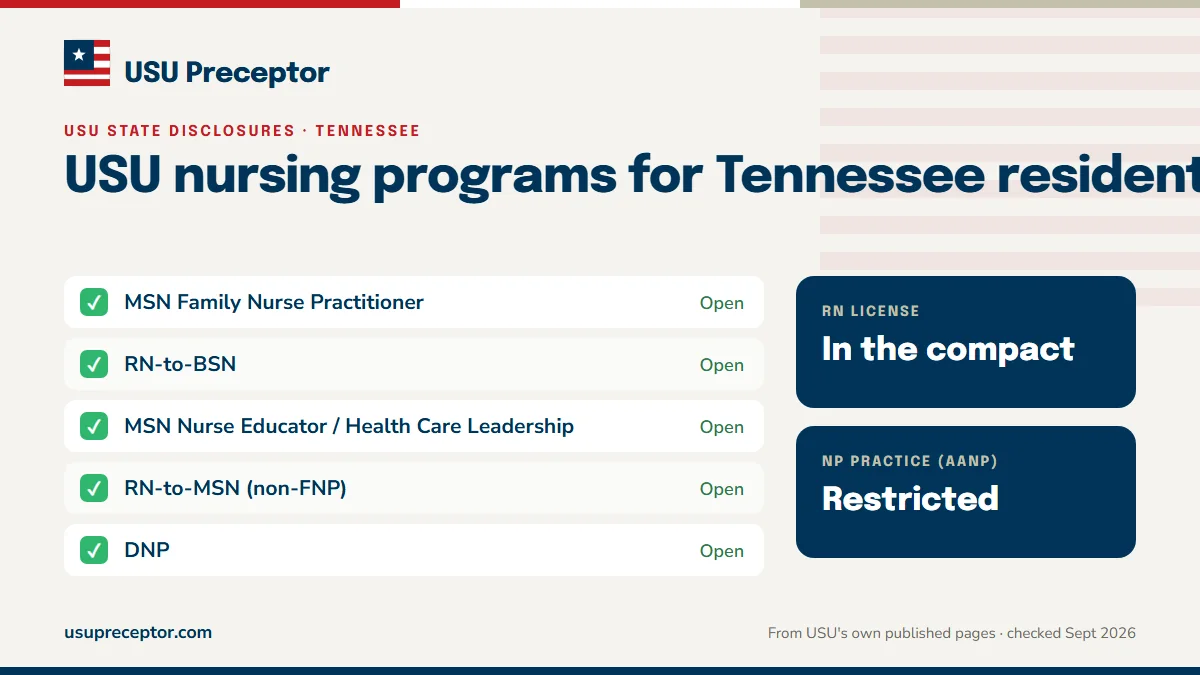
Programs you can take from Tennessee, with two Tennessee footnotes
| Program | Tennessee residents | Clinical or practice hours |
|---|---|---|
| MSN Family Nurse Practitioner | Yes; Tennessee approval on file | 540 across FNP592, FNP594, FNP596, FNP597 |
| MSN Nurse Educator | Yes; clinical specialty required | 100 in MSN578 |
| MSN Health Care Leadership | Yes | 100 in the MSN587 leadership residency |
| RN-to-BSN | Yes; NUR300 required | 90 in NUR378 and NUR499 |
| DNP | Yes | 1,000 post-baccalaureate |
Two USU rules apply only to Tennesseans. Nurse Educator students based in Tennessee must do their MSN578 residency in a nursing clinical specialty area, with a preceptor who has expertise in that specialty and teaching experience. RN-to-BSN students who live in Tennessee must complete NUR300, Physical Examination and Health Assessment, or transfer an equivalent.
The oversight bill: what it says and what's still unconfirmed
Under SB 2013/HB 1905 (Tennessee Nursing Education Integrity and Oversight Act), the Board of Nursing would have to put a two-year moratorium on accepting and approving applications from nursing programs based outside Tennessee, requests to place students for clinicals among them. It doesn't separate pre-licensure, RN-to-BSN and APRN programs. Programs approved before it takes effect keep their approval but must supply data on request, such as preceptor lists and placement statistics.
The bill's findings say a significant number of out-of-state programs place students in Tennessee without adequate oversight, and it asks the Tennessee Center for Nursing Advancement to recommend new standards by June 30, 2027. A secondary source reports an effective date of April 27, 2026; enactment isn't confirmed by an official source, and no current Board of Nursing rule we found expressly makes out-of-state programs obtain approval before clinicals.
Treat the bill as unverified, and before you lock in a site, ask your Clinical Placement Coordinator whether anything in Tennessee has changed.
Supervision rules and who precepts FNP students
Tennessee is restricted in AANP's classes, meaning NPs work under a physician's supervision and face limits on opioid supply and on Schedule II to IV prescribing. USU's rules sit on top of that. Your preceptor can be a board-certified NP or a licensed MD or DO with at least a year of experience, but at least 135 hours must be with an NP, and PAs don't qualify. Our preceptor requirements page spells out the rest.
The THA preceptor incentive may reach a Georgia school
Funded by a state grant, the Nurse Preceptor Incentive Program run by the Tennessee Hospital Association pays preceptors per cycle for at least 70 hours of one-to-one precepting, while funds last. LPNs, RNs and APRNs qualify with an unrestricted Tennessee or multistate license, US citizenship or permanent residence, and the UTHSC preceptor course, which has an NP module.
The student side is what matters for you. THA counts students in accredited Tennessee programs, plus students from schools in Missouri, Mississippi, Arkansas, Georgia, Virginia, Kentucky and Alabama whose hours take place in Tennessee. USU's home state is Georgia and its MSN is CCNE-accredited, so your preceptor may qualify; THA decides. The fall 2026 cycle runs August 1 to December 1, 2026. USU's own preceptor benefits are on our page for preceptors.
Nashville, Memphis, Knoxville, Chattanooga
Nashville's metro, about 2.2 million people, is the largest, followed by the Tennessee side of Memphis (about 1 million), Knoxville (nearly 970,000) and the Tennessee side of Chattanooga (about 440,000). Erlanger, Covenant Health, Methodist Le Bonheur Healthcare, Ballad Health and Vanderbilt University Medical Center are large systems where students search; they aren't USU partners. Aim for their outpatient and primary care practices, since inpatient hours never count.
Memphis spills into Mississippi and Arkansas, and Chattanooga into Georgia. A practice on those sides is out of state for you; USU encourages hours in your state of residence and can't promise a licensing board will accept hours logged elsewhere.
Licensing for Tennessee clinicals
Tennessee implemented the Nurse Licensure Compact on January 19, 2018 and hasn't enacted the APRN Compact. USU requires an active, unencumbered license in your state on file and in each state where you see patients, with liability insurance active in that same state. Our license page covers the compact questions.
Why Tennessee students choose us
We search your part of Tennessee for a preceptor and outpatient site that fit your USU course, help you prepare the packet OFE and the Program Director review, and search again if a preceptor drops. USU approves every preceptor and site. Tell us your course.
Questions USU students ask
Is USU's FNP approved in Tennessee?
Yes, according to USU. Its Board of Nursing disclosure, updated in May 2026, lists Tennessee's continued approval of the MSN-FNP, and Tennessee residents can enroll. Approvals can change, and the 2026 oversight bill is still unresolved as far as we can tell, so check the current list on USU's accreditation page before you apply.
Would the Tennessee moratorium affect students already enrolled?
As written, the moratorium targets new applications from out-of-state programs. Programs approved before the bill takes effect retain their approval but have to report data like placement statistics and preceptor lists. Its enactment isn't confirmed in an official source. If you're partway through the FNP, ask your Clinical Placement Coordinator whether USU has had any notice from Tennessee.
Does my Tennessee preceptor need a special course to precept me?
Not for USU. USU asks for board certification for NPs, at least a year of experience, an active license where the clinical happens, employer permission and the Appendix H Preceptor Information and Acknowledgement Form. The UTHSC preceptor course matters only if your preceptor wants to claim Tennessee's THA incentive.
What happens to my USU clinicals if I move to Tennessee?
Tell USU before you move. USU isn't responsible for securing a placement if you move after a term starts, or within two terms before clinicals when the placement is out of state. Tennessee is open for every admitting USU nursing program, but your address, license and liability insurance all need to line up with Tennessee before hours begin.
Related pages
Last checked 2026-09-23
We check these pages against USU's own catalog, handbooks and disclosures. USU's current handbook and your Clinical Placement Coordinator have the final word.
Six months out is USU's rule. We start now.
Tell us your USU program, your state and when your next practicum opens. We look for preceptors who meet USU's rules and help you build the packet the Office of Field Experience and Program Director review.
- Preceptors matched to the course: family practice, pediatrics, women's health, urgent care within USU's caps
- Appendix H, license, CV and board certification gathered the way OFE asks
- In person near you; telehealth only inside USU's 40-hour limit
Start your placement plan
A placement advisor replies with what a USU-ready preceptor and site look like for you.