Studying with USU from Arkansas: FNP clinicals without a state approval step
All of USU's admitting nursing programs are open to Arkansas residents, the FNP included. Our reading turned up no rule from the Arkansas State Board of Nursing that makes out-of-state programs seek approval before clinical-only placements, though board staff haven't confirmed that. Your search is shaped instead by Arkansas's physician-protocol rules, a compact license and two metros that cross state lines.
Want help finding an Arkansas preceptor?
Tell us your USU course, your term and the town you're in.
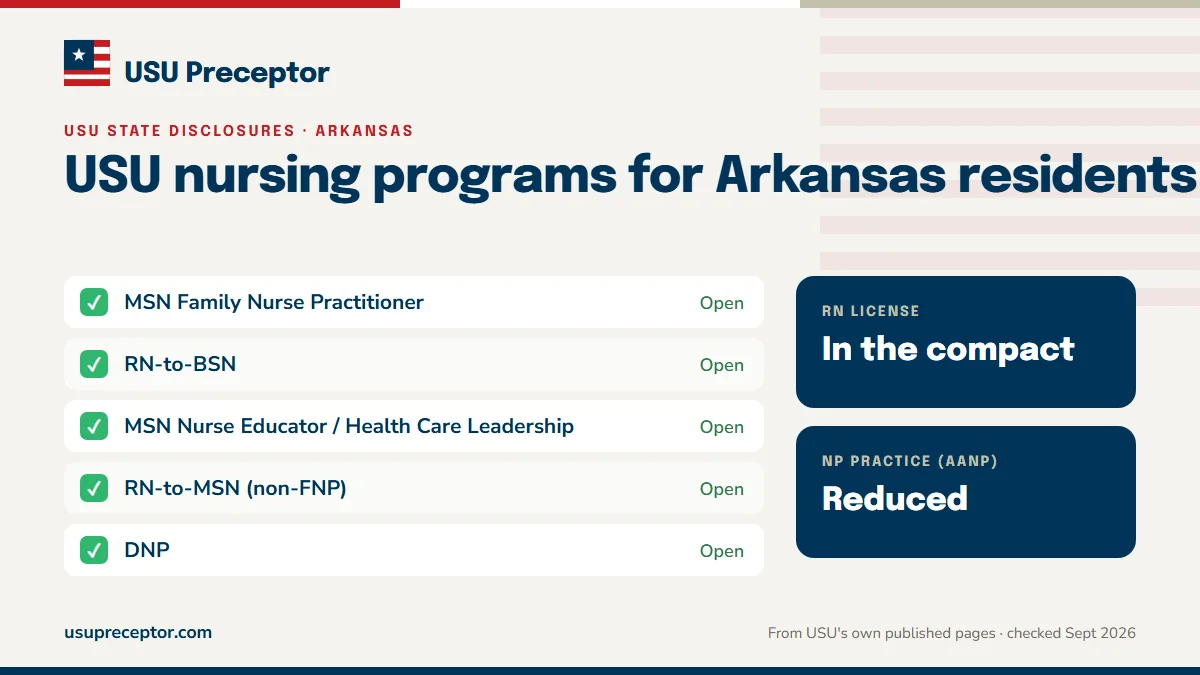
USU programs and hours for Arkansans
| Program | Arkansas residents | Hours to plan for |
|---|---|---|
| MSN Family Nurse Practitioner | Eligible | 540 in FNP592, FNP594, FNP596, FNP597 |
| MSN Nurse Educator | Eligible | 100 in MSN578 |
| MSN Health Care Leadership | Eligible | 100 in MSN587 |
| RN-to-BSN | Eligible | 90 in NUR378 and NUR499 |
| DNP | Eligible | 1,000 post-baccalaureate (up to 500 transferable) |
Arkansas isn't on USU's list of states that need extra clinical filings or hold approvals on file. How the four FNP practicums differ, and who suits each, is on our FNP preceptor page.
What the Arkansas State Board of Nursing does and doesn't cover
Our research found no ASBN rule or web guidance requiring out-of-state programs to get approval before clinical-only placements in Arkansas. Out-of-state institutions come under 17 CAR Part 125, the prelicensure standards, only if they plan to open a new program in Arkansas, and that step also needs approval from the Division of Higher Education. For APRN programs, 17 CAR Part 123, Subpart 10, handles both new and established programs by granting deemed status on the basis of national accreditation.
That reading wasn't confirmed with ASBN staff, so treat it as the best reading of the published rules. Arkansas's Nurse Practice Act exempts from licensure student practice in ASBN-approved programs, but USU's own rule applies either way: you need an active, unencumbered license wherever you do clinicals.
With no state step found, your gates are USU's: three qualified preceptors named six months before each clinical course, Program Director approval, an Affiliation Agreement and the OFE Approval Letter, laid out on our placement process page.
Protocols, physicians and who can precept you
AANP rates Arkansas as reduced practice. For at least one element of practice, an NP must maintain a regulated agreement with a physician, and prescribing select medications is off limits except under a physician protocol agreement. USU accepts a board-certified NP or a licensed MD or DO, licensed in Arkansas, with a year's experience and the employer's permission. At least 135 hours must be with an NP, and PAs aren't eligible.
For pediatric hours, USU's guidance names a pediatrician, or an FNP or PNP working in a pediatrician's office, as the ideal preceptor, so outpatient pediatric practices, including those tied to systems such as Arkansas Children's, are worth a look. No Arkansas preceptor incentive appears in our research.
Your license: the compact is written into Arkansas law
The Nurse Licensure Compact was implemented in Arkansas on January 19, 2018, and it is codified within the state's Nurse Practice Act (Title 17, Chapter 87, Subchapter 6). Arkansas hasn't enacted the APRN Compact.
USU wants an active, unencumbered license in your state on file and anywhere you do clinicals, with liability insurance active in the same state. Our license page covers how multistate licenses work for USU clinicals.
Little Rock, Northwest Arkansas, Fort Smith, Jonesboro
Little Rock-North Little Rock-Conway is the largest metro at about 778,000 people, followed by Fayetteville-Springdale-Rogers at about 622,000, the Arkansas side of Fort Smith at about 193,000, and Jonesboro at about 139,000. Large systems include CHI St. Vincent, Baptist Health, Arkansas Children's and UAMS Health in Little Rock, plus Mercy, a system based in St. Louis that has hospitals in Fort Smith and Northwest Arkansas. They're examples of where students look, not arranged sites, and inpatient hours never count.
Two metros cross state lines. Fort Smith's reaches into Oklahoma, and Memphis, which takes in part of eastern Arkansas, is centered in Tennessee. A practice across either line is out of state for you: USU allows it only on request and can't promise a licensing board will accept those hours.
How we help Arkansas students
A placement advisor looks for a preceptor and site near you in Arkansas that suit your USU course, helps assemble the packet that OFE and your Program Director review, and restarts the search if a preceptor backs out. USU approves every placement. Tell us where you are.
Questions USU students ask
Do I need to contact the Arkansas State Board of Nursing before my clinicals?
Not under the published rules: no ASBN rule requires out-of-state programs to get approval for clinical-only placements, a reading taken from the rule text rather than from board staff. If a site's nursing leadership asks about state approval, pass the question to your Clinical Placement Coordinator, who can answer for USU.
Which USU MSN tracks can I take from Arkansas?
The FNP, Nurse Educator and Health Care Leadership tracks are all open to Arkansas residents. Nurse Educator students need 100 hours in MSN578 with an MSN- or doctorally prepared preceptor at a 1:1 ratio. Health Care Leadership students need 100 hours in MSN587 with a mentor holding a graduate degree such as an MSN, MHA or MBA.
Can I count urgent care hours at an Arkansas clinic?
Yes, within USU's limits: urgent care can make up no more than 135 of your FNP hours, and inpatient hours never count. Optional specialty rotations are capped at 40 hours combined and telehealth at 40, with telehealth patients located in your state on file. Our page on what counts as an FNP hour has the details.
Does my Arkansas preceptor get anything for taking a USU student?
No Arkansas incentive is recorded in our research. USU offers preceptors a 10% tuition discount on certain USU programs, continuing education, online library access and an unpaid Honorary Clinical Faculty title for 135 service hours a year. USU doesn't pay preceptors. See our page for preceptors.
Related pages
Last checked 2026-09-23
We check these pages against USU's own catalog, handbooks and disclosures. USU's current handbook and your Clinical Placement Coordinator have the final word.
Six months out is USU's rule. We start now.
Tell us your USU program, your state and when your next practicum opens. We look for preceptors who meet USU's rules and help you build the packet the Office of Field Experience and Program Director review.
- Preceptors matched to the course: family practice, pediatrics, women's health, urgent care within USU's caps
- Appendix H, license, CV and board certification gathered the way OFE asks
- In person near you; telehealth only inside USU's 40-hour limit
Start your placement plan
A placement advisor replies with what a USU-ready preceptor and site look like for you.