Montana: no board approval step, but a license that works here
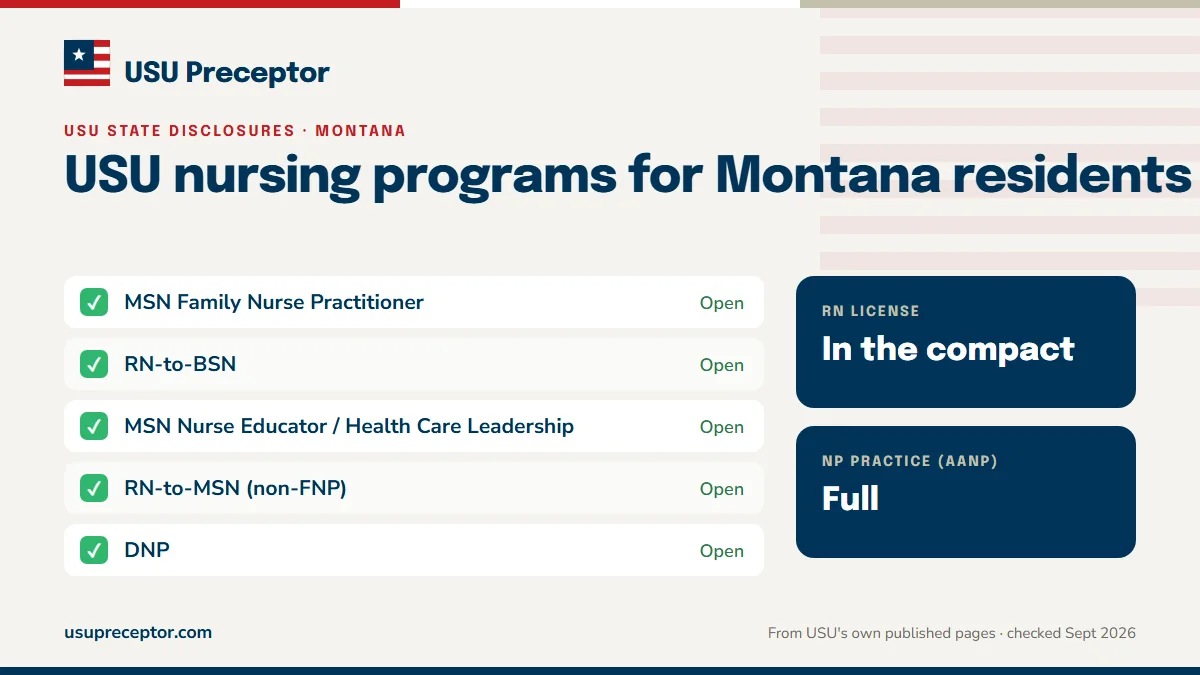
Every current USU nursing program is open to Montana residents. According to the Montana Board of Nursing, only pre-licensure programs need its approval to hold clinicals in Montana; RN-to-BSN and graduate programs don't. What the Board does insist on is an active license valid in Montana, because you'll be caring for Montana patients.
Get your placement plan
Tell us your USU track and where you live. A placement advisor replies with what a USU-ready preceptor and site look like for you.
What the Montana Board requires, and what it doesn't
ARM 24.159.608 sets out a detailed approval process for out-of-state pre-licensure programs. The program director submits a signed request that includes the facility agreement, a plan for faculty supervision, details on faculty and preceptors, proof of national accreditation and board approval, and confirmation by Montana program directors that the placement won't displace any Montana student.
The Board's FAQ puts RN-to-BSN and graduate nursing programs outside that process: they don't need Board approval for Montana clinicals. The condition it keeps is licensure. The program has to make sure the student holds an active license valid in Montana. That lines up with USU's own rule, so Montana adds little on top of what USU already asks of an FNP or RN-to-BSN student.
No Board approval doesn't mean no approvals: USU's Program Director, OFE and the affiliation agreement still stand between you and your first hour.
Programs and hours for Montana residents
| USU program | Open to Montana residents? | Hours to plan for |
|---|---|---|
| MSN Family Nurse Practitioner | Yes | 540 clinical (FNP592 to FNP597) |
| MSN Nurse Educator | Yes | 100 |
| MSN Health Care Leadership | Yes | 100 |
| RN-to-BSN | Yes | 90 (NUR378 and NUR499) |
| DNP | Yes | 1,000 post-baccalaureate |
USU's exclusion lists don't name Montana for any current nursing program; only the Post-Master's FNP, closed to new students everywhere, is off the table. Program specifics are on the FNP and RN-to-BSN pages.
Your license: Montana or multistate
Montana has been a Nurse Licensure Compact participant since January 19, 2018. According to the state's RN licensing page, no Montana license is needed to practice there for a nurse who holds a multistate privilege from another compact state. Montana hasn't enacted the APRN Compact.
USU ties its rule to your address on file: the RN license has to be active and unencumbered there and in any state where you train, and your liability insurance has to match. If you'll rely on a multistate license, confirm with your CPC that USU accepts it before compliance review. Our RN license for clinicals page covers the details.
Billings, Missoula, Bozeman, Helena
Montana's metros are small. Billings, the largest, counted about 194,000 people in 2025 Census estimates; Bozeman and Missoula each had about 129,000, and Helena about 97,000. Systems FNP students in Montana look at include Billings Clinic and Logan Health (one combined system), Benefis Health System, Providence Montana with St. Patrick Hospital in Missoula, and Intermountain Health's St. Vincent Regional Hospital in Billings. They're examples, not USU partners.
In a small market, USU's ratio rule bites: a preceptor may take no more than two students at once, and NP students from other schools count. Ask early whether a preceptor already hosts another program. AANP lists Montana as a full practice state, so NP-run clinics are fair targets, and USU requires an NP for at least 135 of your hours.
What we do for Montana students
A placement advisor hunts across Montana for clinicians who match your USU course and still have room under USU's ratio, and helps you assemble the preceptor packet OFE and the Program Director review. USU makes the approval decisions. A preceptor who drops out means a new search, and we run it. Ask for a Montana search.
Questions USU students ask
Do USU faculty need a Montana license to supervise me?
Only if they give direct patient care in Montana, according to the Board's FAQ. An out-of-state instructor whose role is limited to consulting with you and your preceptor doesn't need one. Your preceptor is a different case: USU wants that clinician's license to be active, unencumbered and valid in Montana if that's where you train.
Does skipping Board approval speed up my Montana placement?
It removes a step that never applied to USU's programs, not any of USU's own. Your Program Director still has to approve the preceptor, OFE still sends the site an affiliation agreement (allow four to six months), Complio still has to clear your compliance items, and no hour counts before the OFE Approval Letter.
What license does the Montana Board expect for RN-to-BSN practicum hours?
The Board's FAQ treats RN-to-BSN programs like graduate ones: no Board approval, but the student must hold an active license valid in Montana. USU's practicum handbook asks for an active license in the state where you'll do the practicum, which for a Montana resident means Montana, across 90 community hours in NUR378 and NUR499.
I live in Montana but my best lead is in Idaho or Wyoming. Can I use it?
Possibly, but it starts at a disadvantage. USU wants your hours in Montana, your state of residence, and warns that hours done outside it may not be accepted for licensure. Raise any cross-border lead with your Clinical Placement Coordinator before you list it. Wyoming, for one, expects the program to notify its board in writing before clinicals begin; see the Wyoming page.
Related pages
Last checked 2026-09-23
We check these pages against USU's own catalog, handbooks and disclosures. USU's current handbook and your Clinical Placement Coordinator have the final word.
Six months out is USU's rule. We start now.
Tell us your USU program, your state and when your next practicum opens. We look for preceptors who meet USU's rules and help you build the packet the Office of Field Experience and Program Director review.
- Preceptors matched to the course: family practice, pediatrics, women's health, urgent care within USU's caps
- Appendix H, license, CV and board certification gathered the way OFE asks
- In person near you; telehealth only inside USU's 40-hour limit
Start your placement plan
A placement advisor replies with what a USU-ready preceptor and site look like for you.